Potentilla erecta
(L.) Raeusch.
Tormentil
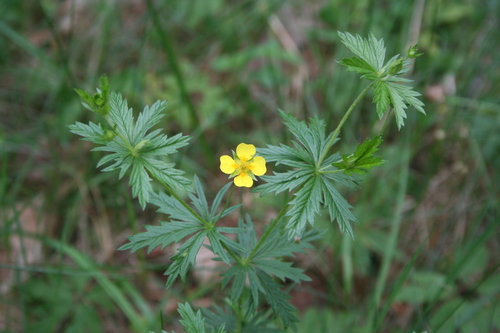
(c) Alexander Baransky, some rights reserved (CC BY-NC), uploaded by Alexander Baransky
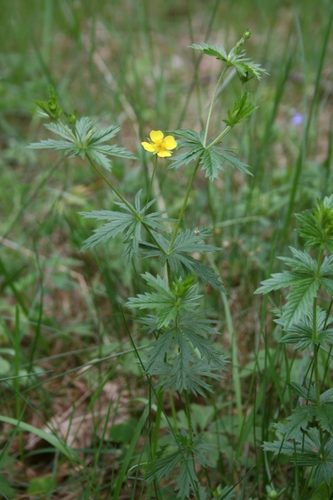
(c) Alexander Baransky, some rights reserved (CC BY-NC), uploaded by Alexander Baransky

(c) Dina Nesterkova, some rights reserved (CC BY-NC), uploaded by Dina Nesterkova
What to Eat
Edible parts: Root, Rhizomes, Flavouring, Shoots
The roots are extremely rich in tannin; prolonged boiling converts this into a gum, after which the root can be eaten. It is considered an emergency food, used only when nothing else is available. A tea can also be made from the rhizomes.
Where to Find It
It is a temperate plant. It grows in grassland, heath and mountain tops. It grows in light acid soil. It is hardy to hardiness zone 5.
Asia, Australia, Balkans, Belarus, Bosnia, Britain, Central Asia, Estonia, Eurasia, Europe, Kazakhstan, Lithuania, Luxembourg, Macedonia, Norway, Romania, Russia, Scandinavia, Slovakia, Slovenia, Spain, Sweden, Tasmania, Turkey, Türkiye, Ukraine,
How to Identify
A herb. It keeps growing from year to year. It grows 30 cm tall and spreads 20 cm wide.
How to Grow
Propagation: Sow seed in early spring or autumn in a cold frame. Once large enough to handle, prick seedlings into individual pots and grow on in a greenhouse through their first winter, then plant out in late spring or early summer after the last expected frosts. For division, spring is the best time. Larger divisions can go directly into permanent positions, while smaller ones are better potted up and grown on in light shade in a cold frame until well established before planting out in late spring or early summer.
Medicinal Uses
Containing more tannin than oak bark, all parts of tormentil are strongly astringent and widely regarded as one of the safest native astringents in herbal medicine. The whole plant, and especially the root, is antibiotic, strongly astringent, haemostatic and hypoglycaemic. It is used to treat diarrhoea, dysentery, irritable bowel syndrome, colitis, ulcerative colitis and sore throats. Externally, it makes an effective styptic for cuts, and a strong decoction is recommended as a wash for mouth ulcers, infected gums, piles and inflamed eyes. Extracts are used for chapping of the anus and cracked nipples. The plant is a reliable toothache remedy and has also been used to treat bed-wetting in children.
Other Uses
A red dye can be obtained from the roots. The plant, and particularly the root, is rich in tannin — the root contains up to 20% tannin. The plant is also used cosmetically as a compress to tone up flabby skin.
Wikipedia
Source ↗Potentilla erecta (syn. Tormentilla erecta, Potentilla laeta, Potentilla tormentilla, known as the (common) tormentil, septfoil or erect cinquefoil ) is a herbaceous perennial plant belonging to the rose family (Rosaceae).
Notes
There are about 500 Potentilla species.
Names & Synonyms
Cervienkovi koren, Srčna moč, Tedre madar, Tedremaran, Tepperot, Trava od srdobolje
References (16)
- Bremness, L., 1994, Herbs. Collins Eyewitness Handbooks. Harper Collins. p 206
- Facciola, S., 1998, Cornucopia 2: a Source Book of Edible Plants. Kampong Publications, p 201
- Girard, N. J., 2020, Sustainable Foraging of Wild Edible Plants in Norway. A Biocultural Approach. M. Sc. thesis Norwegian University. p 135
- Hedrick, U.P., 1919, (Ed.), Sturtevant's edible plants of the world. p 514 (As Potentilla tormentilla)
- http://www.botanic-gardens-ljubljana.com/en/plants
- Jack, M., Wild Foods and Medicines of Forest Garden Transylvania. http://www.forestgardentransylvania.org/ p10
- Kalle, R. & Soukand, R., 2012, Historical ethnobotanical review of wild edible plants of Estonia (1770s-1960s) Acta Societatis Botanicorum Poloniae 81(4):271-281
- Kermath, B. M., et al, 2014, Food Plants in the Americas: A survey of the domesticated, cultivated and wild plants used for Human food in North, Central and South America and the Caribbean. On line draft. p 681
- Luczaj, L., 2012, Ethnobotanical review of wild edible plants of Slovakia. Acta Societatis Botanicorum Poloniae 81(4):245-255
- Nomencl. bot. 152. 1797
- Pieroni, A. & Soukand, R., 2017, Are Borders more Important than Geographical Distance? The Wild Food Ethnobotany of the Boykos and its Overlap with that of the Bukovinian Hutsuls in Western Ukraine. Journal of Ethnobiology 37(2): 326–345
- Pieroni, A. & Soukand, R., 2018, Forest as Stronghold of Local Ecological Practice: Currently Used Wild Food Plants in Polesia, Northern Ukraine. Economic Botany, XX(X) pp. 1-21
- Plants for a Future database, The Field, Penpol, Lostwithiel, Cornwall, PL22 0NG, UK. http://www.scs.leeds.ac.uk/pfaf/
- Redzic, S. J., 2006, Wild Edible Plants and their Traditional Use in the Human Nutrition in Bosnia-Herzegovina. Ecology of Food and Nutrition, 45:189-232
- Soukand, R., et al, 2017, Multi-functionality of the few: current and past uses of wild plants for food and healing in Liubań region, Belarus. Journal of Ethnobiology and Ethnomedicine (2017) 13:10
- Uphof,
More from Rosaceae


