Pouteria lucuma
(Ruiz & Pav.) Kuntze
Lucmo, Lucuma, Eggfruit

(c) Hafiz Issadeen, some rights reserved (CC BY)
(c) Mayriliz Coro, some rights reserved (CC BY-NC)
(c) Mayriliz Coro, some rights reserved (CC BY-NC)
What to Eat
Edible parts: Fruit
When eaten raw, the very sweet fruit is bright yellow and has a mealy and dry texture. In Peru, it is more commonly used as a flavor in juice, milk shakes, and especially ice cream. Its flavor in such preparations has been described variously as being similar to sweet potato, maple syrup, or butterscotch. In Peru, manjar de lúcuma (dulce de leche with lúcuma purée) is a dessert. Multiple sources describe it as the most popular ice cream flavor in Peru and one of the most popular fresh fruits.
Where to Find It
A tropical plant. It is subtropical and grows at 3,000 to 3,300 m altitude in Peru. It can be between 500-2,500 m. It can tolerate frost and grow in cooler climates. It can adapt to drier conditions. It grows in regions with 1,000-1,800 mm rain per year. The temperatures are 20-22°C.
Andes, Bolivia, Central America, Chile, Colombia, Costa Rica, East Timor, Ecuador, Hawaii, Indochina, Laos, Mexico, North America, Peru, Philippines, SE Asia, South America*, Suriname, Timor-Leste, USA, Vietnam,
How to Identify
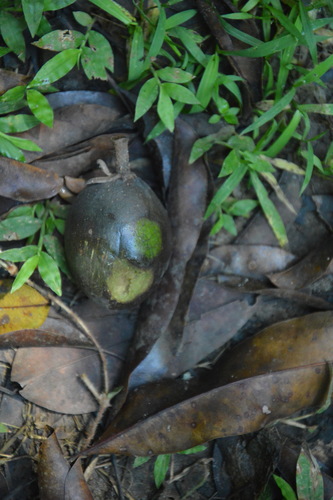
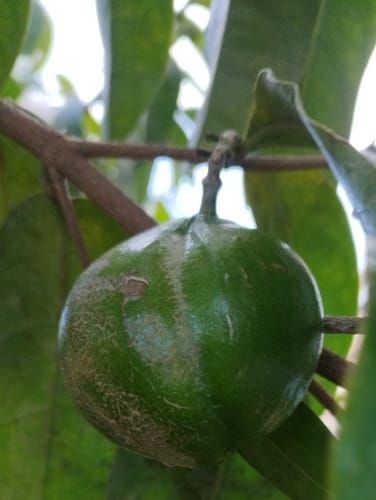
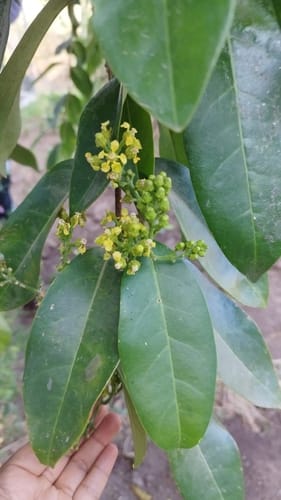
A medium sized tree 8-17 m high. It can spread 6-10 m across. It has many branches. The leaves are alternate. They are oblong or sword shaped. They are 25 cm long by 10 cm across. The fruit are round or oval and green. The pulp is bright yellow. There are some named cultivated varieties.
How to Grow
Plants are usually grown from seed.
Propagation: Seed - remove it from its husk before sowing. Side-grafting. Air-layering may be possible.
Medicinal Uses
The fruit is said to promote lactation in women after they have given birth
Production
Fruit fall and then need to be stored for a few days before fully ripe. Fruit are produced around the year. Fruit can weigh 1 kg. The fruit are easily storeable.
Other Information
The fruit is popular in South America. They are sold in markets. It is a cultivated food plant.
Notes
There are about 150-320 Pouteria species. They grow in the tropics. Fruit are high in folates 42μg/100. NB query this record for Timor.
Names & Synonyms
Eivrucht, Lucma, Lucumo, Mamon, Queo, Rucma, Teissa
References (26)
- Baehni, C. & Bernardi, L., 1970, Flora of Peru. Vol. 8 Part V-A No. 3. Field Museum Natural History. Chicago. p 161
- Barwick, M., 2004, Tropical and Subtropical Trees. A Worldwide Encyclopedic Guide. Thames and Hudson p 345
- Facciola, S., 1998, Cornucopia 2: a Source Book of Edible Plants. Kampong Publications, p 228
- Grandtner, M. M. & Chevrette, J., 2013, Dictionary of Trees, Volume 2: South America: Nomenclature, Taxonomy and Ecology. Academic Press p 527
- Hedrick, U.P., 1919, (Ed.), Sturtevant's edible plants of the world. p 388, p 387 (As Lucuma bifera)
- http://palaeoworks.anu.edu.au/Nuno_PhD/04.pdf
- Kermath, B. M., et al, 2014, Food Plants in the Americas: A survey of the domesticated, cultivated and wild plants used for Human food in North, Central and South America and the Caribbean. On line draft. p 692
- Leon-Lobos, P., et al, 2022, Patterns of Traditional and Modern Uses of Wild Edible Native Plants of Chile: Challenges and Future Perspectives. Plants (Basel) v 11 (6) Table S1
- Lopez-Diago, D. & Garcia, N., 2021, Wild edible fruits of Colombia. Biota ColomBiana 22 (2) p 51
- Morton, Julia F., 1987, Fruits of Warm Climates. Creative Resources Systems, Inc. . p. 405
- Pennington, T.D., 1990, Sapotaceae in Flora Neotropica Monograph 52. New York Botanical Gardens. p 383
- Purseglove, J.W., 1968, Tropical Crops Dicotyledons, Longmans. p 646 (As Lucuma bifera)
- Reis, S. V. and Lipp, F. L., 1982, New Plant Sources for Drugs and Foods from the New York Botanical Garden herbarium. Harvard. p 235
- Revis. gen. pl. 3(3):195. 1898
- Roa, J. A. G. & Boada, D. S. G., 2018, Fundación para el Fortalecimiento de la Fruticultura y Plantas Alimenticias no Convencionales en Colombia.
- Segura, S., et al, 2018, The edible fruit species in Mexico. Genet Resour Crop Evol (2018) 65:1767–1793
- Smith, N., Mori, S.A., et al, 2004, Flowering Plants of the Neotropics. Princeton. p 344
- Striegel, L., et al, 2019, Promising Tropical Fruits High in Folates. Foods 2019, 8, 363; doi:10.3390/foods8090363. www.mdpi.com/journal/foods
- Tapia, M. E., The role of under-utilised plant species with regard to increased food security and improved health of poor poeople, in mountain regions. IIAP-PNUD/Peru
- Torre, de la, L., et al, 2008, Enciclopedia de las Plantas Útiles del Ecuador. Herbario QCA. Pontificia Universidad Católica del Ecuador. p 572
- USDA, ARS, National Genetic Resources Program. Germplasm Resources Information Network - (GRIN). [Online Database] National Germplasm Resources Laboratory, Beltsville, Maryland. Available: www.ars-grin.gov/cgi-bin/npgs/html/econ.pl (10 April 2000)
- Van den Eynden, V., et al, 2003, Wild Foods from South Ecuador. Economic Botany 57(4): 576-603
- Villachica, H., (Ed.), 1996, Frutales Y hortalizas promisorios de la Amazonia. FAO, Lima. p 177
- Wiersema, J. H. & Leon, B., 2013, World Economic Plants. A Standard Reference CRC Press. 2nd Ed. p 554
- World Checklist of Useful Plant Species 2020. Royal Botanic Gardens, Kew
- Zambrana, P, et al, 2017, Traditional knowledge hiding in plain sight – twenty-first century ethnobotany of the Chácobo in Beni, Bolivia. Journal of Ethnobiology and Ethnomedicine (2017) 13:57