Pouteria sapota
(Jacq.) Moore & Stearn.
Sapote, Mamey sapote

(c) Sylvia, some rights reserved (CC BY-ND)
(c) Cinthia Samaniego, some rights reserved (CC BY-NC)
(c) Bayardo Alberto González Ñamendy, some rights reserved (CC BY-NC)
What to Eat
Edible parts: Fruit, Kernel, Seeds, Nuts
Ripe fruit is eaten raw or made into sherbets, ice cream, and drinks, and can also be dried. Unripe fruits are cooked as a vegetable. The ripe pulp is salmon-red to reddish-brown, with a firm, finely granular texture and a rich, sweet, almond-like flavour. The ovoid fruit ranges from 8–20cm long, and most cultivars weigh 500–1,000g, though fruits can reach up to 2.7kg. The seeds have a bitter almond flavour; ground seeds are added to texate, made into a confection, or mixed with cornmeal, sugar, and cinnamon to make a nutritious drink called pozol. Seeds can also be milled to prepare a bitter chocolate. The seed kernel yields 45–60% of a white, semi-solid, vaseline-like oil that is edible when freshly extracted and refined.
Known Hazards
Where to Find It
A tropical plant. It is native from Mexico to Central America. It does best in the hot humid tropical lowlands. It prefers a rainfall above 1900 mm per year. They are susceptible to frost. It cannot tolerate low temperatures. Temperatures between 25°-28°C are best. They cannot tolerate drought. It grows naturally at low elevations in Central America. Trees grow from sea level to 1400 m altitude. A distinct dry season limits the fruiting season. It suits hardiness zones 10-11.
Asia, Australia, Barbados, Belize, Brazil, Cambodia, Central America, Colombia, Costa Rica, Cuba, Dominican Republic, East Timor, Ecuador, El Salvador, Europe, Fiji, Guadeloupe, Guatemala, Guiana, Guianas, Guyana, Haiti, Hawaii, Hispaniola, Honduras, Indochina, Indonesia, Israel, Jamaica, Malaysia, Martinique, Mediterranean, Mexico*, Middle East, Nicaragua, North America, Pacific, Panama, Philippines, Puerto Rico, SE Asia, Sierra Leone, South America, Spain, St Lucia, Suriname, Timor-Leste, Trinidad and Tobago, USA, Venezuela, Vietnam, West Africa, West Indies,
How to Identify
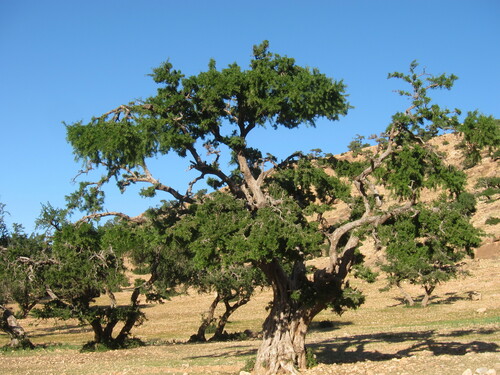
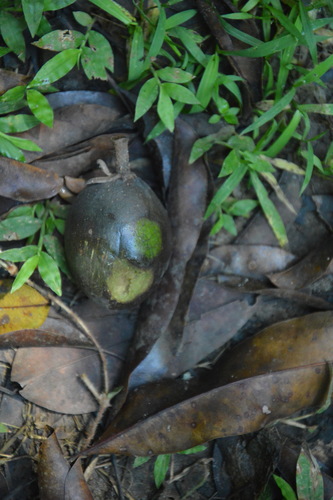
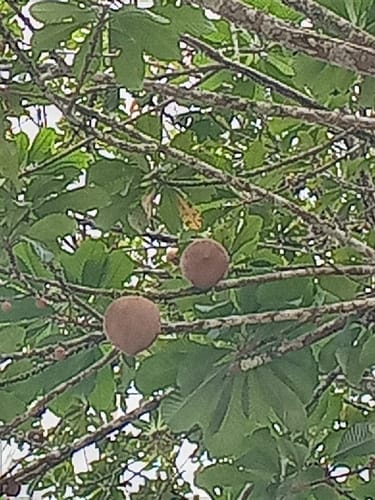
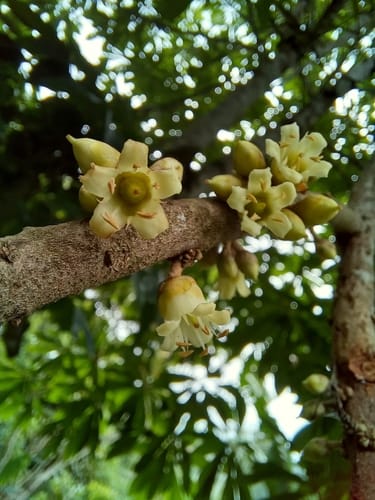
A large tree. It grows 20-45 m tall. The trunk can be 1 m across. There can be buttresses. The branches are thick. There is a dense covering of leaves. The leaves are oval or sword shaped. They are towards the ends of the branches. They are arranged in spirals. The leaf stalk is 2-5 cm long. The leaf blade is 10-30 cm long by 4-10 cm wide. The flowers are small and almost without stalks. They grow in large numbers under branches and along leafless branches. They are in clusters of 6-15 in the axils of fallen leaves. Each flower has 5 true and 5 false stamens. The fruit is large and reddish brown. It has a rough, hard skin. The fruit can be 8-25 cm long. The flesh can be red, orange or greyish. Many varieties occur. They can be long or rounded. The amount of fibre in the flesh varies. The fruit contain one or more seeds. The seeds are large and have a sharp end. They are dark brown and smooth and shiny on one end.
Nutrition Score: 49/100
| Part | Moisture | kJ | kcal | Protein | Vit A | Vit C | Iron | Zinc |
|---|---|---|---|---|---|---|---|---|
| Fruit | 65.6 | 506 | 121 | 1.7 | 400 | 29 | 1.1 | — |
| Fruit | 67.6 | 392 | 94 | 1.4 | — | 23 | 0.9 | — |
How to Grow
Trees can be grown from fresh seed. Seeds take 40-70 days to germinate. This can be made quicker by breaking the seed coat. The best varieties are grafted. Shoots for grafting are best selected during the summer dormant period when the tree has no leaves. Plants can be grown by layering.
Propagation: Remove the seed from its husk before sowing. Viability is short — only 7–14 days — so seeds should be collected from mature fruit and planted immediately in well-drained media. Seeds with a hairline crack in the seed coat appear to germinate more quickly. Propagation is also possible by side-grafting and potentially by air-layering.
Medicinal Uses
The seed kernel oil is used as a skin ointment and as a hair dressing believed to prevent hair loss. Clinical tests at the University of California at Los Angeles in 1970 found no hair-growth promoting activity but confirmed the oil is effective in stopping hair loss caused by seborrhoeic dermatitis. The oil is considered diuretic and is used as a sedative in eye and ear ailments. Seed residue left after oil extraction is applied as a poultice on painful skin conditions. The seed kernel is regarded as a digestive. A seed infusion is used as an eyewash. Pulverized seed coat is reported as a remedy for coronary trouble and, taken with wine, is said to help with kidney stones and rheumatism. The Aztecs used it against epilepsy. The bark is bitter and astringent and contains lucumin, a cyanogenic glycoside; a bark decoction is taken as a pectoral. A tea made from the bark and leaves is used in treating arteriosclerosis and hypertension. The milky sap is emetic and anthelmintic and has been used to remove warts and fungal growths from the skin.
Other Uses
The seed kernel yields 45–60% of a white, semi-solid, vaseline-like oil that, beyond its edible uses, has applications in soap-making, cosmetics, and pharmaceutical products. It is also used as a hair dressing said to promote hair growth and prevent hair loss. The very smooth seeds were historically used in Central America to smooth starched linen in the manner of an iron, and are reportedly still used this way in Guatemala. The oil has also been used to fix colours on painted gourds and other handicraft items. Trees are seldom felled for timber unless they bear poor-quality fruit. The heartwood is buff or brown when fresh, turning reddish with age, sometimes resembling mahogany but redder and often mottled with darker tones. It is fine-grained, compact, generally hard and fairly heavy, strong, easy to work, and fairly durable. It is suitable for cabinetwork and furniture, and also used for building carts, shelving, and house frames.
Wikipedia
Source ↗Pouteria sapota, the mamey sapote, is a species of tree native to Central America and southern Mexico. It is now cultivated throughout Mexico, Central America, and the Caribbean, as well as in Florida and parts of South America. Its fruit is eaten raw in many Latin American countries, and is added to smoothies, milkshakes, ice cream, and other foods.
Production
Trees are slow growing. Grafted trees may bear in 1-4 years. Seedling trees take 8-10 years to fruit. Trees can continue to produce fruit for 100 years. Fruit take about 1 year to mature. A fruit can weigh 2.5 kg.
Notes
There are about 150-320 Pouteria species. They grow in the tropics.
Names & Synonyms
Atzapotlcuahuiti, Chico-mamey, Ciko mama, Cuyg auac, Green sapote, Lankajaka, Mamei, Mamey colorado, Marmalade plum, Ngomo, Saeda, Tru'ng ga, Zapote, Zapote mamey
References (63)
- Barwick, M., 2004, Tropical and Subtropical Trees. A Worldwide Encyclopedic Guide. Thames and Hudson p 344
- Blench, R., 2004, Fruits and Arboriculture in the Indo-Pacific Region. Indo-Pacific Prehistory Association Bulletin 24. (Taipei Papers Volume 2) p 40
- Castaneda, H., & Stepp, J. R., 2007, Ecosystems as Sources of Useful Plants for the Guaymi People of Costa Rica. Ethnobotany Journal. 5:249-257
- Coe, F. G., and Anderson, G. J., 1996, Ethnobotany of the Garifuna of Eastern Nicaragua. Economic Botany 50(1) pp 71-107
- Coe, F. G. and Anderson, G. J., 1999, Ethnobotany of the Sumu (Ulwa) of Southeastern Nicaragua and Comparisons with Miskitu Plant Lore. Economic Botany Vol. 53. No. 4. pp. 363-386
- Coronel, R.E., 1982, Fruit Collections in the Philippines. IBPGR Newsletter p 6 (As Calocarpum sapota)
- Cruz, I. M., et al, 2015, Edible fruits and seeds in the State of Mexico. Revista Mexicana de Ciencias Agricolas. Vol. 6. Num. 2 pp 331-346
- Cundall, P., (ed.), 2004, Gardening Australia: flora: the gardener's bible. ABC Books. p 1078
- D'Ambrosio, U., & Puri, R. K., 2016, Foodways in transition: food plants, diet and local perceptions of change in a Costa Rican Ngäbe community. Journal of Ethnobiology and Ethnomedicine (2016) 12:3 p 27
- Darley, J.J., 1993, Know and Enjoy Tropical Fruit. P & S Publishers. p 110
- FAO, 1993, Valor Nutritivo Y Usis en Alimantacion humana de Algunis Cultivos Autoctonos Subexplotados de Mesoamerica. FAO, Santiago, Chile. p 7
- Food Composition Tables for use in East Asia FAO http://www.fao.org/infoods/directory No. 998
- Grandtner, M. M., 2008, World Dictionary of Trees. Wood and Forest Science Department. Laval University, Quebec, Qc Canada. (Internet database http://www.wdt.qc.ca)
- Hermandez Bermejo, J.E., and Leon, J. (Eds.), 1994, Neglected Crops. 1492 from a different perspective. FAO Plant Production and Protection Series No 26. FAO, Rome. p17, 103
- Hibbert, M., 2002, The Aussie Plant Finder 2002, Florilegium. p 239
- http://palaeoworks.anu.edu.au/Nuno_PhD/04.pdf re Timor
- Ibarra-Manriquez, G., et al, 1997, Useful Plants of the Los Tuxtlas Rain Forest (Veracruz, Mexico): Considerations of their Market Potential. Economic Botany, Vol. 51, No. 4, pp. 362-376
- Jardin, C., 1970, List of Foods Used In Africa, FAO Nutrition Information Document Series No 2.p 123 (As Calocarpum sapota)
- John, L., & Stevenson, V., 1979, The Complete Book of Fruit. Angus & Robertson p 264
- Kermath, B. M., et al, 2014, Food Plants in the Americas: A survey of the domesticated, cultivated and wild plants used for Human food in North, Central and South America and the Caribbean. On line draft. p 696
- Kiple, K.F. & Ornelas, K.C., (eds), 2000, The Cambridge World History of Food. CUP p 1808
- Langlois, H. C., 2004, Ethnobotanical analysis of different successional stages as sources of wild edible plants for the Guaymi people in Costa Rica. M. Sc. thesis University of Florida.
- Lentz, D. L., 1993, Medicinal and Other Economic Plants of the Paya of Honduras. Economic Botany, Vol. 47, No. 4, pp. 358-370 (As Pouteria mammosa (L.) Cronquist)
- Little, E. L., et al, 1974, Trees of Puerto Rico and the Virgin Islands. USDA Handbook 449. Forestry Service. p 792
- Llamas, K.A., 2003, Tropical Flowering Plants. Timber Press. p 344
- Lorenzi, H., Bacher, L., Lacerda, M. & Sartori, S., 2006, Brazilian Fruits & Cultivated Exotics. Sao Paulo, Instituto Plantarum de Estuados da Flora Ltda. p 621
- Macmillan, H.F. (Revised Barlow, H.S., et al) 1991, Tropical Planting and Gardening. Sixth edition. Malayan Nature Society. Kuala Lumpur. p 306
- Mapes, C. & Basurto, F., 2016, Biodiversity and Edible Plants of Mexico. Chapter 5 in R. Lira, et al. (eds.), Ethnobotany of Mexico, Ethnobiology, Springer. p 99
- Martin, F. W., et al, 1987, Perennial Edible Fruits of the Tropics. USDA Handbook 642 p 59 (As Calocarpum sapota)
- Melander, M., 2007, Endangered plants on the market in Havana City, Cuba. Uppsala University, Sweden p 19
- Menninger, E.A., 1977, Edible Nuts of the World. Horticultural Books. Florida p 33
- Miguel, E., et al, 1989, A checklist of the cultivated plants of Cuba. Kulturpflanze 37. 1989, 211-357
- Milow, P., et al, 2013, Malaysian species of plants with edible fruits or seeds and their evaluation. International Journal of Fruit Science. 14:1, 1-27
- Morton, Julia F., 1987, Fruits of Warm Climates. Creative Resources Systems, Inc. . p. 398
- Mutchnick, P. A. and McCarthy, B. C., 1997, An Ethnobotanical Analysis of the Tree Species Common to the Subtropical Moist Forests of the Peten, Guatemala. Economic Botany, Vol. 51, No. 2, pp. 158-183 (As Pouteria mammosa)
- Pascual-Mendoza, S. et al, 2021, Traditional knowledge of edible plants in an indigenous community in the Sierra Norte of Oaxaca, Mexico. Plant Biosystems - An International Journal Dealing with all Aspects of Plant Biology
- Pham-Hoang Ho, 1999, An Illustrated Flora of Vietnam. Nha Xuat Ban Tre. p 630
- Phon, P., 2000, Plants used in Cambodia. © Pauline Dy Phon, Phnom Penh, Cambodia. p 511
- Piedra-Malagón, E. M., et al, 2022, Edible native plants of the Gulf of Mexico Province. Biodiversity Data Journal 10: e80565 p 29
- Plants of Haiti Smithsonian Institute http://botany.si.edu/antilles/West Indies
- PROSEA (Plant Resources of South East Asia) handbook, Volume 2, 1991, Edible fruits and nut. p 259
- Purseglove, J.W., 1968, Tropical Crops Dicotyledons, Longmans. p 646
- Recher, P, 2001, Fruit Spirit Botanical Gardens Plant Index. www.nrg.com.au/~recher/ seedlist.html p 3 (As Pouteria mammosun)
- Roa, J. A. G. & Boada, D. S. G., 2018, Fundación para el Fortalecimiento de la Fruticultura y Plantas Alimenticias no Convencionales en Colombia.
- Sang, D. T., & Mizoue, K. O. N., 2012, Use of Edible Forest Plants among Indigenous Ethnic Minorities in Cat Tien Biosphere Reserve, Vietnam. Asian Journal of Biodiversity Vol. 3 (1), p 23-49
- Smith, N., Mori, S.A., et al, 2004, Flowering Plants of the Neotropics. Princeton. p 344
- Solomon, C., 2001, Encyclopedia of Asian Food. New Holland. p 330
- Soerianegara, I. & Lemmens, R. H. M. L., (Eds.) 1993, Timber trees: Major commercial timbers. Plant Resources of South-East Asia. Wageningen. No. 5(1). p 363
- Staples, G.W. and Herbst, D.R., 2005, A tropical Garden Flora. Bishop Museum Press, Honolulu, Hawaii. p 521
- Tankard, G., 1990, Tropical fruit. An Australian Guide to Growing and using exotic fruit. Viking p 70
- Taxon 16:383. 1967
- Torre, de la, L., et al, 2008, Enciclopedia de las Plantas Útiles del Ecuador. Herbario QCA. Pontificia Universidad Católica del Ecuador. p 573
- Ulian, T., et al, 2020, Unlocking plant resources to support food security and promote sustainable agriculture. Plants, People, Planet. 2020;2:421–445.
- USDA, ARS, National Genetic Resources Program. Germplasm Resources Information Network - (GRIN). [Online Database] National Germplasm Resources Laboratory, Beltsville, Maryland. Available: www.ars-grin.gov/cgi-bin/npgs/html/econ.pl (10 April 2000)
- Usher, G., 1974, A Dictionary of Plants Used by Man. Constable. p 17 (As Achras sapota)
- Van Sam, H. et al, 2008, Uses and Conservation of Plant Species in a National Park. A case study of Ben En, Vietnam. Economic Botany 62:574-593
- Wickens, G.E., 1995, Edible Nuts. FAO Non-wood forest products. FAO, Rome. p153
- Wiersema, J. H. & Leon, B., 2013, World Economic Plants. A Standard Reference CRC Press. 2nd Ed. p 554
- World Checklist of Useful Plant Species 2020. Royal Botanic Gardens, Kew
- www.worldagroforestrycentre.org/treedb/
- Yuncker, T.G., 1940, Flora of the Aguan Valley and the coastal regions near La Ceiba, Honduras. Botany Series, Field Museum of Natural History 9(4) p 325 (As Calocarpum mammosum)
- Zaldivar, M. E., et al, 2002, Species Diversity of Edible Plants Grown in Homegardens of Chibehan Amerindians from Costa Rica. Human Ecology, Vol. 30, No. 3, pp. 301-316
- Zuchowski W., 2007, Tropical Plants of Costa Rica. A Zona Tropical Publication, Comstock Publishing. p 203