Pouteria viridis
(Pittier) Cronquist
Green sapote
(c) Aureliano Argüello Figueroa, some rights reserved (CC BY-NC), uploaded by Aureliano Argüello Figueroa

(c) Jo Jiménez, some rights reserved (CC BY-NC)

(c) Jo Jiménez, some rights reserved (CC BY-NC)
What to Eat
Edible parts: Fruit, Kernel, Nuts, Seeds
The fruit is eaten fresh and raw, and used for preserves and ice cream. The latex serves as a base for chewing gum.
Where to Find It
It is a tropical plant. It grows in the tropical highlands. It grows on clay soils. It occurs between 1000 and 2300 m altitude in Guatemala. It tolerates 4-5° of frost. It grows in the highlands of Central America.
Asia, Australia, Belize, Brazil, Central America*, Costa Rica*, El Salvador, Guatemala, Honduras, Mexico*, Nicaragua, North America, Pacific, Philippines, SE Asia,
How to Identify
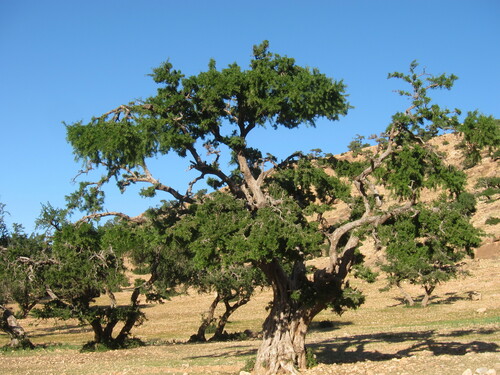
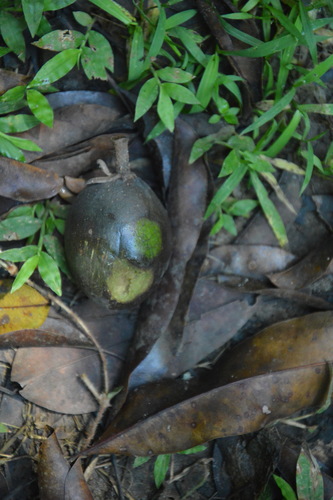
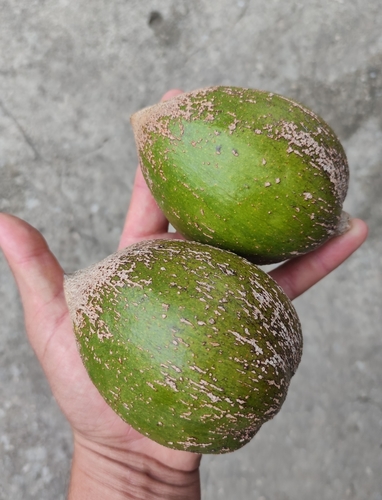
A large tree. It grows up to 18 m tall. Young branches have dense brown hairs. The leaves are clustered at the tips of flowering branches and alternate on non fruiting branches. They are broadly sword shaped and pointed. They are 10-25 cm long by 5-7 cm wide. The leaves are hairy underneath. The flowers contain both sexes The flowers are 1.3 cm long and on leafless branches in the axils of the leaf scars. The fruit are large and smooth with a green skin. They are 12 cm across. The skin is thin and the flesh is red and juicy. The seeds are small.
Nutrition Score: 49/100
| Part | Moisture | kJ | kcal | Protein | Vit A | Vit C | Iron | Zinc |
|---|---|---|---|---|---|---|---|---|
| Fruit | 68.4 | 460 | 110 | 1.8 | 50 | 53 | 0.7 | — |
How to Grow
Plants can be grow from seed. They can also be grown by grafting or air-layering.
Propagation: Seed - remove it from its husk before sowing. Side-grafting. Air-layering may be possible.
Medicinal Uses
The fruit is an edible sapote. The flesh is sweet and juicy. The moisture content is 68 to 70%. It can be eaten raw or made into desserts, drinks, and preserves. The seeds are edible, as well, and can be served roasted. The latex of the tree can be made into chewing gum. Parts of the plant have traditional medicinal uses. The seed oil is applied to the hair to prevent hair loss. Bark extracts have been used for skin conditions, and the latex has been applied to the skin to treat warts and fungal infections. The bark reportedly has antitermite properties. The strong, reddish wood of the tree has occasionally been used for construction and to make furniture and tools. The species is planted in reforestation efforts and for erosion control.
Wikipedia
Source ↗Pouteria viridis is a species of flowering plant in the family Sapotaceae known by the common name green sapote. Other common names include red faisan, white faisan (Belize), zapote blanco, zapote rojo, zapote de castilla, zapote de montana (Costa Rica), zapote verde, zapote injerto (Costa Rica, El Salvador, Honduras), injerto verde (Guatemala), zapotillo calenturiento (Honduras), zapote amarillo, zapote mico, zapote real (Nicaragua), chulul (Mexico), yashtul, mameicito (Spanish), chul (Mam), ixulul (Jacalteco), raxtulul (Poqomchiʼ), tulul (Tz’utujil), and sapota zalená (Czech).
Production
A fruit weighs about 500 g. Fruit mature in about 12 months.
Notes
There are about 150-320 Pouteria species. They grow in the tropics.
Names & Synonyms
Chokcho, Chong, Chulul, Injerto, Injerto verde, Raxtul, Red faisan, Sapota-verde, White faisan, Zapote injerto
References (28)
- Arora, R. K., 2014, Diversity in Underutilized Plant Species - An Asia-Pacific Perspective. Bioversity International. p 82
- Bircher, A. G. & Bircher, W. H., 2000, Encyclopedia of Fruit Trees and Edible Flowering Plants in Egypt and the Subtropics. AUC Press. p 74 (As Calocarpum viridis)
- Coronel, R.E., 1982, Fruit Collections in the Philippines. IBPGR Newsletter p 9 (As Calocarpum viride)
- Darley, J.J., 1993, Know and Enjoy Tropical Fruit. P & S Publishers. p 111
- Facciola, S., 1998, Cornucopia 2: a Source Book of Edible Plants. Kampong Publications, p 228
- Gouldstone, S., 1983, Growing your own Food-bearing Plants in Australia. Macmillan p 128 (As Calocarpum viride)
- Grandtner, M. M., 2008, World Dictionary of Trees. Wood and Forest Science Department. Laval University, Quebec, Qc Canada. (Internet database http://www.wdt.qc.ca)
- Hibbert, M., 2002, The Aussie Plant Finder 2002, Florilegium. p 239
- John, L., & Stevenson, V., 1979, The Complete Book of Fruit. Angus & Robertson p 286
- Kermath, B. M., et al, 2014, Food Plants in the Americas: A survey of the domesticated, cultivated and wild plants used for Human food in North, Central and South America and the Caribbean. On line draft. p 699
- Kiple, K.F. & Ornelas, K.C., (eds), 2000, The Cambridge World History of Food. CUP p 1781 (As Calocarpum viride)
- Lloydia 9:290. 1946
- Macmillan, H.F. (Revised Barlow, H.S., et al) 1991, Tropical Planting and Gardening. Sixth edition. Malayan Nature Society. Kuala Lumpur. p 306
- Martin, F. W., et al, 1987, Perennial Edible Fruits of the Tropics. USDA Handbook 642 p 59 (As Calocarpum viride)
- Menninger, E.A., 1977, Edible Nuts of the World. Horticultural Books. Florida p 33
- Morton, Julia F., 1987, Fruits of Warm Climates. Creative Resources Systems, Inc. . p. 401
- Popenoe,
- Purseglove, J.W., 1968, Tropical Crops Dicotyledons, Longmans. p 646
- Recher, P, 2001, Fruit Spirit Botanical Gardens Plant Index. www.nrg.com.au/~recher/ seedlist.html p 3
- Segura, S., et al, 2018, The edible fruit species in Mexico. Genet Resour Crop Evol (2018) 65:1767–1793
- Staples, G.W. and Herbst, D.R., 2005, A tropical Garden Flora. Bishop Museum Press, Honolulu, Hawaii. p 522
- Suwardi, A. B., et al, 2020, Wild edible fruits generate substantial income for local people of the Gunung Leuser National Park, Aceh Tamiang Region. Ethnobotany Research & Applications 20:11
- Tankard, G., 1990, Tropical fruit. An Australian Guide to Growing and using exotic fruit. Viking p 108
- TodaFruta.com.br
- USDA, ARS, National Genetic Resources Program. Germplasm Resources Information Network - (GRIN). [Online Database] National Germplasm Resources Laboratory, Beltsville, Maryland. Available: www.ars-grin.gov/cgi-bin/npgs/html/econ.pl (10 April 2000)
- Wickens, G.E., 1995, Edible Nuts. FAO Non-wood forest products. FAO, Rome. p153
- Wiersema, J. H. & Leon, B., 2013, World Economic Plants. A Standard Reference CRC Press. 2nd Ed. p 554
- World Checklist of Useful Plant Species 2020. Royal Botanic Gardens, Kew