Prinsepia sinensis
(Oliv.) Oliv. ex Bean
Cherry prinsepia
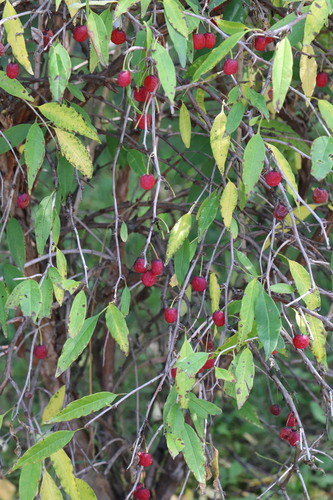
(с) Nina Filippova, некоторые права защищены (CC BY), загрузил Nina Filippova

(c) theonlyavry, some rights reserved (CC BY-NC)
What to Eat
Edible parts: Fruit
The fruit can be eaten raw or cooked. Red and juicy with a pleasant sour taste, it can be enjoyed fresh or made into jellies. The plum-shaped fruit is about 15mm long and contains one large seed.
Where to Find It
It is a temperate plant. It grows in shady places and open places and beside streams. It suits hardiness zones 5-9.
Asia, Australia, Canada, China, Himalayas, Korea, Manchuria*, Russia,
How to Identify
A spreading open shrub. It has spines and loses its leaves during the year. It grows 2-3 m tall. The crown is rounded. The leaves are sword shaped and bright green. They are 8 cm long and 2.5 cm wide. The flowers are bright yellow and have 5 petals. They are fragrant. The flowers are produced along the entire stem length. They are in clusters of 1-4 on the previous year's growth. They fruit is cherry like. It is edible.
How to Grow
Plants can be grown from seed. These are best if given cold treatment before planting. Plants can be transplanted and pruned. Plants can be grown by stem cuttings or half ripe wood. They can also be grown by layering.
Propagation: Seed is best given 2 months of cold stratification. Sow in autumn if possible, otherwise in late winter or early spring in a cold frame in light shade — germination may be inhibited by light. Prick out seedlings into individual pots when large enough to handle, grow on in a greenhouse or cold frame through their first winter, and plant out in late spring or early summer of the following year. Cuttings of half-ripe wood can be taken in July or August in a frame.
Medicinal Uses
None known
Other Uses
None known.
Wikipedia
Source ↗A deciduous shrub growing to 1.8m at a medium rate. Hardy to UK zone 4. Flowers April to May with seeds ripening August to September. Hermaphroditic and insect-pollinated. Adapts to light sandy, medium loamy, and heavy clay soils, preferring well-drained conditions across mildly acidic to mildly alkaline pH ranges. Tolerates semi-shade or full sun and prefers moist soil.
Production
In China plants flower in April and May and fruit in May to September.
Notes
There are 4 Prinsepia species.
References (6)
- Cundall, P., (ed.), 2004, Gardening Australia: flora: the gardener's bible. ABC Books. p 1084
- Bull. Misc. Inform. Kew 1909:354. 1909
- Facciola, S., 1998, Cornucopia 2: a Source Book of Edible Plants. Kampong Publications, p 201
- Flora of China @ efloras.org Volume 9
- Lee, Y. M., 2014 Important Plants of East Asia II: Endemic Plant Stories. East Asia Biodiversity Conservation Network p 79
- Tanaka,
More from Rosaceae


