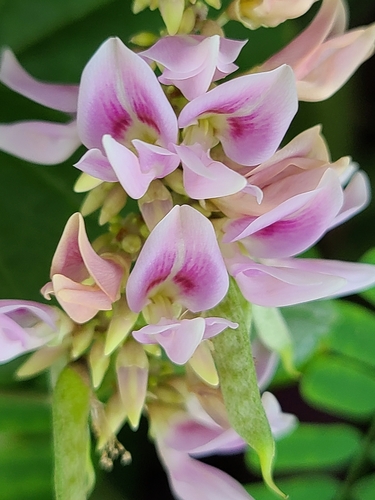
Prosopis africana
(Guill. et Perr.) Taub.
Mesquite

(c) iles-ecologiques, some rights reserved (CC BY-NC)

(c) Marco Schmidt, some rights reserved (CC BY-NC-SA)

(c) Marco Schmidt, some rights reserved (CC BY-NC-SA)
What to Eat
Edible parts: Seeds, Pods, Fruit, Vegetable
The fermented seeds are used as a food condiment.
Known Hazards
Where to Find It
A tropical plant. It can grow in forest, savannah and Sahel in West Africa. It grows in areas with an annual rainfall between 400-1,200 mm. It grows between 720-1,220 m above sea level. It can grow in arid places.
Africa, Benin, Burkina Faso, Cameroon, Central Africa, Central African Republic, CAR, Chad, Congo, Côte d'Ivoire, East Africa, Egypt, Ethiopia, Gambia, Ghana, Guinea, Guinée, Guinea-Bissau, Ivory Coast, Liberia, Mali, Middle East, Niger, Nigeria, North Africa, Sahel, Saudi Arabia, Senegal, Sierra Leone, South Sudan, Sudan, Tanzania, Togo, Uganda, West Africa,
How to Identify
A large tree. It can grow to 25 m high. The trunk is 80 cm across. It grows straight and un-buttressed in forests and low and crooked in open conditions. The crown is open. The leaves droop. The bark is very dark and scaly. The leaves are alternate and twice divided. The leaves are 10-15 cm long. There are 9-16 pairs of leaflets along 3-6 pairs of opposite leaflets stalks. The leaflets are oblong and 12-30 mm long. The flowers are pale green to yellow. They have a scent. The fruit are dark brown pods. They are thick and hard and 15 cm long by 3 cm wide. There are about 10 loose rattling seeds in each pod.
Nutrition Score: 54/100
| Part | Moisture | kJ | kcal | Protein | Vit A | Vit C | Iron | Zinc |
|---|---|---|---|---|---|---|---|---|
| Seeds dried | 4.2 | 1450 | 347 | 15.4 | — | — | — | — |
How to Grow
Plants are grown from seeds. Seeds are best when treated with hot water to allow them to germinate. The seedlings can be transplanted after 14-18 weeks.
Propagation: Fresh, still-moist seed needs no pre-treatment. Dried seed should be soaked in warm water for 12–24 hours until visibly swollen; if necessary, make a small incision in the seed coat, taking care not to damage the embryo, to allow water to enter. Sow in a nursery bed. At 25°C, around 85% of seeds germinate within a week. Seedlings are ready for planting out at 14–18 weeks. Air-dried seeds can remain viable for several years at room temperature.
Medicinal Uses
The leaves are used to treat headache, toothache, and various other head ailments. Combined with bark, they are used against rheumatism. The bark is astringent and is used for skin diseases, caries, and fevers, and can also be made into an eyewash. The roots are diuretic and are used to treat gonorrhoea, tooth and stomach ache, dysentery, and bronchitis.
Other Uses
The tree is suited for erosion control, shade, avenue planting, windbreaks, hedges, and soil conservation. It fixes atmospheric nitrogen and fallen leaves act as green manure, making it valuable in parkland agroforestry and Sahel agroforestry systems, where it grows well in valleys and rocky soils. The bark and roots contain tannin, with the bark holding around 18% tannins. A gum is obtained from the stems. Seedpod ash is used as a potash source for soap making. The sapwood is yellow, clearly distinct from the red-brown heartwood, which turns wine-red after drying. The wood is hard, medium to heavy density, fine-grained, durable, and resistant to termites. It blunts tools and requires pre-drilling before nailing, but is easy to carve, turn, and glue. It is used for pestles, mortars, mallets, cudgels, furniture, joinery, railway sleepers, boat building, axe handles, and craft work. The wood is highly valued as fuel and for charcoal. Flowers are rich in nectar and pollen, attracting bees and other pollinators. Pods are eaten by birds and mammals, and the tree provides shelter and nesting habitat for wildlife. Bark, fallen pods, and leaf litter offer shelter and overwintering sites for invertebrates.
Wikipedia
Source ↗Prosopis africana is a deciduous tree reaching 10 m tall and 6 m wide at a medium growth rate, hardy to UK zone 10. It is self-fertile, nitrogen-fixing, and noted for attracting wildlife. Flowers are insect-pollinated. The tree grows in light sandy, medium loamy, and heavy clay soils with good drainage, tolerating mildly acid, neutral, basic, very acid, and very alkaline pH levels. It requires full sun and prefers moist soil. It tolerates strong winds but not maritime exposure.
Production
It flowers shortly after the rainy season.
Other Information
It is sold in local markets.
Notes
There are about 44 Prosopis species. Also as Mimosaceae.
Names & Synonyms
Bal-tencali, Buiengue, Bussagan, Cachem-cachao, Culengo, Culim-o, Djandjam-o, Djeiha, Djendon, Gbaaye, Karbon, Keseg-keseg, Ogea, Pau-carvao, Po-carvao, Po-de-carbom, Po-di-carvom, Quessem-quessem, Tchalem-ai, Tchela-tche-lengage, Tchela, Tchelangadje, Tchelem, Teacali-mand, Tentera
References (21)
- Abbiw, D.K., 1990, Useful Plants of Ghana. West African uses of wild and cultivated plants. Intermediate Technology Publications and the Royal Botanic Gardens, Kew. p 49
- Alyegba, S. S. et al, 2013, Ethnobotanical Survey of Edible Wild Plants in Tiv Communities of Benue State, Nigeria. Journal of Natural Sciences Research. Vol.3, No.7
- Atato, A., et al, 2010, Diversity of Edible Wild Fruit Tree Species of Togo. Global Science Books.
- Ballal, M. E., et al, 2014, Ethno-botany of Natural Forests of Nuba Mountains, South Kordofan State, Sudan. Journal of Forest Poducts & Industries. 3(1):13-19
- Bonou, A., et al, 2013, Valeur economique des Produits Forestiers Non Ligneux (PFNL) au Benin. Editions Universitaires Europeennes p 92
- Burkill, H. M., 1985, The useful plants of west tropical Africa, Vol. 3. Kew.
- Busson, 1965,
- Chapman, J. D. & Chapman, H. M., 2001, The Forest Flora of Taraba and Andamawa States, Nigeria. WWF & University of Canterbury. p 184
- H. G. A. Engler & K. A. E. Prantl, Nat. Pflanzenfam. 3(3):119. 1892
- Ezeagu, I. E. et al, 2002, Seed protein and nitrogen-to-protein conversion factors for some uncultivated tropical plant seeds. Food Chemistry 78:105-109
- Gallagher, D. E., 2010, Farming beyond the escarpment: Society, Environment, and Mobility in Precolonial Southeastern Burkina Faso. PhD University of Michigan.
- Grubben, G. J. H. and Denton, O. A. (eds), 2004, Plant Resources of Tropical Africa 2. Vegetables. PROTA, Wageningen, Netherlands. p 564
- Jardin, C., 1970, List of Foods Used In Africa, FAO Nutrition Information Document Series No 2.p 28
- Maydell, H. von, 1990, Trees and shrubs of the Sahel: their characteristics and uses. Margraf. p 353
- Menninger, E.A., 1977, Edible Nuts of the World. Horticultural Books. Florida p 99
- N'Danikou, S. et al, 2010, Eliciting Local Values of Wild Edible Plants in Southern Bénin to Identify Priority Species for Conservation. Economic Botany, 20(10), 2011, pp. 1–15.
- Peters, C. R., O'Brien, E. M., and Drummond, R.B., 1992, Edible Wild plants of Sub-saharan Africa. Kew. p 130
- Royal Botanic Gardens, Kew (1999). Survey of Economic Plants for Arid and Semi-Arid Lands (SEPASAL) database. Published on the Internet; http://www.rbgkew.org.uk/ceb/sepasal/internet [Accessed 28th April 2011]
- Terra, G.J.A., 1973, Tropical Vegetables. Communication 54e Royal Tropical Institute, Amsterdam, p 68
- Vivien, J., & Faure, J.J., 1996, Fruitiers Sauvages d'Afrique. Especes du Cameroun. CTA p 207
- www.worldagroforestrycentre.org/treedb/