Prosopis alba
Griseb.
White carob tree
(c) Bernd, some rights reserved (CC BY-NC)
(c) Bernd, some rights reserved (CC BY-NC)

(c) Taiel Nazar, some rights reserved (CC BY-NC)
What to Eat
Edible parts: Fruit, Pods
The pods can be eaten fresh as a fruit or preserved in their own sweet juice. Dried and ground into flour, the powder can be mixed with a little water and eaten immediately or used to make cakes. The popular drink 'aloja' is prepared from the fresh, sweet pods. A soft, sweet-flavoured gum obtained from the stems is used as a candy. The pods are considered a staple crop providing balanced carbohydrate.
Where to Find It
A tropical plant. It grows in subtropical regions. It cannot tolerate frost. It grows in areas with an annual rainfall between 100-500 mm. It can tolerate drought. It can grow in salty soils. It grows below 1,000 m above sea level. It can grow to 3,000 m above sea level. In Argentina it grows from sea level to 2,500 m above sea level. It can grow in arid places.
Africa, Argentina, Asia, Bolivia, Brazil*, Central America, Chile, India, Indonesia, Israel, Mediterranean, Middle East, Morocco, Pakistan, Paraguay*, Peru, SE Asia, Senegal, South America*, Sudan, Uruguay, USA,
How to Identify
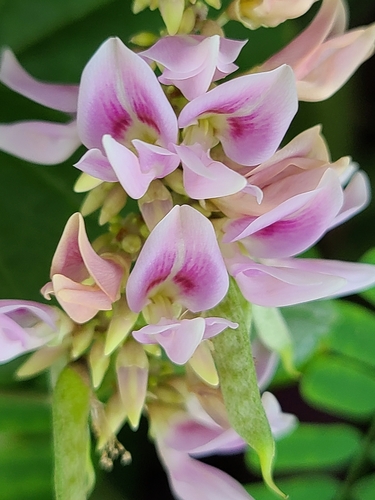
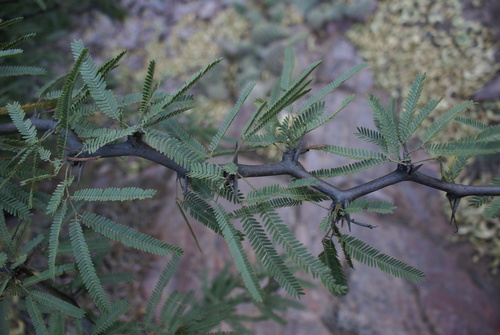
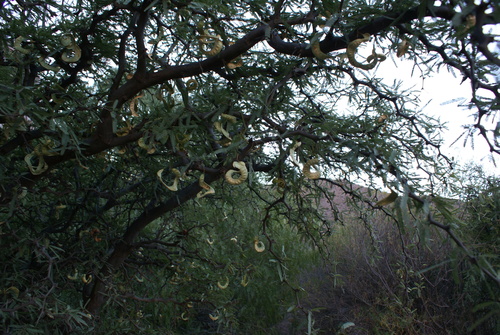
A tree. It grows 8-10 m high. It has spines. It has a short trunk about 1 m across. The crown is 10 m across. The bark is thin and grey. The leaves have small leaflets along the stalk. The flowers are small and greenish-white. The fruit are pods and are red-orange. They are 20 cm long. The seeds are brown and 7 mm long.
Nutrition Score: 50/100
| Part | Moisture | kJ | kcal | Protein | Vit A | Vit C | Iron | Zinc |
|---|---|---|---|---|---|---|---|---|
| Fruit dried | 7.1 | 1430 | 389 | 6.9 | — | — | — | — |
How to Grow
It grows best in areas where annual daytime temperatures fall within the range 10 - 20°c, though it can tolerate 7 - 28°c and an absolute maximum of 45°c. Mature specimens can tolerate occasional short-lived temperatures down as low as -6°c, though younger plants can be killed at -1°c. It prefers a mean annual rainfall in the range 200 - 500mm, tolerating 100 - 700mm. Requires a sunny position. Succeeds in most soils so long as they are well-drained. Tolerates somewhat saline soils. Prefers a pH in the range 5 - 6.5, tolerating 4.5 - 7. Established plants are very drought tolerant. Under optimal conditions, a large tree (40 cm in basal diameter and 7 m in canopy diameter) may produce 40 kg of pods. Some forms of this plant are thorn-free. This species has a symbiotic relationship with certain soil bacteria; these bacteria form nodules on the roots and fix atmospheric nitrogen. The growing plant utilizes some of this nitrogen, but some can also be used by other plants growing nearby. Mesquite pods are typically harvested in late Summer to Autumn, depending on the species and environmental conditions. Mesquite trees flower in Spring, usually from April to June (Northern Hemisphere). Mesquite trees are fast growers, often reaching heights of 4-10 meters (12-35 feet) in just a few years, depending on the species and environmental conditions.
Propagation: Seed remains viable for several years in normal storage. The hard seed coat requires scarification before sowing; this can be achieved by burning, nicking, or immersion in boiling water. If seeds are not extracted from pods before sowing, several minutes of boiling are typically needed to break dormancy. Seeds are normally sown directly into containers. Germination begins after about 2 weeks and may continue for up to a month. Plants are ready for field planting when 30–35cm tall. Direct seeding is also possible. Seeds should be inoculated with mesquite rhizobia. The species competes well with grasses and shrubs.
Medicinal Uses
Leaf extracts have shown antibacterial activity. The bark, branches, gum, and foliage are antiseptic, antidysenteric, and emollient, and are used as a treatment for gastritis.
Other Uses
The nitrogen-fixing properties, rapid growth, and deep roots make this species suitable for erosion control and soil improvement. It is planted in reclamation schemes for salt-affected soils and used as a windbreak. A gum from the trunk has physical and chemical properties similar to gum arabic. The bark and wood are rich in tannins, with the wood containing 5–9%. The heartwood is reddish-brown and the sapwood yellowish. The wood is fairly dense and difficult to work, and is used for parquet floors, doors, and furniture. It is excellent for firewood and charcoal production. Flowers attract bees and other pollinators. Pods are consumed by birds and mammals, and the tree provides shelter and nesting habitat for wildlife. Bark, fallen pods, and leaf litter provide overwintering sites and shelter for invertebrates.
Wikipedia
Source ↗Prosopis alba is a deciduous tree reaching 10 m tall with a 10 m spread, growing at a medium rate. It thrives in UK zone 10 and tolerates light sandy, medium loamy, and heavy clay soils with good drainage. The tree adapts to mildly acidic through basic soil pH and saline conditions, though it requires full sun and cannot tolerate shade. It prefers dry to moist soil and handles drought well, resisting strong winds but not maritime exposure. Bee-pollinated flowers support nitrogen fixation and attract wildlife.
Other Information
It is an important food.
Notes
Also as Mimosaceae.
Names & Synonyms
Algarrobo blanco, Argentine mesquite, Cupesi, Huancu, Huilca, Ibope, Iwope, Ogope, Jwa'ayuk, Najnuna, Pohon algoroba putih, Pohon karob putih, Tacu, Tewes, Thaco, Wape'i, Yana-tacu, Yurakk takko
References (27)
- Abh. Koenigl. Ges. Wiss. Goettingen 19:83; Pl. lorentz. 35. 1874
- Arenas, P. and Scarpa, G. F., 2006, Edible wild plants of the Chorote Indians, Gran Chaco, Argentina. Botanical Journal of the Linnean Society. Vol. 153 (1): pp 73-85
- Cordero, S. E., Abello, L. A., & Galvez, F. L., 2017, Plantas silvestres comestibles y medicinales de Chile y otras partes del mundo. CORMA p 101
- Grandtner, M. M. & Chevrette, J., 2013, Dictionary of Trees, Volume 2: South America: Nomenclature, Taxonomy and Ecology. Academic Press p 533
- Kermath, B. M., et al, 2014, Food Plants in the Americas: A survey of the domesticated, cultivated and wild plants used for Human food in North, Central and South America and the Caribbean. On line draft. p 702
- Kiple, K.F. & Ornelas, K.C., (eds), 2000, The Cambridge World History of Food. CUP p 1716
- Leon-Lobos, P., et al, 2022, Patterns of Traditional and Modern Uses of Wild Edible Native Plants of Chile: Challenges and Future Perspectives. Plants (Basel) v 11 (6) Table S1
- Macmillan, H.F. (Revised Barlow, H.S., et al) 1991, Tropical Planting and Gardening. Sixth edition. Malayan Nature Society. Kuala Lumpur. p 306
- Malezas Comestibles del Cono Sur, INTA, 2009, Buernos Aires
- Martin, F. W., et al, 1987, Perennial Edible Fruits of the Tropics. USDA Handbook 642 p 99
- Molares, S. & Ladio, A., 2012, The Usefulness of Edible and Medicinal Fabaceae in Argentine and Chilean Patagonia: Environmental Availability and Other Sources of Supply. Evidence-Based Complementary and Alternative Medicine. Volume 2012, Article ID 901918, 12 pages, Hindawi Publishing Corporation.
- Montani, M. C. & Scarpa, G. F., 2016, Recursos vegetales y prácticas alimentarias entre indígenas tapiete del noreste de la provincia de Salta, Argentina. Darwiniana, nueva serie vol.4 no.1 San Isidro jul. 2016
- Palmieri, V. S., et al, 2018, Aproximaciones etnobotánicas de las especies y prácticas de frutos nativos comestibles de la Actualidad. Aportes para la interpretación del pasado prehispánico de cerro colorado (Córdoba, Argentina). Bol. Soc. Argent. Bot. 53 (1): 115-133
- Palmeiri, V. S., & Geisa, M. G., 2019, Las plantas comestibles empleadas por las comunidades comechingonas de San Marcos Sierras (Córdoba, Argentina). Primeras aproximaciones. Bol. Soc. Argent. Bot. 54: 295-309.
- Palmieri, V. S., et al, 2022, Wild edible plants of the Central Mountains in Argentina. Comparing subregions to understand the complexity of local botanical knowledge. Rodriguésia 73: e01092021. 2022
- Polini, G., et al, Useful and edible plants of Paraguay Region of Chaco. p 82
- Royal Botanic Gardens, Kew (1999). Survey of Economic Plants for Arid and Semi-Arid Lands (SEPASAL) database. Published on the Internet; http://www.rbgkew.org.uk/ceb/sepasal/internet [Accessed 28th April 2011]
- Scarpa, G. F., 2009, Wild food plants used by the indigenous peoples of South American Gran Chaco: A general synopsis and intercultural comparison. Journal of Applied Botany and Food Quality 83:90-101
- Schmedia-Hirschmann, G., 1994, Plants resources Used by the Ayoreo of the Paraguayan Chaco. Economic Botany Vol. 48. No. 3. pp. 252-258
- Schmeda-Hirschmann, G., et al, 1999, Proximate Composition and Biological Activity of Food Plants gathered by Chilean Amerindians. Economic Botany Vol. 53. No. 2. pp. 177-187
- Sukarya, D. G., (Ed.) 2013, 3,500 Plant Species of the Botanic Gardens of Indonesia. LIPI p 471
- Ulian, T., et al, 2020, Unlocking plant resources to support food security and promote sustainable agriculture. Plants, People, Planet. 2020;2:421–445.
- Vasquez, Roberto Ch. & Coimbra, German S., 1996, Frutas Silvestres Comestibles de Santa Cruz. p 242
- Villagran, C., et al, 1999, La Tradicion Altiplanica: Estudio Etnobotanico en Los Andes de Iquique, Primera Region, Chile. Chungara, volumen 31 No. 1 pp 81-186
- Wiersema, J. H. & Leon, B., 2013, World Economic Plants. A Standard Reference CRC Press. 2nd Ed. p 557
- www.hidawi.com/journals/ecam/2012/901918/tab1/
- www.worldagroforestrycentre.org/treedb/