Prunus cornuta
(Wallich ex Royle) Steud.
Himalayan bird cherry
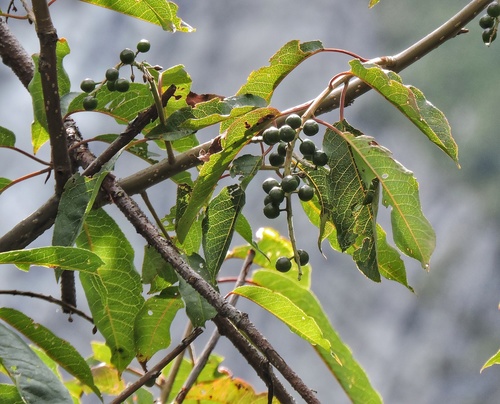
(c) Subhajit Roy, some rights reserved (CC BY-NC-ND), uploaded by Subhajit Roy
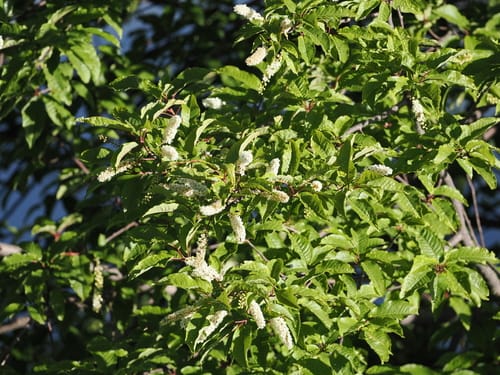
(c) Jonathan Newman, some rights reserved (CC BY-NC)
What to Eat
Edible parts: Fruit, Seeds
The fruit can be eaten raw or cooked and has an acid flavour. Each fruit is about 8mm in diameter and contains a single large seed. The seed is also edible raw or cooked, but should not be eaten if it tastes too bitter.
Known Hazards
Where to Find It
It is a temperate plant. In Nepal it occurs between 2100-3500 m altitude. It grows in deciduous forest on shady slopes.
Afghanistan, Asia, Bhutan, China, Himalayas, India, Indochina, Myanmar, Nepal, Northeastern India, SE Asia, Tibet,
How to Identify
A medium sized tree. It has grey-brown bark. The leaves have stalks. The leaves are 2.5-17 cm long by 1-7.5 cm wide. They are oblong to sword shaped. They have long points. They have close, fine teeth. The flowers are white. They occur in long drooping clusters. These can be 10-15 cm long. The flowers are 1 cm across. The fruit is round. It is dark purple or black when ripe. The fruit are 8 mm across. They are acid and edible.
How to Grow
Plants are grown from seed.
Propagation: Seed requires 2–3 months of cold stratification and is best sown in a cold frame as soon as it is ripe. Stored seed should be sown in a cold frame as early in the year as possible and protected from mice. Germination can be slow, sometimes taking 18 months. Prick out seedlings into individual pots when large enough to handle, overwinter them in a greenhouse or cold frame, and plant out in late spring or early summer the following year. Cuttings of half-ripe wood with a heel can be taken in July/August in a frame. Softwood cuttings from strongly growing plants can be taken in spring to early summer in a frame. Layering can be done in spring.
Medicinal Uses
No specific research has been recorded for this species, but all members of the genus contain amygdalin and prunasin, compounds that break down in water to release hydrocyanic acid (prussic acid or cyanide). In small amounts this exceedingly poisonous compound stimulates respiration, improves digestion and gives a sense of well-being.
Other Uses
A green dye can be obtained from the leaves, and a dark grey to green dye from the fruit. The wood is close and even-grained, takes a fine polish, and is used for construction and tools.
Wikipedia
Source ↗Prunus cornuta, the Himalayan bird cherry, is a species of bird cherry native to the foothills of the Himalayas, including China and the countries of the Indian subcontinent. A medium-sized tree, it can reach 18 m. It is used for a rootstock for sweet cherries in India. Its specific epithet references the "horned" deformation of the fruit seen when a tree is afflicted with the fungal disease pocket plum gall, ascribed to the species Taphrina padi.
Notes
There are about 200 Prunus species.
Names & Synonyms
Aarupate, Aarya, Arupate, Bart, Dudia, Jamun, Jamu, Jammu, Jamnu, Jamoi, Jamunoi, Jangali khurpani, Kalakat, Mehal, Mokhoshi, Ngourashi, Nyolove, Paras, Shoma, Zambchule
References (21)
- Agarwal, R. & Chandra, V., 2019, Diversity of wild edible plants in the Mandal-Chopta forest, Uttarakhand. Journal of Medicinal Plants Studies 2019; 7(1): 89-92
- Altschul, S.V.R., 1973, Drugs and Foods from Little-known Plants. Notes in Harvard University Herbaria. Harvard Univ. Press. Massachusetts. no. 1479
- Ambasta, S.P. (Ed.), 2000, The Useful Plants of India. CSIR India. p 495
- Dobriyal, M. J. R. & Dobriyal, R., 2014, Non Wood Forest Produce an Option for Ethnic Food and Nutritional Security in India. Int. J. of Usuf. Mngt. 15(1):17-37
- Karki, S., et al, 2017, Minor Fruits in Nepal: Utilization and Conservation Efforts. Proceedings of 2nd National Workshop on CUAPGR, 2017.
- Manandhar, N.P., 2002, Plants and People of Nepal. Timber Press. Portland, Oregon. p 382
- Masoodi, H. U. R. & Sundriyal, R. C., 2020, Richness of non-timber forest products in Himalayan communities—diversity, distribution, use pattern and conservation status. Journal of Ethnobiology and Ethnomedicine 16:56
- Mehta, P. S. et al, 2010, Native plant genetic resources and traditional foods of Uttarakhand Himalaya for sustainable food security and livelihood. Indian Journal or Natural products and Resources. Vol 1(1), March 2010 pp 89-96
- Negi, P. S. & Subramani, S. P., 2015, Wild Edible Plant Genetic Resources for Sustainable Food Security and Livelihood of Kinnaur District, Himachal Pradesh, India, International Journal of Conservation Science. 6 (4): 657-668
- Nomencl. bot. ed. 2, 2:403. 1841
- Pfoze, N. L., et al, 2012, Survey and assessment of floral diversity on wild edible plants from Senapati district of Manipur, Northeast India. Journal of Biodiversity and Environmental Sciences. 1(6):50-52
- Plants for a Future database, The Field, Penpol, Lostwithiel, Cornwall, PL22 0NG, UK. http://www.scs.leeds.ac.uk/pfaf/
- Polunin, O., & Stainton, A., 2006, Flowers of the Himalaya, Oxford India Paperbacks. p 115
- Rana, D., et al, 2019, Ethnobotanical knowledge among the semi-pastoral Gujjar tribe in the high altitude (Adhwari’s) of Churah subdivision, district Chamba, Western Himalaya. Journal of Ethnobiology and Ethnomedicine (2019) 15:10
- Rana, J.C. et al, 2011, Genetic resources of wild edible plants and their uses among tribal communities of cold arid regions of India. Genetic Resources and Crop Evolution. 59:135-149
- Rana, P. K., et al, 2014, Uses of Local Plant Biodiversity among the Tribal Communities of Pangi Valley of District Chamba in Cold Desert Himalaya, India. The Scientific World Journal. Volume 2014, Article ID 753289, 15 pages
- Rawat, G.S., & Pangtey, Y.P.S., 1987, A Contribution to the Ethnobotany of Alpine Regions of Kumaon. J. Econ. Tax. Bot. Vol. 11 No. 1 pp 139-147
- Singh, H.B., Arora R.K.,1978, Wild edible Plants of India. Indian Council of Agricultural Research, New Delhi. p 69
- Singh, V. B., et al, (Ed.) Horticulture for Sustainable Income and Environmental Protection. Vol. 1 p 219
- Thakur, D., et al, 2017, Why they eat, what they eat: patterns of wild edible plants consumption in a tribal area of Western Himalaya. Journal of Ethnobiology and Ethnomedicine (2017) 13:70
- Upreti, K., et al, 2010, Diversity and Distribution of Wild Edible Fruit Plants of Uttarakhand. Bioversity Potentials of the Himalaya. p 180
More from Rosaceae


