Prunus grayana
Maxim.
Japanese bird cherry, Gray's chokeberry
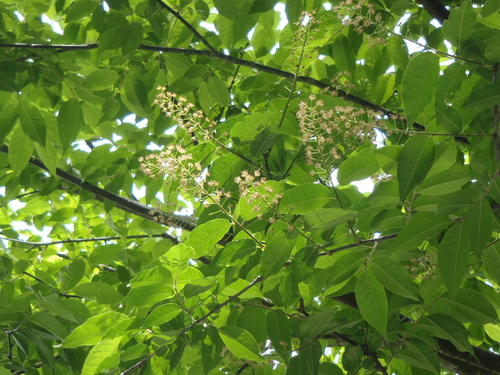
(c) Keita Watanabe, some rights reserved (CC BY-NC), uploaded by Keita Watanabe

(c) Joshua Calfo, some rights reserved (CC BY-NC)

(c) Joshua Calfo, some rights reserved (CC BY-NC)
What to Eat
Edible parts: Flowers, Fruit, Seeds
The fruit can be eaten raw or cooked. In Japan, immature fruits are eaten when young and salted. The fruit is about 8mm in diameter and contains one large seed. Salted flower buds and young fruits are also eaten in Japan and have a pungent taste. The seed can be eaten raw or cooked, but should not be consumed if it is too bitter.
Known Hazards
Where to Find It
Temperate. It suits hardiness zones 6-10.
Asia, Australia, Japan,
How to Identify
A small tree. It grows 9 m high and spreads 6 m wide. It loses its leaves during the year. It has short stem. The leaves have bristles on the edge. The flowers are white and small. They are in clusters. The fruit are small and black.
How to Grow
Thrives in a well-drained moisture-retentive loamy soil. Prefers some lime in the soil but is likely to become chlorotic if too much lime is present. Requires a sunny position. This species is closely related to P. padus. Most members of this genus are shallow-rooted and will produce suckers if the roots are damaged. Plants in this genus are notably susceptible to honey fungus.
Propagation: Seed requires 2–3 months of cold stratification and is best sown in a cold frame as soon as it is ripe. Stored seed should be sown in a cold frame as early in the year as possible and protected from mice. Germination can be slow, sometimes taking 18 months. Prick out seedlings into individual pots when large enough to handle, overwinter in a greenhouse or cold frame, and plant out in late spring or early summer the following year. Cuttings of half-ripe wood with a heel can be taken in July or August in a frame. Softwood cuttings from strongly growing plants can be taken in spring to early summer in a frame. Layering can be done in spring.
Medicinal Uses
No specific medicinal use has been recorded for this species, but like all members of the genus it contains amygdalin and prunasin, compounds that break down in water to release hydrocyanic acid (cyanide or prussic acid). In small amounts, this highly poisonous substance is said to stimulate respiration, improve digestion, and produce a sense of well-being.
Other Uses
A green dye can be obtained from the leaves, and a dark grey to green dye from the fruit. The wood is hard and easily split, and is used for printing blocks, tool handles, and similar purposes.
Wikipedia
Source ↗Prunus grayana (syn. Padus grayana (Maxim.) C.K.Schneid., Prunus padus var. japonica Miq.; Japanese bird cherry or Gray's bird cherry; Japanese ウワミズザクラ Uwa-mizu-zakura; Chinese 灰叶稠李 hui ye chou li) is a species of bird cherry native to Japan and China, occurring at medium altitudes of 1,000–3,800 m in the temperate zone. It prefers sunshine and moist (but drained) soil. It is a small deciduous tree reaching a height of 8–20 m. The trunk is slender with smooth grey to purple-grey bark marked with horizontal brown lenticels, with a strong smell when cut. The leaves are elliptical to ovoid, 4–10 cm long and 1.8–4.5 cm broad, with a serrated margin with aristate tips to the serrations. The lowest teeth of a leaf feature two glands. The flowers are produced on 5–8 cm long racemes, each flower 7–10 mm diameter, with five white petals; they are hermaphroditic, and appear in mid-spring after the leaves. The fruit is a small drupe, about 8 mm in diameter, green at first, then red and finally ripening black in mid summer. It is very closely related to Prunus padus (Bird cherry), differing in the aristate tips to the leaf serration (blunt-pointed in P. padus), and the longer style in the flower.
Notes
There are about 200 Prunus species.
Names & Synonyms
References (6)
- Bull. Acad. Imp. Sci. Saint-Petersbourg 29:107; Melanges Biol. Bull. Phys.-Math. Acad. Imp. Sci. Saint-Petersbourg 11:704. 1883 (Diagn. pl. nov. asiat.)
- Cundall, P., (ed.), 2004, Gardening Australia: flora: the gardener's bible. ABC Books. p 1094
- Facciola, S., 1998, Cornucopia 2: a Source Book of Edible Plants. Kampong Publications, p 203
- Plants for a Future, The Field, Penpol, Lostwithiel, Cornwall, PL22 0NG, UK. http://www.scs.leeds.ac.uk/pfaf/
- Tanaka,
- Uphof,
More from Rosaceae


