Prunus incisa
Thunberg
Fuji cherry

(c) autan, some rights reserved (CC BY-NC-ND)

(c) 登坂久雄, some rights reserved (CC BY-NC), uploaded by 登坂久雄
(c) Matt Chansler, some rights reserved (CC BY-NC), uploaded by Matt Chansler
What to Eat
Edible parts: Fruit, Seeds
The fruit can be eaten raw or cooked. It is fairly small, about 8mm in diameter, and contains one large seed. The seed can also be eaten raw or cooked, but should not be consumed if it is too bitter.
Known Hazards
Where to Find It
It is native to S.W. Japan. In grows in woods in the mountains. Temperate. It suits hardiness zones 6-9.
Asia, Australia, Japan,
How to Identify
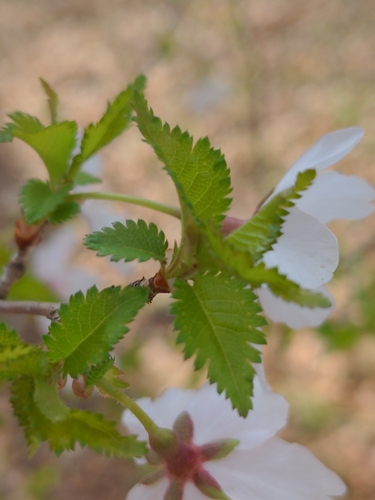
A deciduous shrub or small tree. It grows 5-10 m high. It spreads 4.5 m wide. It is a broad spreading shape. The bark is dark grey and forms cracks along the trunk. The leaves are oval and 6 cm long by 3 cm wide. They taper to a point at the tip. There are sharp teeth along the edge. The leaves are bronze red when young and become dark green and hairy on both sides. The flowers are white or pale pink and are 2 cm across. They have 5 petals with notches in them. The flowers occur in small clusters of 2 or 3. The fruit is egg shaped and purple-black. It is 8 mm long.
How to Grow
Thrives in a well-drained moisture-retentive loamy soil. Prefers some lime in the soil but is likely to become chlorotic if too much lime is present. Succeeds in sun or partial shade though it fruits better in a sunny position. Plants are hardy to about -20°c. A very ornamental plant, but it is slow growing. A tree in a very windy position in Cornwall was 2 metres tall in spring 1994 when 4 years old and was flowering heavily. Most members of this genus are shallow-rooted and will produce suckers if the roots are damaged. Plants in this genus are notably susceptible to honey fungus.
Propagation: Seed requires 2–3 months of cold stratification and is best sown in a cold frame as soon as it is ripe. Stored seed should be sown in a cold frame as early in the year as possible and protected from mice. Germination can be slow, sometimes taking 18 months. Prick out seedlings into individual pots when large enough to handle, overwinter in a greenhouse or cold frame, and plant out in late spring or early summer the following year. Cuttings of half-ripe wood with a heel can be taken in July or August in a frame. Softwood cuttings from strongly growing plants can be taken in spring to early summer in a frame. Layering can be done in spring.
Medicinal Uses
No specific medicinal use has been recorded for this species, but like all members of the genus it contains amygdalin and prunasin, compounds that break down in water to release hydrocyanic acid (cyanide or prussic acid). In small amounts, this highly poisonous substance is said to stimulate respiration, improve digestion, and produce a sense of well-being.
Other Uses
A green dye can be obtained from the leaves, and a dark grey to green dye from the fruit. Plants can be grown as a hedge.
Wikipedia
Source ↗Prunus incisa, the Fuji cherry, is a species of flowering plant in the family Rosaceae, which gets its scientific name from the deep incisions on the leaves. It is an endemic species in Japan and grows wild in Kantō, Chūbu and Kinki regions. It is called the Fuji cherry because it grows in particular abundance around Mount Fuji and Hakone. A dainty slow-growing, early white-flowering cherry tree, this century-old cultigen from Hondo, Japan is highly regarded as an ornamental, but the wood has no industrial value. It is hardy to −20 °C (−4 °F), and crossed with Prunus speciosa, has yielded the cultivar Prunus 'Umineko'. It is in the ornamental section Pseudocerasus of the cherry subgenus Cerasus of the genus Prunus. Ma et al. classified it in a group with Prunus nipponica. The following cultivars have gained the Royal Horticultural Society's Award of Garden Merit: 'The Bride' 'Kojo-no-mai' 'Oshidori' Prunus incisa f. yamadei 'Kojo-no-Mai' is a cultivar suitable for the very small garden, as with judicious pruning it can be kept to a maximum size of 1.5–2 m (5–7 ft). In a large pot it will produce a dome of twiggy growth, and has the added bonus of brilliant autumn colour.
Notes
There are about 200 Prunus species.
Names & Synonyms
References (7)
- Coombes, A.J., 2000, Trees. Dorling Kindersley Handbooks. p 261
- Cundall, P., (ed.), 2004, Gardening Australia: flora: the gardener's bible. ABC Books. p 1094
- Hedrick, U.P., 1919, (Ed.), Sturtevant's edible plants of the world. p 524
- Lord, E.E., & Willis, J.H., 1999, Shrubs and Trees for Australian gardens. Lothian. p 67
- J. A. Murray, Syst. veg. ed. 14:461. 1784 May-Jun (Fl. jap. 202. 1784 Aug)
- Plants for a Future, The Field, Penpol, Lostwithiel, Cornwall, PL22 0NG, UK. http://www.scs.leeds.ac.uk/pfaf/
- Ryan, S., 2008, Dicksonia. Rare Plants Manual. Hyland House. p 47
More from Rosaceae


