Prunus mahaleb
L.
Mahaleb cherry

(c) Steve Parr, some rights reserved (CC BY-NC), uploaded by Steve Parr
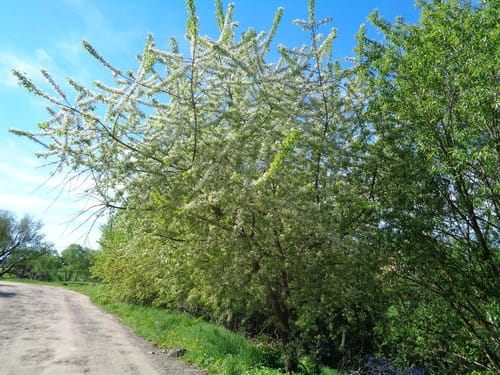
(c) Вадим Рыбаков, some rights reserved (CC BY-NC)
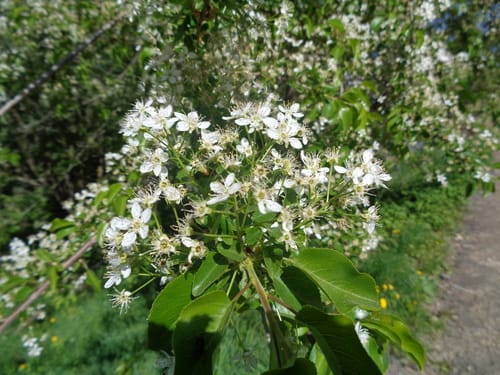
(c) Вадим Рыбаков, some rights reserved (CC BY-NC)
What to Eat
Edible parts: Fruit, Seeds, Spice, Leaves - flavouring
The fruit might be edible — fruits of all members of this genus are more or less edible, though not always of good quality. Bitter fruit should not be eaten in quantity due to the presence of toxic compounds. The fruit is about 6mm in diameter and contains one large seed. The dried seed kernels are used as a flavouring in breads, sweet pastries and confectionery, where they impart an intriguing flavour. The seed should not be eaten if it tastes too bitter — see toxicity notes.
Known Hazards
Where to Find It
Temperate. It grows in northern China. In Argentina it grows between 500-1,000 m above sea level. Arboretum Tasmania.
Argentina, Armenia, Asia, Australia, Azerbaijan, Balkans, Bosnia, Canada, Caucasus, Central Asia, China, Croatia, Europe, Greece, India, Iran, Iraq, Italy, Kazakhstan, Luxembourg, Mediterranean, Mexico, Middle East, North America, Pakistan, Palestine, Sicily, Slovenia, South America, Spain, Syria, Tajikistan, Tasmania, Turkey, Türkiye, USA,
How to Identify
A spreading deciduous tree. It grows about 12 m high. The leaves are 6 cm long and oval. They have fine teeth around the edge. The leaves are bright green. The flowers are single and white. The fruit is green and 10 mm across. The fruit ripen to black. The kernels are light brown. They are tear shaped and 5 mm long. They are creamy-white inside.
How to Grow
Thrives in a well-drained moisture-retentive loamy soil, growing best in a poor soil. Prefers some lime in the soil but is likely to become chlorotic if too much lime is present. Succeeds in sun or partial shade though it fruits better in a sunny position. Most members of this genus are shallow-rooted and will produce suckers if the roots are damaged. Plants in this genus are notably susceptible to honey fungus.
Propagation: Seed requires 2–3 months of cold stratification and is best sown in a cold frame as soon as it is ripe. Stored seed should be sown in a cold frame as early in the year as possible. Protect seed from mice. Germination can be slow, sometimes taking 18 months. Prick out seedlings into individual pots when large enough to handle, grow on in a greenhouse or cold frame through their first winter, and plant out in late spring or early summer the following year. Cuttings of half-ripe wood with a heel can be taken in July/August in a frame. Softwood cuttings from strongly growing plants can be taken in spring to early summer in a frame. Layering can be done in spring.
Medicinal Uses
The seed is tonic. All members of the genus contain amygdalin and prunasin, which break down in water to form hydrocyanic acid (cyanide or prussic acid). In small amounts this exceedingly poisonous compound stimulates respiration, improves digestion and gives a sense of well-being.
Other Uses
A green dye can be obtained from the leaves, and a dark grey to green dye from the fruit. The plant can be used as a rootstock for cultivated cherries. The wood is hard and very heavy, polishes well, and is used for turnery and ornamental items.
Wikipedia
Source ↗Prunus mahaleb, the St Lucie cherry or mahaleb cherry, is a species of cherry, native to central and southern Europe, northwest Africa, southwest Asia, and parts of central Asia. The tree is cultivated for a spice obtained from the seeds inside the cherry stones. The seeds have a fragrant scent and have a taste comparable to bitter almonds with cherry notes.
Other Information
It is cultivated.
Notes
There are about 200 Prunus species.
Names & Synonyms
Cerecino, Cerezo sta. Rosa, Gilas, Guindal bravia, Guindera silvestre, Mahlab, Mahleb, Perfumed cherry, Raseljka, Rešeljika, St Lucie Cherry
References (30)
- Ali-Shtayeh, M. S., et al, 2008, Traditional knowledge of wild edible plants used in Palestine (Northern West Bank): A comparative study. J Ethnobiol Ethnomed. 4: 13
- Ambasta, S.P. (Ed.), 2000, The Useful Plants of India. CSIR India. p 496
- Cerne, M., 1992, Wild Plants from Slovenia used as Vegetables. Acta Horticulturae 318
- Demir, I. & Ayaz, N., 2022, Wild edible plants contributing to the traditional foods of Mardin (Turkey) Province. Indian Journal of Traditional Knowledge Vol 21(3), July 2022, pp 569-582 (As Cerasus mahaleb)
- Dzhangaliev, A. D., et al, 2003, The Wild Fruit and Nut Plants of Kazakhstan, Horticultural Reviews, Vol. 29. pp 305-371
- Ertug, F, Yenen Bitkiler. Resimli Türkiye Florası -I- Flora of Turkey - Ethnobotany supplement (As Cerasus mahaleb)
- Facciola, S., 1998, Cornucopia 2: a Source Book of Edible Plants. Kampong Publications, p 203
- Flora of China @ efloras.org Volume 9
- Gonzalez, J. A., et al, 2011, The consumption of wild and semi-domesticated edible plants in the Arribes del Duero (Salamanca-Zamora, Spain): an ananalysis of traditional knowledge. Genetic Resources and Crop Evolution 58:991-1006
- Hemphill, I, 2002, Spice Notes. Macmillan. p 237
- Hibbert, M., 2002, The Aussie Plant Finder 2002, Florilegium. p 241
- Hinnawi, N. S. A., 2010, An ethnobotanical study of wild edible plants in the Northern West Bank "Palestine". An-Najah National University. p 96
- http://www.botanic-gardens-ljubljana.com/en/plants
- Khan, D. & Shaukat, S.S., 2006, The Fruits of Pakistan: Diversity, Distribution, Trends of Production and Use. Int. J. Biol. Biotech., 3(3):463-499
- Kremer, B.P., 1995, Shrubs in the Wild and in Gardens. Barrons. p 150
- Little, E.L., 1980, National Audubon Society Field Guide to North American Trees. Alfred A. Knopf. p 500
- Luczaj, L. et al, 2013, Wild food plants used in the villages of the Lake Vrana Nature Park (northern Dalmatia, Croatia). Acta Societatis Botanicorum Poloniae, 82(4): 275-281
- Maganha, A. G., et al, 2010, Pharmacological evidences for the extracts and secondary metabolites from plants of the genus Hibiscus. Food Chemistry 118: 1-10
- Pasta, S., et al, 2020, An Updated Checklist of the Sicilian Native Edible Plants: Preserving the Traditional Ecological Knowledge of Century-Old Agro-Pastoral Landscapes. Frontiers in Plant Science. Volume 11|Article 388
- Pieroni, A., et al, 2020, Wild food plants traditionally gathered in central Armenia: archaic ingredients or future sustainable foods? Environment, Development and Sustainability. Springer p 10
- Plants for a Future, The Field, Penpol, Lostwithiel, Cornwall, PL22 0NG, UK. http://www.scs.leeds.ac.uk/pfaf/
- Postman, J. D., et al, 2012, Recent NPGS Coordinated Expeditions in the Trans-Caucasus Region to Collect Wild Relatives of Temperate Fruit and Nut Crops. In Acta Horticulturae Number 948 p 191-198
- Redzic, S. J., 2006, Wild Edible Plants and their Traditional Use in the Human Nutrition in Bosnia-Herzegovina. Ecology of Food and Nutrition, 45:189-232
- Segura, S., et al, 2018, The edible fruit species in Mexico. Genet Resour Crop Evol (2018) 65:1767–1793
- Sfikas, G., 1984, Trees and shrubs of Greece. Efstathiadis Group. Athens. p 70
- Sp. pl. 1:474. 1753
- Tanaka,
- Tardio, J., et al, Ethnobotanical review of wild edible plants in Spain. Botanical J. Linnean Soc. 152 (2006), 27-71
- Wiersema, J. H. & Leon, B., 2013, World Economic Plants. A Standard Reference CRC Press. 2nd Ed. p 562
- World Checklist of Useful Plant Species 2020. Royal Botanic Gardens, Kew
More from Rosaceae


