Prunus maritima
Marshall
Beach plum, Shore plum, Sand plum
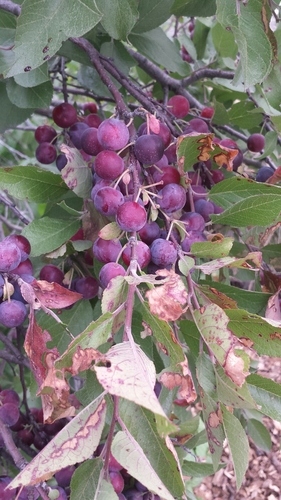
(c) Tom Norton, some rights reserved (CC BY), uploaded by Tom Norton
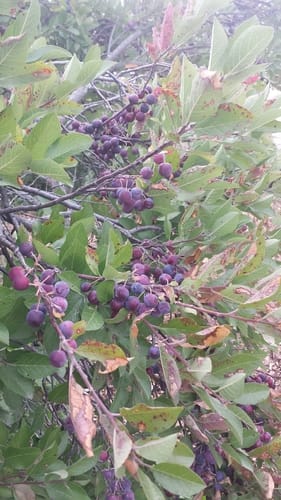
(c) Tom Norton, some rights reserved (CC BY)
What to Eat
Edible parts: Fruit, Seeds
The fruit is variable in quality — the best forms are sub-acid to sweet and can be eaten fresh, used in pies and preserves, or dried for later use. It measures about 15mm in diameter and contains one large seed. The seed can be eaten raw or cooked, but should not be consumed if it tastes too bitter — see toxicity notes.
Known Hazards
Where to Find It
It occurs naturally on the sand dunes of the Atlantic Coast of USA. It occurs naturally in soils with low nutrients and low water holding capacity. They are subject to drought, high winds and salt content. Temperate. It suits hardiness zones 3-9.
Australia, Canada, North America, USA,
How to Identify
A shrub. It has a low growth habit. It grows 1.8 m high and spreads 2 m wide. The bark is dark. It loses its leaves during the year. The leaves are glossy. They are dark green but paler underneath. The flowers form a showy display. They are white and in pairs or small clusters. The fruit are 1.5 cm across. They are purple, red or yellow. They are plum-like and edible. Some kinds are very sour.
How to Grow
Thrives in a well-drained moisture-retentive loamy soil[, doing well on limestone11, 200]. Prefers some lime in the soil but is likely to become chlorotic if too much lime is present. Requires a sunny position. Tolerates maritime exposure. The beach plum is cultivated for its edible fruit in N. America, there are some named varieties. The fruit is often sold in local markets and the plant is of potential commercial importance. The fruit seldom ripens when grown in the interior of America. The cultivar 'Eastham' has large well-flavoured fruit and is a heavy cropper. 'Hancock' is an early ripening form with sweet juicy fruit. 'Squibnocket' is of high quality and is also a good sand binder. Most members of this genus are shallow-rooted and will produce suckers if the roots are damaged. Plants in this genus are notably susceptible to honey fungus. A clumping plant, forming a colony from shoots away from the crown but with a limited spread. Prunus maritima (Beach Plum) is not self-fertile and requires cross-pollination with another Prunus maritima shrub for fruit production. Harvesting typically occurs in late summer to early autumn, with specific timing varying by species. For instance, plums and peaches are usually harvested from July to September (Northern Hemisphere), while almonds are harvested in August to September (Northern Hemisphere). Prunus species usually flower in early spring, often between March and April (Northern Hemisphere), depending on the species and local climate. Growth rates vary among species, but generally, Prunus trees can grow moderately fast, often reaching full height in 3 to 5 years. However, they may take several years to bear fruit, depending on the species and growing conditions.
Propagation: Seed requires 2–3 months of cold stratification and is best sown in a cold frame as soon as it is ripe. Stored seed should be sown in a cold frame as early in the year as possible. Protect seed from mice. Germination can be slow, sometimes taking 18 months. Prick out seedlings into individual pots when large enough to handle, grow on in a greenhouse or cold frame through their first winter, and plant out in late spring or early summer the following year. Cuttings of half-ripe wood with a heel can be taken in July/August in a frame. Softwood cuttings from strongly growing plants can be taken in spring to early summer in a frame. Layering can be done in spring.
Medicinal Uses
No specific research has been recorded for this species, but all members of the genus contain amygdalin and prunasin, which break down in water to form hydrocyanic acid (cyanide or prussic acid). In small amounts this exceedingly poisonous compound stimulates respiration, improves digestion and gives a sense of well-being.
Other Uses
A green dye can be obtained from the leaves, and a dark grey to green dye from the fruit. The plants have extensive root systems and can be used to bind sand along the coast. They can also be used as windbreaks and in alley cropping systems, and support biodiversity by providing habitat for pollinators and other wildlife. The flowers are rich in nectar and pollen, attracting bees, butterflies and other pollinators. The fruits provide food for birds and mammals, and the trees offer shelter, roosting and nesting sites. The bark and leaf litter provide overwintering habitat for invertebrates and beneficial insects.
Wikipedia
Source ↗Prunus maritima, the beach plum, is a species of plum native to the East Coast of the United States. It is a choice wild edible and its few pests and salt tolerance make it a resilient fruit crop for degraded lands and urban soils.
Other Information
Fruit are sold in markets.
Notes
There are about 200 Prunus species.
Names & Synonyms
Beach Plum, Graves' Plum, Prunus maritima
References (16)
- Arbust. amer. 112. 1785
- Beckstrom-Sternberg, Stephen M., and James A. Duke. "The Foodplant Database." http://probe.nalusda.gov:8300/cgi-bin/browse/foodplantdb.(ACEDB version 4.0 - data version July 1994)
- Cundall, P., (ed.), 2004, Gardening Australia: flora: the gardener's bible. ABC Books. p 1095
- Elias, T.S. & Dykeman P.A., 1990, Edible Wild Plants. A North American Field guide. Sterling, New York p 167
- Esperanca, M. J., 1988. Surviving in the wild. A glance at the wild plants and their uses. Vol. 1. p 84
- Facciola, S., 1998, Cornucopia 2: a Source Book of Edible Plants. Kampong Publications, p 203
- Flowerdew, B., 2000, Complete Fruit Book. Kyle Cathie Ltd., London. p 185
- Hedrick, U.P., 1919, (Ed.), Sturtevant's edible plants of the world. p 525
- Jackes, D. A., 2007, Edible Forest Gardens
- Kermath, B. M., et al, 2014, Food Plants in the Americas: A survey of the domesticated, cultivated and wild plants used for Human food in North, Central and South America and the Caribbean. On line draft. p 713
- Plants for a Future, The Field, Penpol, Lostwithiel, Cornwall, PL22 0NG, UK. http://www.scs.leeds.ac.uk/pfaf/
- Small, E., 2009, Top 100 Food Plants. The world's most important culinary crops. NRC Research Press. p 435
- USDA, ARS, National Genetic Resources Program. Germplasm Resources Information Network - (GRIN). [Online Database] National Germplasm Resources Laboratory, Beltsville, Maryland. Available: www.ars-grin.gov/cgi-bin/npgs/html/econ.pl (10 April 2000)
- Uva, R.H., Whitlow, T., 1997, Beach Plum (Prunus maritima) 11.4 In The Australian New Crops Newsletter No 8.
- Wiersema, J. H. & Leon, B., 2013, World Economic Plants. A Standard Reference CRC Press. 2nd Ed. p 563
- World Checklist of Useful Plant Species 2020. Royal Botanic Gardens, Kew
More from Rosaceae


