Prunus mume
(Siebold) Siebold & Zucc.
Ume, Japanese plum, Japanese apricot

(c) CHUNG CHANG-LIN, some rights reserved (CC BY-NC), uploaded by CHUNG CHANG-LIN

(c) alpacafish, some rights reserved (CC BY-NC)
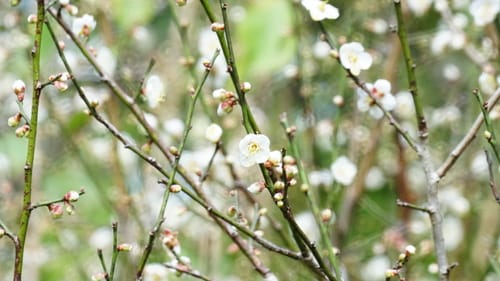
(c) vivi1874, some rights reserved (CC BY-NC)
What to Eat
Edible parts: Flowers, Fruit, Seeds
The fruit can be eaten raw or cooked, but it is hard and sour even when fully ripe, making it barely palatable fresh. It is widely used in the Orient, most commonly pickled and served as a condiment or vegetable — this is the umeboshi plum found in Oriental stores, preserved in salt and used as a relish in rice dishes. The fruit contains approximately 0.9% protein, 18.9% carbohydrate, 0.6% ash, and no fat. Per 100g dry weight (388 calories, 0% water), it provides: protein 9.7g, fat 13.4g, carbohydrate 67.9g, fibre 10.4g, ash 9g; calcium 82mg, phosphorus 269mg, iron 13.4mg, sodium 60mg, potassium 2328mg; vitamin A 149mg, thiamine (B1) 0.37mg, riboflavin (B2) 0.37mg, niacin 3.73mg, vitamin C 75mg. The fruit is about 3cm in diameter and contains one large seed. Flowers are used as a flavouring in tea. The seed is edible raw or cooked, but should not be eaten if too bitter. Young budlings are also noted as edible, though no further details are given.
Known Hazards
Where to Find It
Temperate. It is frost hardy. It suits hardiness zones 6-10. In Yunnan.
Asia, Australia, Brazil, British Indian Ocean Terr., BIOT, China*, Europe, Himalayas, India, Indochina, Japan*, Korea, Laos, Myanmar, SE Asia, South America, Taiwan, Tibet, Vietnam,
How to Identify
A small tree. It loses its leaves during the year. It grows up to 6 m tall. It spreads 8 m wide. The leaves are 10 cm long. The flowers occur singly. They are 25 mm wide. They are pink or red. They have an almond scent. The fruit has one hard stone inside. The fruit are yellow and velvety. They are sour and edible.
Nutrition Score: 24/100
| Part | Moisture | kJ | kcal | Protein | Vit A | Vit C | Iron | Zinc |
|---|---|---|---|---|---|---|---|---|
| Fruit | 86.6 | 217 | 52 | 1.3 | — | — | 1.8 | — |
How to Grow
Plants can be grown by seed, cuttings or by grafting.
Propagation: Seed requires 2–3 months of cold stratification and is best sown in a cold frame as soon as it is ripe. Stored seed should be sown in a cold frame as early in the year as possible, with protection from mice. Germination can be slow, sometimes taking 18 months. Prick seedlings into individual pots when large enough to handle, overwinter in a greenhouse or cold frame, then plant out in late spring or early summer the following year. Half-ripe cuttings with a heel can be taken in July/August in a frame; softwood cuttings from vigorous plants in spring to early summer in a frame. Layering in spring is also an option.
Medicinal Uses
The unripe fruit is antibacterial, antipyretic, antispasmodic, astringent, carminative, cholagogue, pectoral, sialagogue, and vermifuge, with broad-spectrum antibacterial activity. Cooling and refreshing, it is combined with other herbs and used internally for bronchitis, chronic coughs, chronic diarrhoea, and roundworms. The fruit is also used to treat diarrhoea and dysentery, stop bleeding, and ease coughs. Externally, it is applied to fungal skin infections, corns, and warts. The half-ripe smoked fruit is considered antispasmodic, carminative, and febrifuge. As with all members of the genus, the plant contains amygdalin and prunasin, which break down in water to form hydrocyanic acid (prussic acid). In small amounts this highly poisonous compound stimulates respiration, improves digestion, and produces a sense of well-being.
Other Uses
A green dye can be obtained from the leaves, and a dark grey to green dye from the fruit. The plant is noted for its scent.
Wikipedia
Source ↗Prunus mume, also known as Chinese plum, is a tree species in the family Rosaceae. It is also referenced by its flowers as plum blossom. Although referred to as a plum in English, it is classified in the Armeniaca section of the genus Prunus, making it an apricot. Mei flowers, or meihua (梅花), which bloom in the late winter and early spring, notably during the spring festival (春節), symbolize endurance, as they are the first to bloom despite the cold; the flower is one of the Three Friends of Winter. The plant is intimately associated with art, literature, and everyday life in China, from where it was then introduced to Korea, Vietnam, and Japan. In East Asian cuisine (Chinese, Japanese, Korean, and Vietnamese cuisine), the fruit, known as meizi (梅子) in Chinese, is used in juices and sauces; as a flavoring for alcohol; and may be pickled or dried. It is also used in traditional Chinese medicine. Meihua are also appreciated for their characteristic fragrance, which is unique among apricots. Prunus mume should not be confused with the plum Prunus salicina, a related species also grown in China, Japan, Korea, and Vietnam also referred to with the common name of Chinese plum, nor with the common apricot Prunus armeniaca, which is closely related under the same section.
Production
In Yunnan the fruit are harvested in August.
Other Information
It is a cultivated food plant.
Notes
There are about 200 Prunus species.
Names & Synonyms
Damasco-japones, Kangjue, Maesilnamu, Mei, Miume, Mo hoa-vang
References (33)
- Altschul, S.V.R., 1973, Drugs and Foods from Little-known Plants. Notes in Harvard University Herbaria. Harvard Univ. Press. Massachusetts. no. 1475
- Ambasta, S.P. (Ed.), 2000, The Useful Plants of India. CSIR India. p 496
- Arora, R. K., 2014, Diversity in Underutilized Plant Species - An Asia-Pacific Perspective. Bioversity International. p 58 (Also as Armeniaca mume)
- Bodkin, F., 1991, Encyclopedia Botanica. Cornstalk publishing, p 842
- Brickell, C. (Ed.), 1999, The Royal Horticultural Society A-Z Encyclopedia of Garden Plants. Convent Garden Books. p 838
- Cundall, P., (ed.), 2004, Gardening Australia: flora: the gardener's bible. ABC Books. p 1095
- Facciola, S., 1998, Cornucopia 2: a Source Book of Edible Plants. Kampong Publications, p 194 (As Armeniaca mume)
- Flora of China Vol. 9, p 400 (As Armeniaca mume)
- Fl. jap. 1:29, t. 11. 1836
- Food Composition Tables for use in East Asia FAO http://www.fao.org/infoods/directory No. 818
- Hedrick, U.P., 1919, (Ed.), Sturtevant's edible plants of the world. p 525
- Hibbert, M., 2002, The Aussie Plant Finder 2002, Florilegium. p 241
- Hu, Shiu-ying, 2005, Food Plants of China. The Chinese University Press. p 445
- Joyce, D., 1998, The Garden Plant Selector. Ryland, Peters and Small. p 116
- Ju, Y., et al, 2013, Eating from the wild: diversity of wild edible plants used by Tibetans in Shangri-la region, Yunnan, China, Journal of Ethnobiology and Ethno medicine 9:28 (As Armeniaca mume)
- Kuo, W. H. J., (Ed.) Taiwan's Ethnobotanical Database (1900-2000), http://tk.agron.ntu.edu.tw/ethnobot/DB1.htm
- Levy-Yamamori, R., & Taaffe, G., 2004, Garden Plants of Japan. Timber Press. p 188
- Liu, Yi-tao, & Long, Chun-Lin, 2002, Studies on Edible Flowers Consumed by Ethnic Groups in Yunnan. Acta Botanica Yunnanica. 24(1):41-56
- Lord, E.E., & Willis, J.H., 1999, Shrubs and Trees for Australian gardens. Lothian. p 67
- Lorenzi, H., Bacher, L., Lacerda, M. & Sartori, S., 2006, Brazilian Fruits & Cultivated Exotics. Sao Paulo, Instituto Plantarum de Estuados da Flora Ltda. p 499
- Pham-Hoang Ho, 1999, An Illustrated Flora of Vietnam. Nha Xuat Ban Tre. p 805
- Plants for a Future, The Field, Penpol, Lostwithiel, Cornwall, PL22 0NG, UK. http://www.scs.leeds.ac.uk/pfaf/
- Small, E., 2009, Top 100 Food Plants. The world's most important culinary crops. NRC Research Press. p 88
- Song, M., et al, 2013, Traditional knowledge of wild edible plants in Jeju Island, Korea. Indian Journal of Traditional Knowledge. 12(2) pp 177-194
- Tanaka,
- Thomson, G. & Morgan, W., (Ed.) 2004, Access to Asian Foods Newsletter, Vic Govt., Australia Issue 70
- TodaFruta.com.br
- Topp, B., Noller, J., & Russell, D., 2007, Development of Prunus mume, a new tree crop for Australia. RIRDC Publication No. 07/053
- Uphof,
- Valder, P., 1999, The Garden Plants of China. Florilegium. p 106
- Weckerle, C. S., et al, 2006, Plant Knowledge of the Shuhi in the Hengduan Mountains, Southwest China. Economic Botany 60(1):2-23 (As Armeniaca mume)
- Wiersema, J. H. & Leon, B., 2013, World Economic Plants. A Standard Reference CRC Press. 2nd Ed. p 563
- World Checklist of Useful Plant Species 2020. Royal Botanic Gardens, Kew
More from Rosaceae


