Prunus persica
(L.) Batsch
Peach
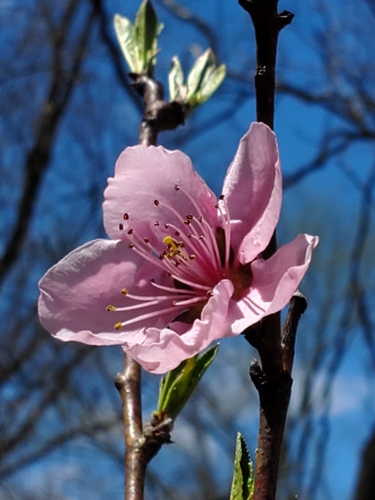
(c) Colleen, some rights reserved (CC BY-NC), uploaded by Colleen
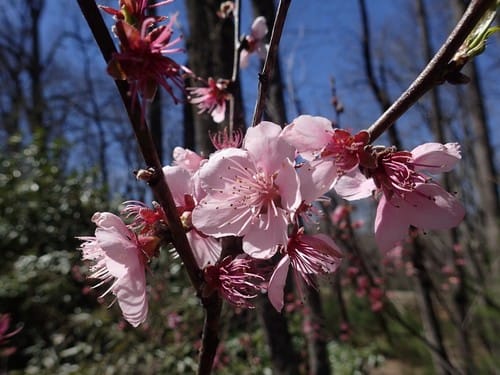
(c) Evan M. Raskin, some rights reserved (CC BY)

(c) Andrew Tree, some rights reserved (CC BY), uploaded by Andrew Tree
What to Eat
Edible parts: Fruit, Seeds, Flowers, Gum, Leaves
The fruit can be eaten raw, cooked, or dried for later use and is commonly used in ice creams, pies, and jams. Fully ripe fruits of the best cultivars are very juicy with a rich flavour. Wild trees in the Himalayas yield around 36.5kg of fruit per year. The wild fruit contains approximately 5.2% sugars, 2% protein, 1.6% ash, and 2.3mg of vitamin C per 100g, and is a good source of vitamin A — wild peaches are nutritionally richer than cultivated forms. Fruit size varies widely between cultivars and wild forms, reaching up to 7cm in diameter, and contains a single seed. Dried fruit composition per 100g: 350 calories; water 0%; protein 5.5g; fat 1.4g; carbohydrate 90g; fibre 10g; ash 4g; calcium 60mg; phosphorus 135mg; iron 6.5mg; sodium 30mg; potassium 1800mg; vitamin A 3000mg; thiamine (B1) 0.15mg; riboflavin (B2) 0.25mg; niacin 4.7mg; vitamin C 70mg. Flowers can be eaten raw in salads, used as a garnish, or brewed into a tea. Distilled flowers yield a white liquid that imparts a flavour similar to the seed. The seed is edible raw or cooked but should not be eaten if bitter, as it can contain high concentrations of hydrocyanic acid. A semi-drying oil, which may be assumed edible, is obtained from the seed, which contains up to 45% oil. A gum from the stem can be used for chewing.
Known Hazards
Where to Find It
It is a temperate plant. It is native to China. They need a specific cold requirement below 7°C to start flowers and leaves forming but a warm period for fruit ripening. Some low chill varieties are available. It likes a warm sheltered position. It will tolerate mild frosts. Mild hot summers and cool cold winters are best. In Nepal it grows between 1100-2000 m altitude. Some varieties can be grown in some highland regions in the tropics if the leaves are picked off. It needs a pH between 5.7-6.9. In Argentina it grows between 1,000-2,000 m above sea level. It suits hardiness zones 5-10. In Yunnan.
Many countries. Africa, Andorra, Argentina, Asia, Australia, Balkans, Bhutan, Brazil, Cameroon, Cape Verde, Caucasus, Central America, Central Asia, China*, Colombia, Costa Rica, Cuba, Ecuador, Ethiopia, Fiji, Georgia, Haiti, Himalayas, Hungary, India, Iran, Italy, Korea, Macedonia, Madagascar, Malaysia, Mediterranean, Mexico, Nepal, North America, Northeastern India, Pacific, Pakistan, Papua New Guinea, PNG, SE Asia, Sikkim, South Africa, Southern Africa, South America, Spain, St Helena, Swaziland, Switzerland, Tajikistan, Tanzania, Tibet, Uruguay, USA, Vietnam, West Indies, Zambia,
How to Identify
A small tree. It loses its leaves during the year. It grows 3-8 m tall. It has an open growth habit. The leaves have stalks. These are 5-10 mm long. The leaves are oblong to sword shaped. They have fine teeth along the edge. The leaf blades are 7-15 cm long and 2-3 cm wide. They are acute at the base and taper to the tip. The flowers occur singly. They appear before the leaves. The flowers are small and pink or white. The fruit varies in shape and size. It is round with a groove down the side. It is 5-8 cm across. It is yellow when ripe. It has one hard stone inside with holes in it. There are a very large number of cultivated varieties.
Nutrition Score: 27/100
| Part | Moisture | kJ | kcal | Protein | Vit A | Vit C | Iron | Zinc |
|---|---|---|---|---|---|---|---|---|
| Fruit - raw | 86.2 | 156 | 37 | 0.6 | 500 | 8 | 0.4 | 0.1 |
| Seeds | 4 | — | — | — | — | — | — | — |
How to Grow
It is easily grown from seed. It can be budded. Trees can be grown from seed but do not breed true. It is better to graft. Branches which have borne fruit should be removed to allow new fruit bearing wood to grow.
Propagation: Seed requires 2–3 months of cold stratification and is best sown in a cold frame as soon as it is ripe. Stored seed is best given 2 months of warm stratification followed by 3 months cold, then sown as early in the year as possible. Protect seed from mice. Germination can be slow, sometimes taking 18 months. Prick seedlings into individual pots when large enough to handle, overwinter in a greenhouse or cold frame, then plant out in late spring or early summer the following year. Cuttings of half-ripe wood with a heel can be taken in July/August in a frame, though success rates are very low. Softwood cuttings from vigorous plants can be taken in spring to early summer in a frame. Layering can be done in spring.
Medicinal Uses
The leaves are astringent, demulcent, diuretic, expectorant, febrifuge, laxative, parasiticide, and mildly sedative. They are used internally for gastritis, whooping cough, coughs, and bronchitis, and can help relieve vomiting and morning sickness in pregnancy — though the dosage must be monitored carefully because of the diuretic action. Dried and powdered leaves have been used to help heal sores and wounds. Leaves are harvested in June and July then dried for later use. The flowers are diuretic, sedative, and vermifuge, used internally for constipation and oedema. A gum from the stems is alterative, astringent, demulcent, and sedative. The seed is antiasthmatic, antitussive, emollient, haemolytic, laxative, and sedative, used internally for constipation in the elderly, coughs, asthma, and menstrual disorders. The bark is demulcent, diuretic, expectorant, and sedative, used internally for gastritis, whooping cough, coughs, and bronchitis. The root bark is used for dropsy and jaundice. Bark is harvested from young trees in spring and dried for later use. The seed contains laetrile, also called vitamin B17, which has been claimed to have a positive effect in cancer treatment, though current evidence is limited. The pure substance is nearly harmless, but on hydrolysis yields hydrocyanic acid, a fast-acting poison, and should be treated with caution. In small amounts this highly poisonous compound can stimulate respiration, improve digestion, and produce a sense of well-being.
Other Uses
A green dye can be obtained from the leaves (yellow according to one source), and a dark grey to green dye from the fruit. A semi-drying oil from the seed is used as a substitute for almond oil in skin creams. Bruised leaves rubbed inside a container will remove strong odours such as garlic or cloves, provided any grease has first been fully cleaned off. A gum from the stem is used as an adhesive. The species can be used in windbreaks and alley cropping systems.
Wikipedia
Source ↗A deciduous tree reaching 6 m tall and wide with fast growth. Hardy to UK zone 5, not frost tender. Flowers appear in April with seeds ripening July to August. Hermaphroditic, bee-pollinated flowers are self-fertile. Notable for attracting wildlife. Tolerates light sandy, medium loamy, and heavy clay soils with good drainage. Grows in mildly acid to mildly alkaline pH. Requires full sun and prefers moist soil.
Production
Budded trees commence fruiting in 2 or 3 years. Useful bearing takes 8-10 years. Trees often need zinc and borax sprays. Trees tend to be fairly short lived (20 years).
Other Information
It is a cultivated fruit tree.
Notes
There are about 200 Prunus species.
Names & Synonyms
Aadu, Aaru, Aaruu, Aro, Aru, Atami, Boksanamu, Chekom, Dao, Delaoji mikhri, Durazno, Glae, Ke momo, Kham-bu, Krishi, Likphi-kyanyi-ngu-sa-ngum, Limpentjisi, Melocoton, Me-man, Mfysoki, Mikriashi, Mopeta, Mpiasi, Muberegisi, Nara bogori, Paiso, Pecher, Persico duraznero, Persico, Persik, Peso, Pfirsichbaum, Phai-zong, Piichi, Shaftalu, Shanzi, Tao zi, Tao, Tao he, Thei dakte, Umpentijisi, Yetaozi
References (119)
- Ambasta, S.P. (Ed.), 2000, The Useful Plants of India. CSIR India. p 496
- Amin, M., et al, 2023, Edible wild plant species used by different linguistic groups of Kohistan Upper Khyber Pakhtunkhwa (KP), Pakistan. Journal of Ethnobiology and Ethnomedicine 19:6 p 11
- Anderson, E. F., 1993, Plants and people of the Golden Triangle. Dioscorides Press. p 219
- Awan, M. R., et al, 2011, Studies on traditional knowledge of economically important plants of Kaghan Valley, Mansehra District, Pakistan. Journal of Medicinal Plants Research Vol. 5(16), pp. 3958-3967
- Bajpai, O., et al, 2015, Tree species of the Himalayan Terai region of Uttar Pradesh, India: a checklist. Check List 11(4): 1718
- Balkrishna, A., et al, 2022, Indigenous Uses of Plants among Forest-dependent Communities of Seijosa, Arunachal Pradesh. International Journal of Economic Plants 2022, 9(1):064-080
- Bekele-Tesemma A., Birnie, A., & Tengnas, B., 1993, Useful Trees and Shrubs for Ethiopia. Regional Soil Conservation Unit. Technical Handbook No 5. p 374
- Beckstrom-Sternberg, Stephen M., and James A. Duke. "The Foodplant Database." http://probe.nalusda.gov:8300/cgi-bin/browse/foodplantdb.(ACEDB version 4.0 - data version July 1994) (As Amygdalus persica)
- Beytr. Entw. Gewachsreich 30. 1801
- Bhatia, H., et al, 2018, Traditionally used wild edible plants of district Udhampur, J&K, India. Journal of Ethnobiology and Ethnomedicine (2018) 14:73
- Bianchini, F., Corbetta, F., and Pistoia, M., 1975, Fruits of the Earth. Cassell. p 150
- Blamey, M and Grey-Wilson, C., 2005, Wild flowers of the Mediterranean. A & C Black London. p 77
- Bodkin, F., 1991, Encyclopedia Botanica. Cornstalk publishing, p 842
- Bremness, L., 1994, Herbs. Collins Eyewitness Handbooks. Harper Collins. p 76
- Brickell, C. (Ed.), 1999, The Royal Horticultural Society A-Z Encyclopedia of Garden Plants. Convent Garden Books. p 839
- Burkill, I.H., 1966, A Dictionary of the Economic Products of the Malay Peninsula. Ministry of Agriculture and Cooperatives, Kuala Lumpur, Malaysia. Vol 2 (I-Z) p 1842
- Bussman, R. W., et al, 2021, Unity in diversity—food plants and fungi of Sakartvelo (Republic of Georgia), Caucasus. Journal of Ethnobiology and Ethnomedicine (2021) 17:72 p 14
- Chakraborty, S. & Chaturbedi, H. P., 2014, Some Wild Edible Fruits of Tripura- A Survey. Indian Journal of Applied research. (4) 9
- Chandrashekara, U. M., 2009, Tree species yielding edible fruit in the coffee-based homegardens of Kerala, India: their diversity, uses and management. Food Sec. 1:361-370
- Cheifetz, A., (ed), 1999, 500 popular vegetables, herbs, fruits and nuts for Australian Gardeners. Random House p 226
- Coombes, A.J., 2000, Trees. Dorling Kindersley Handbooks. p 267
- Cruz, I. M., et al, 2015, Edible fruits and seeds in the State of Mexico. Revista Mexicana de Ciencias Agricolas. Vol. 6. Num. 2 pp 331-346
- Cull, B.W., 1995, Fruit Growing in Warm Climates. Reed. p 186
- Cundall, P., (ed.), 2004, Gardening Australia: flora: the gardener's bible. ABC Books. p 1096
- Dashorst, G.R.M., and Jessop, J.P., 1998, Plants of the Adelaide Plains & Hills. Botanic Gardens of Adelaide and State Herbarium. p 74
- Dobriyal, M. J. R. & Dobriyal, R., 2014, Non Wood Forest Produce an Option for Ethnic Food and Nutritional Security in India. Int. J. of Usuf. Mngt. 15(1):17-37
- Duarte, M. C., et al, 2022, Diversity of Useful Plants in Cabo Verde Islands: A Biogeographic and Conservation Perspective. Plants 2022, 11, 1313 p 15
- Facciola, S., 1998, Cornucopia 2: a Source Book of Edible Plants. Kampong Publications, p 193 (As Amygdalus persica)
- Farfan, B., et al, 2007, Mazahua Ethnobotany and Subsistence in the Monarch Butterfly Biosphere Reserve, Mexico. Economic Botany 61(2) 2007, pp 173-191
- Flora of Australia Volume 49, Oceanic Islands 1, Australian Government Publishing Service, Canberra. (1994) p 162
- Flowerdew, B., 2000, Complete Fruit Book. Kyle Cathie Ltd., London. p 42
- Fowler, D. G., 2007, Zambian Plants: Their Vernacular Names and Uses. Kew. p 83
- French, B.R., 1986, Food Plants of Papua New Guinea, A Compendium. Asia Pacific Science Foundation p 263
- Glowinski, L., 1999, The Complete Book of Fruit Growing in Australia. Lothian. p 54
- Gouldstone, S., 1983, Growing your own Food-bearing Plants in Australia. Macmillan p 116
- Haj, F., et al, 2012, Species Diversity and Ethno Botanical Classes of the Flora of Allai Valley District Battagram Pakistan. International Journal of Plant Research 2012, 2(4): 111-123
- Hamayun, M., Ethnobotanical Studies of some Useful Shrubs and Trees of District Buner, NWFP, Pakistan
- Hani Medicine of Xishuangbanna, 1999, p 675
- Hedrick, U.P., 1919, (Ed.), Sturtevant's edible plants of the world. p 525
- Hu, Shiu-ying, 2005, Food Plants of China. The Chinese University Press. p 446
- Hwang, H., et al, 2013, A Study on the Flora of 15 Islands in the Western Sea of Jeollanamdo Province, Korea. Journal of Asia-Pacific Biodiversity Vol. 6, No. 2 281-310
- Hwang, HS, et al, 2014, Distribution characteristics of plant in the Ungseokbong Mountain, Gyeongsangnam-do, Korea. Journal of Asia-Pacific Biodiversity. 7(2014) e164-e178
- Jabeen, A., et al, 2009, Indigenous uses of economically important flora of Margallah Hills National Park, Islamabad, Pakistan. African Journal of Biotechnology Vol. 8 (5), pp. 763-784
- Jardin, C., 1970, List of Foods Used In Africa, FAO Nutrition Information Document Series No 2.p 156
- John, L., & Stevenson, V., 1979, The Complete Book of Fruit. Angus & Robertson p 219
- Kang, Y., et al, 2012, Wild food plants and wild edible fungi in two valleys on the Qinling Mountains (Shaanxi, central China) Journal of Ethnobiology and Ethnomedicine; 9:26
- Kapelle, M., et al, 2000, Useful plants within a Campesino Community in a Costa Rican Montane Cloud Forest. Mountain Research and Development, 20(2): 162-171
- Khan, D. & Shaukat, S.S., 2006, The Fruits of Pakistan: Diversity, Distribution, Trends of Production and Use. Int. J. Biol. Biotech., 3(3):463-499
- Kiple, K.F. & Ornelas, K.C., (eds), 2000, The Cambridge World History of Food. CUP p 1830
- Krishen P., 2006, Trees of Delhi, A Field Guide. DK Books. p 111
- Kumar, A., et al, 2012, Ethnobotanical Edible Plant Biodiversity of Lepcha Tribes. Indian Forester, 138 (9):798-803
- Larios, et al., 2013, Plant management and biodiversity conservation in Náhuatl homegardens of the Tehuacán Valley, Mexico. Journal of Ethnobiology and Ethnomedicine 2013 9:74.
- Lazarides, M. & Hince, B., 1993, Handbook of Economic Plants of Australia, CSIRO. p 199
- Li, S., et al, 2020, Monpa, memory, and change: an ethnobotanical study of plant use in Mêdog County, South-east Tibet, China. Journal of Ethnobiology and Ethnomedicine. (2020) 16:5 p 22
- Liu, Yi-tao, & Long, Chun-Lin, 2002, Studies on Edible Flowers Consumed by Ethnic Groups in Yunnan. Acta Botanica Yunnanica. 24(1):41-56
- Little, E.L., 1980, National Audubon Society Field Guide to North American Trees. Alfred A. Knopf. p 505
- Long, C., 2005, Swaziland's Flora - siSwati names and Uses http://www.sntc.org.sz/flora/
- Lord, E.E., & Willis, J.H., 1999, Shrubs and Trees for Australian gardens. Lothian. p 67
- Lorenzi, H., Bacher, L., Lacerda, M. & Sartori, S., 2006, Brazilian Fruits & Cultivated Exotics. Sao Paulo, Instituto Plantarum de Estuados da Flora Ltda. p 500
- Macmillan, H.F. (Revised Barlow, H.S., et al) 1991, Tropical Planting and Gardening. Sixth edition. Malayan Nature Society. Kuala Lumpur. p 317
- Magwede, K., van Wyk, B.-E., & van Wyk, A. E., 2019, An inventory of Vhavenḓa useful plants. South African Journal of Botany 122 (2019) 57–89
- Manandhar, N.P., 2002, Plants and People of Nepal. Timber Press. Portland, Oregon. p 382
- Mashile, S. P., et al, 2019, Indigenous fruit plants species of the Mapulana of Ehlanzeni district in Mpumalanga province, South Africa. South African Journal of Botany 122 (2019) 180–183
- Masoodi, H. U. R. & Sundriyal, R. C., 2020, Richness of non-timber forest products in Himalayan communities—diversity, distribution, use pattern and conservation status. Journal of Ethnobiology and Ethnomedicine 16:56
- Mbuya, L.P., Msanga, H.P., Ruffo, C.K., Birnie, A & Tengnas, B., 1994, Useful Trees and Shrubs for Tanzania. Regional Soil Conservation Unit. Technical Handbook No 6. p 414
- Medhi, P. & Borthakur, S. K., 2012, Phytoresources from North Cachur Hills of Assam -3: Edible plants sold at Hflong market. Indian Journal of Natural Products and Resources. 3(1) pp 84-109
- Miguel, E., et al, 1989, A checklist of the cultivated plants of Cuba. Kulturpflanze 37. 1989, 211-357
- Miya, M. S. & Gautum, D., 2021, Checklist of floral species at the Institute of Forestry, Pokhara Campus, Pokhara, Nepal. Journal of Institute of Forestry, Nepal 18 (2021) 133-177
- Moerman, D. F., 2010, Native American Ethnobotany. Timber Press. p 442
- Murtem, G. & Chaudhrey, P., 2016, An ethnobotanical note on wild edible plants of Upper Eastern Himalaya, India. Brazilian Journal of Biological Sciences, 2016, v. 3, no. 5, p. 63-81
- Palmieri, V. S., et al, 2022, Wild edible plants of the Central Mountains in Argentina. Comparing subregions to understand the complexity of local botanical knowledge. Rodriguésia 73: e01092021. 2022
- Parmar, C., & Kaushel, M. K., 1982, In Wild Fruits. Kalyani Publishers, New Delhi, India. p 70
- Pascual-Mendoza, S. et al, 2021, Traditional knowledge of edible plants in an indigenous community in the Sierra Norte of Oaxaca, Mexico. Plant Biosystems - An International Journal Dealing with all Aspects of Plant Biology
- Patiri, B. & Borah, A., 2007, Wild Edible Plants of Assam. Geethaki Publishers. p 50
- Pfoze, N. L., et al, 2012, Survey and assessment of floral diversity on wild edible plants from Senapati district of Manipur, Northeast India. Journal of Biodiversity and Environmental Sciences. 1(6):50-52
- Pham-Hoang Ho, 1999, An Illustrated Flora of Vietnam. Nha Xuat Ban Tre. p 804
- Plants for a Future, The Field, Penpol, Lostwithiel, Cornwall, PL22 0NG, UK. http://www.scs.leeds.ac.uk/pfaf/
- Plants of Haiti Smithsonian Institute http://botany.si.edu/antilles/West Indies
- Polunin, O., & Stainton, A., 2006, Flowers of the Himalaya, Oxford India Paperbacks. p 114
- Porcher, V., et al, 2022, Growing up in the Betsileo landscape: Children’s wild edible plants knowledge in Madagascar. PLoS ONE 17(2): e0264147.
- Postman, J. D., et al, 2012, Recent NPGS Coordinated Expeditions in the Trans-Caucasus Region to Collect Wild Relatives of Temperate Fruit and Nut Crops. In Acta Horticulturae Number 948 p 191-198
- Rana, D., et al, 2019, Ethnobotanical knowledge among the semi-pastoral Gujjar tribe in the high altitude (Adhwari’s) of Churah subdivision, district Chamba, Western Himalaya. Journal of Ethnobiology and Ethnomedicine (2019) 15:10
- Rana, D., et al, 2020, Use of medicinal plants for treating different ailments by the indigenous people of Churah subdivision of district Chamba, Himachal Pradesh, India. Environment, Development and Sustainability. Springer.
- Recher, P, 2001, Fruit Spirit Botanical Gardens Plant Index. www.nrg.com.au/~recher/ seedlist.html p 3
- Rexhepi, B., et al, 2018, Ethnobotanical Study of Wild Edible Plants in Pelagonia Region (Southwestern Macedonia) International Journal of Advances in Science Engineering and Technology, Vol. 6 (1) p 57
- Roa, J. A. G. & Boada, D. S. G., 2018, Fundación para el Fortalecimiento de la Fruticultura y Plantas Alimenticias no Convencionales en Colombia.
- Ruiters-Welcome, A. K., 2019, Food plants of southern Africa. Ph.D. thesis. Univ. of Johannesburg p 95
- Schmidt, E., Lotter, M., & McCleland, W., 2007, Trees and shrubs of Mpumalanga and Kruger National Park. Jacana Media p 140
- Segura, S., et al, 2018, The edible fruit species in Mexico. Genet Resour Crop Evol (2018) 65:1767–1793
- Sharma, B.B., 2005, Growing fruits and vegetables. Publications Division. Ministry of Information and broadcasting. India. p 106
- Sharma, P., et al, 2013, Wild edibles of Murari Devi and surrounding areas in Mandi district of Himachal Pradesh, India. International Journal of Biodiversity and Conservation. Vol. 5(9), pp. 580-592, September 2013
- Sher, H. et al, 2011, Ethnobotanical and Economic Observations of Some Plant Resources from the Northern Parts of Pakistan. Ethnobotany research & Applications 9:027-041
- Small, E., 2009, Top 100 Food Plants. The world's most important culinary crops. NRC Research Press. p 405
- Song, M., et al, 2013, Traditional knowledge of wild edible plants in Jeju Island, Korea. Indian Journal of Traditional Knowledge. 12(2) pp 177-194
- Srivastava, R. C., 2010, Traditional knowledge of Nyishi (Daffla) tribe of Arunachal Pradesh. Indian Journal of Traditional Knowledge. 9(1):26-37
- Staples, G.W. and Herbst, D.R., 2005, A tropical Garden Flora. Bishop Museum Press, Honolulu, Hawaii. p 476
- Sundriyal, M. & Sundriyal, R. C., 2004, Structure, Phenology, Fruit Yield, and Future Prospects of some Prominent Wild Edible Plant Species of the Sikkim Himalaya, India. Journal of Ethnobiology 24(1): 113-138
- Suresh, C. P. et al, 2014, Wild Edible Tree Fruits of Sikkim Himalayas. Journal of Tree Sciences 33(1): 43-48
- Swaziland's Flora Database http://www.sntc.org.sz/flora
- Thakur, D., et al, 2017, Why they eat, what they eat: patterns of wild edible plants consumption in a tribal area of Western Himalaya. Journal of Ethnobiology and Ethnomedicine (2017) 13:70
- Thaman, R.R., 1976, The Tongan Agricultural System, University of the South Pacific, Suva, Fiji. p 420
- Torre, de la, L., et al, 2008, Enciclopedia de las Plantas Útiles del Ecuador. Herbario QCA. Pontificia Universidad Católica del Ecuador. p 534 (Also as Persica vulgaris)
- Tsering, J., et al, 2017, Ethnobotanical appraisal on wild edible plants used by the Monpa community of Arunchal Pradesh. Indian Journal of Traditional Knowledge. Vol 16(4), October 2017, pp 626-637
- Upreti, K., et al, 2010, Diversity and Distribution of Wild Edible Fruit Plants of Uttarakhand. Bioversity Potentials of the Himalaya. p 181
- USDA, ARS, National Genetic Resources Program. Germplasm Resources Information Network - (GRIN). [Online Database] National Germplasm Resources Laboratory, Beltsville, Maryland. Available: www.ars-grin.gov/cgi-bin/npgs/html/econ.pl (10 April 2000)
- Valder, P., 1999, The Garden Plants of China. Florilegium. p 110
- van Wyk, B., 2005, Food Plants of the World. An illustrated guide. Timber press. p 310
- Vivien, J., & Faure, J.J., 1996, Fruitiers Sauvages d'Afrique. Especes du Cameroun. CTA p 279
- Watkins, R., 1979, Cherry, plum, peach, apricot and almond, in Simmonds, N.W., (ed), Crop Plant Evolution. Longmans. London. p 242
- Welcome, A. K. & Van Wyk, B.-E., 2019, An inventory and analysis of the food plants of southern Africa. South African Journal of Botany 122 (2019) 136–179
- Wiersema, J. H. & Leon, B., 2013, World Economic Plants. A Standard Reference CRC Press. 2nd Ed. p 563
- Williamson, J., 2005, Useful Plants of Malawi. 3rd. Edition. Mdadzi Book Trust. p 208
- World Checklist of Useful Plant Species 2020. Royal Botanic Gardens, Kew
- www.ethnobiomed.com (As Amygdalus persica)
- www.efloras.org Flora of China Volume 9 ( As Amygdalus persica)
- Yeshi, K. et al, 2017, Taxonomical Identification of Himalayan Edible Medicinal Plants in Bhutan and the Phenolic Contents and Antioxidant Activity of Selected Plants. TBAP 7 (2) 2017 pp 89 - 106
- Zeven, A. C. & de West, J. M. J., 1982, Dictionary of cultivated plants and their regions of diversity. Wageningen. p 100, 118 (As Amygdalus)
- Zeng, Y., et al, 2014, Evaluation of antioxidant activities of extracts from 19 Chinese edible flowers. SpringerPlus 2014, 3:315
- Zhang, L., et al, 2016, Ethnobotanical study of traditional edible plants used by the Naxi people during droughts. Journal of Ethnobiology and Ethnomedicine. 12:39 ( As Amygdalus persica)
More from Rosaceae


