Prunus prostrata
Labill.
Mountain cherry, Prostrate cherry
(c) anastasia_zik, some rights reserved (CC BY-NC)
(c) rudymaex, some rights reserved (CC BY-NC)
What to Eat
Edible parts: Fruit, Seeds
The fruit can be eaten raw or cooked, though it is not very palatable. It contains a single large seed, which is also edible raw or cooked — avoid it if it tastes too bitter due to potential toxicity.
Known Hazards
Where to Find It
Temperate. It grows on rocky and exposed places in hills and mountains. It grows up to 1,500 m above sea level.
Africa, Asia, Europe, India, Mediterranean, Middle East, Morocco, North Africa, Pakistan, Spain, Syria, Turkey, Türkiye,
How to Identify
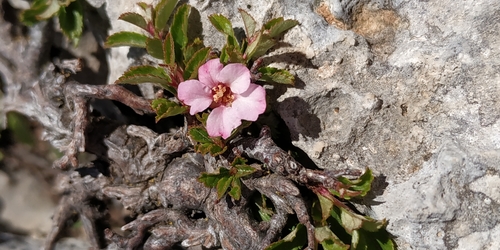
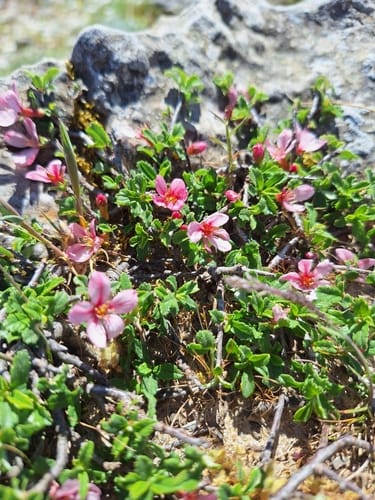
A low spreading shrub. It has many twigs. It loses its leaves during the year. It grows flat on the ground or forms small hummocks. The young twigs have fine hairs. The leaves are narrowly oblong. They have sharp teeth. They have grey hairs underneath. The flowers are bright pink and 12-15 mm across. The mostly occur singly. The fruit is a small cherry. It is red when ripe and 8 mm across.
How to Grow
Requires a well-drained moisture retentive soil. Thrives in a loamy soil, doing well on limestone. Prefers some chalk in the soil but it is apt to become chlorotic if too much is present. Requires a very sunny position. The plants dislike strong winds often dying back when growing in exposed positions. Plants normally flower profusely in British gardens. Grows well in the rock garden. Most members of this genus are shallow-rooted and will produce suckers if the roots are damaged. Plants in this genus are notably susceptible to honey fungus.
Propagation: Seed requires 2–3 months of cold stratification and is best sown in a cold frame as soon as it is ripe. Stored seed should be sown as early in the year as possible. Protect seed from mice. Germination can be slow, sometimes taking 18 months. Prick seedlings into individual pots when large enough to handle, overwinter in a greenhouse or cold frame, then plant out in late spring or early summer the following year. Cuttings of half-ripe wood with a heel can be taken in July/August in a frame. Softwood cuttings from vigorous plants can be taken in spring to early summer in a frame. Layering can be done in spring.
Medicinal Uses
No specific research has been recorded for this species, but like all members of the genus it contains amygdalin and prunasin, compounds that break down in water to release hydrocyanic acid (prussic acid). In small amounts this highly poisonous substance can stimulate respiration, aid digestion, and produce a sense of well-being.
Other Uses
A green dye can be extracted from the leaves, while the fruit yields a dark grey to green dye.
Wikipedia
Source ↗Prunus prostrata (mountain cherry, rock cherry, creeping cherry, spreading cherry or prostrate cherry) is a hardy alpine shrub found naturally above about 2000 m. up to as high as 4000 m. in Spain, France, Algeria, Morocco, Tunisia, Albania, Croatia, Greece, North Macedonia, Sardinia, Turkey, and Syria. It grows as tall as 1 m., more typically 0.15-0.30 m., sometimes in the crevices of vertical surfaces. The branches tend to follow the surface at any angle. Flowering patches of the plant on the rocky slopes, sometimes still snow-clad, are striking to climbers. The bark is reddish brown. The leaves are ovate, with serrate margins, tomentose with white down on undersurface, glabrous above. The petioles lack glands. The flowers are an unusual light rose color, coming out in April–May, solitary or in pairs, nearly sessile, with a tubular calyx. There are 22-24 stamens. The fruit is red, ovate, with thin flesh, ripening in July.
Notes
There are about 200 Prunus species.
Names & Synonyms
Aberqouk immissawn, Belaluk, Fikt, Gilgit, Horisme, Kalam, Swat
References (8)
- Ambasta, S.P. (Ed.), 2000, The Useful Plants of India. CSIR India. p 496
- Blamey, M and Grey-Wilson, C., 2005, Wild flowers of the Mediterranean. A & C Black London. p 77
- Hedrick, U.P., 1919, (Ed.), Sturtevant's edible plants of the world. p 528
- Icon. pl. Syr. 1:15, t. 6. 1791
- Nassif, F., & Tanji, A., 2013, Gathered food plants in Morocco: The long forgotten species in Ethnobotanical Research. Life Science Leaflets 3:17-54
- Plants for a Future, The Field, Penpol, Lostwithiel, Cornwall, PL22 0NG, UK. http://www.scs.leeds.ac.uk/pfaf/
- Singh, H.B., Arora R.K.,1978, Wild edible Plants of India. Indian Council of Agricultural Research, New Delhi. p 69
- Yesil, Y., et al, 2019, Wild edible plants in Yeşilli (Mardin-Turkey), a multicultural area. Journal of Ethnobiology and Ethnomedicine (2019) 15:52 (As Cerasus prostrata)
More from Rosaceae


