Prunus sibirica
L.
Siberian apricot, Guilesu, Hegerin guilesu

(c) Daba, some rights reserved (CC BY-NC), uploaded by Daba
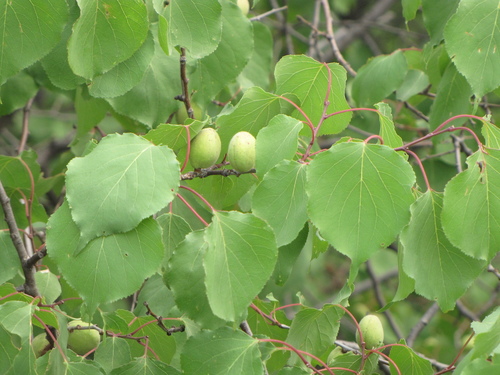
(c) Jens-Christian Svenning, some rights reserved (CC BY), uploaded by Jens-Christian Svenning
What to Eat
Edible parts: Fruit, Seeds - oil, Stems - tea
The fruit measures about 25mm x 25mm, contains one large seed, and is sour and barely palatable, though it is occasionally eaten raw or cooked. The seed can be eaten raw or cooked and, despite its bitter taste, is normally used as an almond flavouring. An edible oil extracted from the seed is also used as an almond flavouring and resembles olive oil in character. Do not eat the seed if it is excessively bitter.
Known Hazards
Where to Find It
It is a temperate plant. It grows in forests and mountainous areas between 400-2,500 m above sea level in north central China.
Asia, China, Korea, Mongolia, Russia, Siberia,
How to Identify
A shrub or small tree. It grows 2-5 m high. The bark is dark grey. The branches are spreading. They have a few hairs when young. The leaf blade is oval and 5-10 cm long by 4-7 cm wide. The flowers occur singly. The fruit are yellow to orange and 1.5-2.5 cm long and wide.
How to Grow
Thrives in a well-drained moisture-retentive loamy soil, growing well on limestone. Prefers some lime in the soil but is likely to become chlorotic if too much lime is present. Succeeds in sun or partial shade though it fruits better in a sunny position. This species is reputed to be hardy to about -50°c and as such is of potential use for conferring greater cold tolerance in breeding programmes with the closely related apricot, P. armeniaca. Most members of this genus are shallow-rooted and will produce suckers if the roots are damaged. Plants in this genus are notably susceptible to honey fungus.
Propagation: Seed requires 2–3 months of cold stratification and is best sown in a cold frame as soon as it is ripe. Stored seed should be sown in a cold frame as early in the year as possible, with protection from mice. Germination can be slow, sometimes taking up to 18 months. Prick out seedlings into individual pots when large enough to handle, overwinter in a greenhouse or cold frame, and plant out in late spring or early summer the following year. Cuttings of half-ripe wood with a heel can be taken in July/August in a frame. Softwood cuttings from vigorous plants can be taken in spring to early summer in a frame. Layering can be done in spring.
Medicinal Uses
The seed is analgesic, antiasthmatic, antiseptic, antitussive, and emollient, and is used in the treatment of coughs, asthma, acute or chronic bronchitis, and constipation. The seed contains amygdalin and prunasin, which break down in water to release hydrocyanic acid (prussic acid or cyanide). In small amounts, this highly toxic compound can stimulate respiration, aid digestion, and produce a sense of well-being.
Other Uses
The plant is a potential rootstock for apricots. A green dye can be extracted from the leaves, and the fruit yields a dark grey to green dye. An oil is obtained from the seed.
Wikipedia
Source ↗Prunus sibirica, commonly known as Siberian apricot, is a species of shrub or small tree native to northern China, Korea, Mongolia, and eastern Siberia. It is classified in the rose family, Rosaceae, and is one of several species whose fruit are called apricot, although this species is rarely cultivated for its fruit. The species was named by Carl Linnaeus in 1753.
Notes
There are about 200 Prunus species.
Names & Synonyms
Heger-e in guilesu, Shan xing
References (7)
- Flora of China Vol. 9, p 398 (As Armeniaca sibirica)
- Hedrick, U.P., 1919, (Ed.), Sturtevant's edible plants of the world. p 528
- https://en.wikipedia.org/wiki/List of wild edible plants in Mongolian cuisine (As Prunus armeniaca var. sibirica)
- Khasbagan, Hu-Yin Huai, and Sheng-Ji pei, 2000, Wild Plants in the Diet of Athorchin Mongol Herdsmen in Inner Mongolia. Economic Botany 54(4): 528-536
- Plants for a Future, The Field, Penpol, Lostwithiel, Cornwall, PL22 0NG, UK. http://www.scs.leeds.ac.uk/pfaf/
- Sachula, et al, 2020, Wild edible plants collected and consumed by the locals in Daqinggou, Inner Mongolia, China. Journal of Ethnobiology and Ethnomedicine (2020) 16:60 (As Armeniaca sibirica)
- Sp. pl. 1:474. 1753
More from Rosaceae


