Prunus spinosa
(L.) Walt.
Plum, Sloe, Blackthorn

(c) Guillaume Fried, some rights reserved (CC BY-NC), uploaded by Guillaume Fried
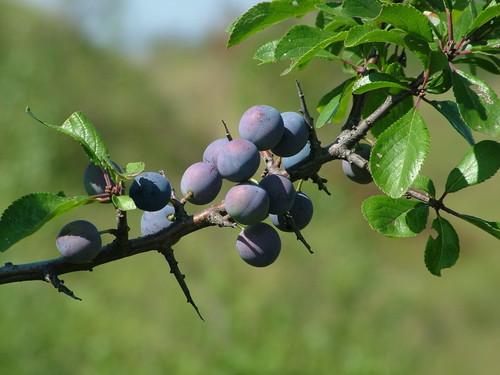
(c) Marek Michalski, some rights reserved (CC BY-NC), uploaded by Marek Michalski

(c) Pavel Kacl, some rights reserved (CC BY), uploaded by Pavel Kacl
What to Eat
Edible parts: Fruit, Seeds
The fruit can be eaten raw or cooked, though it is exceedingly astringent and is more commonly cooked. After frosting, it loses some astringency and some people find it palatable raw — fruits eaten in December have been described as fairly pleasant. It is most often made into jellies, syrups, conserves, or used to flavour sloe gin and other liqueurs. In France, the unripe fruit is pickled like an olive. The fruit is about 15mm in diameter and contains one large seed. The seed can also be eaten raw or cooked, but should be avoided if it tastes too bitter. The leaves make a reasonable tea substitute, and dried fruits can be added to herbal teas. The flowers are edible and suitable for crystallising or sugaring.
Known Hazards
Where to Find It
It is a temperate plant. It grows on the edges of scrub woodland and in hedges. It suits hardiness zones 4-10. Tasmania Herbarium.
Africa, Albania, Andorra, Armenia, Asia, Australia, Austria, Azerbaijan, Balkans, Belarus, Belgium, Bosnia, Britain, Bulgaria, Caucasus, Central Asia, China, Croatia, Czech Republic, Denmark, Estonia, Europe, Finland, France, Georgia, Germany, Greece, Hungary, Iran, Ireland, Italy, Kazakhstan, Latvia, Lithuania, Luxembourg, Macedonia, Mediterranean, Middle East, Moldova, Netherlands, North Africa, North America, Norway, Poland, Portugal, Romania, Russia, San Marino, Scandinavia, Sicily, Slovakia, Slovenia, Spain, Sweden, Switzerland, Tasmania, Tunisia, Turkey, Türkiye, Ukraine, USA, Yugoslavia,
How to Identify
A large shrub. It can grow to a small tree. It is often only 4 m high. It develops suckers. It loses its leaves during the winter. It is thorny. The leaves are small and alternate. They are dull above and hairy underneath. Flowers have 5 petals and red tipped anthers. The flowers are white. They appear before the leaves. The fruit are blue-black. They are berry sized.
Nutrition Score: 0/100
| Part | Moisture | kJ | kcal | Protein | Vit A | Vit C | Iron | Zinc |
|---|---|---|---|---|---|---|---|---|
| Fruit | 196 | 47 | 0.8 | — | — | — | — | — |
How to Grow
Requires a well-drained moisture retentive soil. Succeeds in all soils except very acid peats. Succeeds in light shade but fruits better in a sunny position. Thrives in a loamy soil, doing well on limestone. Prefers some chalk in the soil but apt to become chlorotic if too much is present. Thrives on chalk according to another report. Plants are very resistant to maritime exposure. An important food plant for the caterpillars of several species of butterfly, especially the larvae of the brown and black hairstreak butterflies. A good bee plant. Plants are shallow-rooted and of a suckering habit, they can form dense impenetrable thickets which are ideal for nesting birds, especially nightingales. Flowers are often damaged by late frosts. Plants regenerate quickly after cutting or after fast moving forest fires, producing suckers from below ground level. This species is notably resistant to honey fungus. In garden design, as well as the above-ground architecture of a plant, root structure considerations help in choosing plants that work together for their optimal soil requirements including nutrients and water. Harvesting typically occurs in late summer to early autumn, with specific timing varying by species. For instance, plums and peaches are usually harvested from July to September (Northern Hemisphere), while almonds are harvested in August to September (Northern Hemisphere). Prunus species usually flower in early spring, often between March and April (Northern Hemisphere), depending on the species and local climate. Growth rates vary among species, but generally, Prunus trees can grow moderately fast, often reaching full height in 3 to 5 years. However, they may take several years to bear fruit, depending on the species and growing conditions. Some Prunus species (like many plums and almonds) are self-fertile, while others (like sweet cherries and certain apricots) require cross-pollination with another compatible variety for optimal fruit set.
Propagation: Seed requires 2–3 months of cold stratification and is best sown in a cold frame as soon as it is ripe. Stored seed should be sown in a cold frame as early in the year as possible and protected from mice. Germination can be slow, sometimes taking 18 months. Prick out seedlings into individual pots when large enough to handle, overwinter them in a greenhouse or cold frame, then plant out in late spring or early summer the following year. Cuttings of half-ripe wood with a heel can be taken in July/August in a frame. Softwood cuttings from vigorous plants can be taken in spring to early summer in a frame. Layering can be done in spring. Suckers can be divided and replanted directly into permanent positions during the dormant season.
Medicinal Uses
The flowers, bark, leaves, and fruits are aperient, astringent, depurative, diaphoretic, diuretic, febrifuge, laxative, and stomachic. An infusion of the flowers is used to treat diarrhoea (especially in children), bladder and kidney disorders, and stomach weakness. Like all members of the genus, this species contains amygdalin and prunasin, which break down in water to release hydrocyanic acid (prussic acid). In small amounts, this compound stimulates respiration, aids digestion, and produces a sense of well-being. The German Commission E Monographs approve Prunus spinosa for treating inflammation of the mouth and pharynx.
Other Uses
The bark is a good source of tannin and can be used to make ink. The juice of unripe fruits leaves an almost indelible mark on laundry. Pulped ripe fruit is used cosmetically in astringent face masks. Leaves yield a green dye; the fruit produces a dark grey to green dye; and bark boiled in an alkali gives a yellow dye. The plant is highly resistant to maritime exposure and suckers freely, making it well suited for hedging in exposed coastal positions. The hedge is stock-proof when well maintained, though it is fairly bare in winter and not the best shelter at that time of year. Its suckering habit makes it a natural pioneer species that invades cultivated ground and encourages woodland regeneration. The wood is very hard and used for turnery and rake teeth; suitable branches are prized for walking sticks due to their twisted, characterful shapes. Prunus spinosa also works well in windbreaks and alley cropping systems, and supports pollinators and wildlife through its nectar- and pollen-rich flowers and fruit.
Wikipedia
Source ↗Prunus spinosa, called blackthorn or sloe, is a species of flowering plant in the rose family, Rosaceae. It is native to Europe and West Asia, and has been naturalized in parts of North America. The fruits are used to make sloe gin in Great Britain and patxaran in Basque Country. The wood is used to make walking sticks, including the Irish shillelagh.
Other Information
The fruit are especially eaten by children. They are supplied to restaurants. They are used to make jellies. They are sold in local markets. It is cultivated.
Notes
There are about 200 Prunus species.
Names & Synonyms
Abrunheiro, Andrina, Belosai, Berqouq el ouach, Cakal erigi, Ci li, črni trn, Ciruelicas de gato, Crn trn, Deli erik, Domuz erigi, Endrino, Epine moire, Erik, Hei ci li, K'vranchkhi, Marnkheni, Palline bocche, Porumbar, Prignole, Prugnolo, Prunellier, Prunello, Schlehdorn, Schwarzdorn, Shalor, Slapetorn, Strozzapreti, Teren, Tranka, Trnina, Trninka, Trnky, Tsyoren, Uva booca
References (87)
- Abbet, C., et al, 2014, Ethnobotanical survey on wild alpine food plants in Lower and Central Valais (Switzerland). Journal of Ethnopharmacology 151 (2014) 624–634
- Aipeisova S.A., et al, 2019, Wild useful herbs of Aktobe Region (Western Kazakhstan). Ukrainian Journal of Ecology, 9(3), 329-331
- Blamey, M and Grey-Wilson, C., 2005, Wild flowers of the Mediterranean. A & C Black London. p 77
- Bodkin, F., 1991, Encyclopedia Botanica. Cornstalk publishing, p 842
- BOUQUET,
- Bremness, L., 1994, Herbs. Collins Eyewitness Handbooks. Harper Collins. p 77
- Brickell, C. (Ed.), 1999, The Royal Horticultural Society A-Z Encyclopedia of Garden Plants. Convent Garden Books. p 839
- Bussman, R. W., et al, 2016, A comparative ethnobotany of Khevsureti, Samtskhe-Javakheti, Tusheti, Svaneti, and Racha-Lechkhumi, Republic of Georgia (Sakartvelo), Caucasus. Journal of Ethnobiology and Ethnomedicine.
- Bussman, R. W. et al, 2017, Ethnobotany of Samtskhe-Javakheti, Sakartvelo (Republic of Georgia), Caucasus. Indian Journal of Traditional Knowledge Vol. 16(1) pp 7-24
- Bussman, R. W., et al, 2021, Unity in diversity—food plants and fungi of Sakartvelo (Republic of Georgia), Caucasus. Journal of Ethnobiology and Ethnomedicine (2021) 17:72 p 14
- Cerne, M., 1992, Wild Plants from Slovenia used as Vegetables. Acta Horticulturae 318
- Ciocarlan, N. & Ghendov, V., 2015, Ethnobotanical and Ecological Studies of Wild Edible Plants from Bugeac Steppe, Republic of Moldova. Journal of EcoAgriTourism. Cailta terra Vol. 11(2):
- Cundall, P., (ed.), 2004, Gardening Australia: flora: the gardener's bible. ABC Books. p 1099
- Denes, A., et al, 2012, Wild plants used for food by Hungarian ethnic groups living in the Carpathian Basin. Acta Societatis Botanicorum Poloniae 81 (4): 381-396
- Dolina, K. & Luczaj, L., 2014, Wild food plants used on the Dubrovnik coast (south-eastern Croatia) Acta Soc Bot Pol 83(3):175–181
- Dzhangaliev, A. D., et al, 2003, The Wild Fruit and Nut Plants of Kazakhstan, Horticultural Reviews, Vol. 29. pp 305-371
- Egea, I., et al., 2010, Six Edible Wild fruits as potential Antioxidant Additives or Nutritional Supplements. Plant Foods for Human Nutrition. 65:121-129
- Ertug, F, Yenen Bitkiler. Resimli Türkiye Florası -I- Flora of Turkey - Ethnobotany supplement
- Esperanca, M. J., 1988. Surviving in the wild. A glance at the wild plants and their uses. Vol. 2. p 225
- Facciola, S., 1998, Cornucopia 2: a Source Book of Edible Plants. Kampong Publications, p 204
- Flora of China. Vol. 9, p 402
- Flowerdew, B., 2000, Complete Fruit Book. Kyle Cathie Ltd., London. p 34, 184
- Girard, N. J., 2020, Sustainable Foraging of Wild Edible Plants in Norway. A Biocultural Approach. M. Sc. thesis Norwegian University. p 134
- Girones-Vilaplana, A., et al, 2012, New Beverages of Lemon Juice Enriched with the Exotic Berries Maqui, Acai, and Blackthorn: Bioactive Components and in Vitro Biological Properties. Journal of Agricultural and Food Chemistry. 60:6571-6580
- Glowinski, L., 1999, The Complete Book of Fruit Growing in Australia. Lothian. p 58
- Gonzalez, J. A., et al, 2011, The consumption of wild and semi-domesticated edible plants in the Arribes del Duero (Salamanca-Zamora, Spain): an ananalysis of traditional knowledge. Genetic Resources and Crop Evolution 58:991-1006
- Gunes, S. et al, 2018, Survey of wild food plants for human consumption in Karaisali (Adana-Turkey). Indian Journal of Traditional Knowledge. Vol. 17(2), April 2018, pp 290-298
- Hancer, C. K., et al, 2020, Traditional Knowledge of Wild Edible Plants of Biga (Çanakkale), Turkey. Acta Societatis Botanicorum Poloniae / 2020 / Volume 89 / Issue 1 / Article 8914
- Harris, E & J., 1983, Field Guide to the Trees and Shrubs of Britain. Reader's Digest. p 57
- Hedrick, U.P., 1919, (Ed.), Sturtevant's edible plants of the world. p 529
- Heywood, V. H. & Zohary, D.,1995, A Catalogue of the Wild Relatives of Cultivated Plants Native to Europe. Flora Mediterranea 5 - 1995, p 394
- Hibbert, M., 2002, The Aussie Plant Finder 2002, Florilegium. p 242
- http://en.hortipedia.com
- http://nordicfood lab/org/blog/2102/9/wild-edible-plants-an-overview
- http://www.botanic-gardens-ljubljana.com/en/plants
- Irving, M., 2009, The Forager Handbook, A Guide to the Edible Plants of Britain. Ebury Press p 274
- Kargioglu, M. et al, 2010, Traditional Uses of Wild Plants in the Middle Aegean Region. Human Ecology 38:429-450
- Kermath, B. M., et al, 2014, Food Plants in the Americas: A survey of the domesticated, cultivated and wild plants used for Human food in North, Central and South America and the Caribbean. On line draft. p 715
- Kiple, K.F. & Ornelas, K.C., (eds), 2000, The Cambridge World History of Food. CUP p 1853
- Kremer, B.P., 1995, Shrubs in the Wild and in Gardens. Barrons. p 151
- Lentini, F. and Venza, F., 2007, Wild food plants of popular use in Sicily. J Ethnobiol Ethnomedicine. 3: 15
- Lord, E.E., & Willis, J.H., 1999, Shrubs and Trees for Australian gardens. Lothian. p 68
- Luczaj, L., 2012, Ethnobotanical review of wild edible plants of Slovakia. Acta Societatis Botanicorum Poloniae 81(4):245-255
- Luczaj, L. et al, 2012, Wild food plant use in 21st century Europe: the disappearance of old traditions and the search for new cuisines involving wild edibles. Acta Soc Bot Pol 81(4):359–370
- Łukasz Łuczaj and Wojciech M Szymański, 2007, Wild vascular plants gathered for consumption in the Polish countryside: a review. J Ethnobiol Ethnomedicine. 3: 17
- Luczaj, L. et al, 2013, Wild food plants used in the villages of the Lake Vrana Nature Park (northern Dalmatia, Croatia). Acta Societatis Botanicorum Poloniae, 82(4): 275-281
- Luczaj, L. et al, 2014, Wild Food Plants of Dalmatia (Croatia). in A. Pieroni, C. L. Quave (eds.), Ethnobotany and Biocultural Diversities in the Balkans, p 138
- Luczaj, L., et al, 2015, Wild food plants and fungi used by Ukrainians in the western part of the Maramureş region in Romania. Acta Soc Bot Pol 84(3):339–346
- Mabey, R., 1973, Food for Free. A Guide to the edible wild plants of Britain, Collins. p 169
- Maghradze, D. et al, 2012, Minor and Underutilized Fruits in Georgia and Their Wild Relatives. In Acta Horticulturae Number 948 p 41-47
- Michael, P., 2007, Edible Wild Plants and Herbs. Grub Street. London. p 28
- Miskoska-Milevska, E. et al, 2020, Traditional uses of wild edible plants in the Republic of North Macedonia. PHYTOLOGIA BALCANICA 26(1): 155–162, Sofia, 2020 p 159
- Morton,
- Nanagulyan, S., et al, 2020, Wild plants and fungi sold in the markets of Yerevan (Armenia). Journal of Ethnobiology and Ethnomedicine 16:26
- Nedelcheva A., 2013, An ethnobotanical study of wild edible plants in Bulgaria. EurAsian Journal of BioSciences 7, 77-94
- Özdemir, E. and Kültür, S., 2017, Wild Edible Plants of Savaştepe District (Balıkesir, Turkey), Marmara Pharm J 21/3: 578-589
- Pardo-de-Santayana, M., et al, 2005, The gathering and consumption of wild edible plants in the Campoo (Cantabria, Spain). International Journal of Food Sciences and Nutrition. 56(7): 529-542
- Pardo-de-Santayana, M., et al, 2007, Traditional knowledge of wild edible plants used in the northwest of the Iberian Peninsula (Spain and Portugal): a comparative study. Journal of Ethnobiology and Ethnomedicine 2007, 3:27
- Pasta, S., et al, 2020, An Updated Checklist of the Sicilian Native Edible Plants: Preserving the Traditional Ecological Knowledge of Century-Old Agro-Pastoral Landscapes. Frontiers in Plant Science. Volume 11|Article 388
- Pieroni, A., 1999, Gathered wild food plants in the Upper Valley of the Serchio River (Garfagnana), Central Italy. Economic Botany 53(3) pp 327-341
- Pieroni A, Nebel S, Santoro RF, Heinrich M., 2005, Food for two seasons: culinary uses of non-cultivated local vegetables and mushrooms in a south Italian village. Int J Food Sci Nutr. 56(4):245-72
- Pieroni, A., et al, 2020, Wild food plants traditionally gathered in central Armenia: archaic ingredients or future sustainable foods? Environment, Development and Sustainability. Springer p 10
- Plants for a Future, The Field, Penpol, Lostwithiel, Cornwall, PL22 0NG, UK. http://www.scs.leeds.ac.uk/pfaf/
- Postman, J. D., et al, 2012, Recent NPGS Coordinated Expeditions in the Trans-Caucasus Region to Collect Wild Relatives of Temperate Fruit and Nut Crops. In Acta Horticulturae Number 948 p 191-198
- Redzic, S. J., 2006, Wild Edible Plants and their Traditional Use in the Human Nutrition in Bosnia-Herzegovina. Ecology of Food and Nutrition, 45:189-232
- Redzic, S., 2010, Use of Wild and Semi-Wild Edible Plants in Nutrition and Survival of People in 1430 Days of Siege of Sarajevo during the War in Bosnia and Herzegovina (1992–1995). Coll. Antropol 34 (2010) 2:551-570
- Rigat, M et al, 2009, Ethnobotany of Food Plants in the High River Ter Valley (Pyrenees, catalonia, Iberian Peninsula): Non-Crop Food Vascular Plants and Crop Food Plants with medicinal Properties. Ecology of Food and Nutrition, 48:303-327
- Rivera, C., et al, 2005, The Ethnobotanical Study of Local Mediterranean Food Plants as Medicinal Resources in Southern Spain. Journal of Physiologyand Pharmacology. 56, Suppl. 1, 97-114
- Ruiz-Rodriguez, B. M., et al, 2014, Wild blackthorn (Prunus spinosa L.) and hawthorn (Crataegus monogyna Jacq.) fruits as valuable sources of antioxidants. Fruits, Vol. 69, p.61-73
- Ryan, S., 2008, Dicksonia. Rare Plants Manual. Hyland House. p 49
- Sansanelli, S., et al, 2014, Wild food plants traditionall consumed in the area of Bologna (Emilia Romagna region, Italy). Journal of Ethnobiology and Ethnomedicine 10:69
- Sansanelli, S., et al, 2017, Ethnobotanical survey of wild food plants traditionally collected and consumed in the Middle Agri Valley (Basilicata region, southern Italy). Journal of Ethnobiology and Ethnomedicine (2017) 13:50
- Sfikas, G., 1984, Trees and shrubs of Greece. Efstathiadis Group. Athens. p 70
- Signorini, M. A., et al, 2009, Plants and traditional knowledge: An ethnobotanical investigation on Monte Ortobene (Nuoro, Sardinia). Journal or Ethnobiology and Ethnomedicine, 5:6
- Simkova, K. et al, 2014, Ethnobotanical review of wild edible plants used in the Czech Republic. Journal of Applied Botany and Food Quality 88, 49-67
- Sp. pl. 1:475. 1753
- Stryamets, N., et al, 2015, From economic survival to recreation: contemporary uses of wild food and medicine in rural Sweden, Ukraine and NW Russia. Journal of Ethnobiology and Ethnomedicine 11:53
- Svanberg, I., 2012, The use of wild plants as food in pre-industrial Sweden. Acta Societatis Botanicorum Poloniae 81(4): 317-327
- Tanaka,
- Tasmanian Herbarium Vascular Plants list p 51
- Tardio, J., et al, Ethnobotanical review of wild edible plants in Spain. Botanical J. Linnean Soc. 152 (2006), 27-71
- van Wyk, B., 2005, Food Plants of the World. An illustrated guide. Timber press. p 311
- Vari, A., et al, 2020, Berries, greens, and medicinal herbs—mapping and assessing wild plants as an ecosystem service in Transylvania (Romania). Journal of Ethnobiology and Ethnomedicine (2020) 16:13
- Wiersema, J. H. & Leon, B., 2013, World Economic Plants. A Standard Reference CRC Press. 2nd Ed. p 565
- World Checklist of Useful Plant Species 2020. Royal Botanic Gardens, Kew
- www.efloras.org Flora of China Volume 9
- Zeven, A. C. & de West, J. M. J., 1982, Dictionary of cultivated plants and their regions of diversity. Wageningen. p 101
More from Rosaceae


