Pseudocydonia sinensis
(Thouin) C. K. Schneid.
Chinese quince, Oriental quince, Karin

(c) autan, some rights reserved (CC BY-NC-ND)
(c) guanhong, some rights reserved (CC BY-NC)
(c) guanhong, some rights reserved (CC BY-NC)
What to Eat
Edible parts: Fruit
The fruit can be eaten as a sweetmeat, candied, preserved in syrup, or made into a liqueur. The juice can be mixed with ginger and made into a beverage. The fruit is very large, growing up to 18cm long.
Where to Find It
It is a temperate plant. It does best in full sun. It can grow in light shade. It suits continental climates with long hot summers. It will grow in fairly poor soils. It can grow in a range of pH values from acid to alkaline. The soil should be moist but not water-logged. It suits hardiness zones 5-10. Arboretum Tasmania.
Asia, Australia, Britain, China*, Europe, Korea, Mexico, Tasmania,
How to Identify
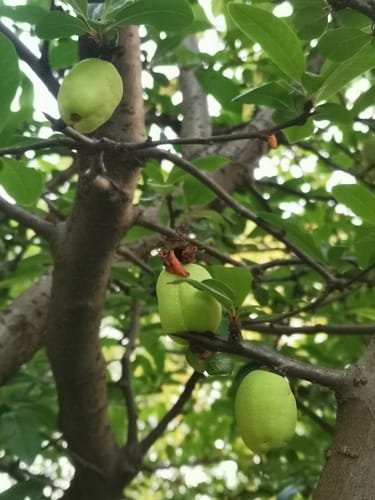
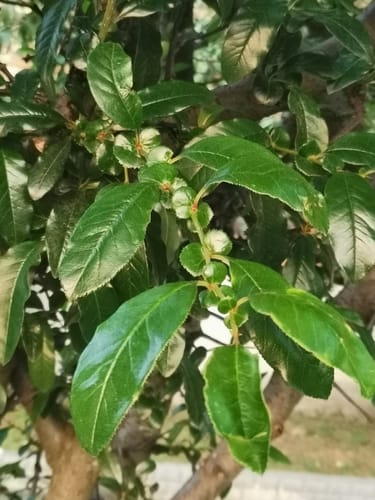
A small tree. It grows 6-10 m high and spreads 3 m wide. It can lose its leaves during the year. The bark is dappled. The leaves are smaller than common quince. The leaves are brownish and woolly underneath. They become coloured in autumn. The flowers are reddish-pink. The fruit is oval and 18 cm long. It has a sweet smell.
Nutrition Score: 17/100
| Part | Moisture | kJ | kcal | Protein | Vit A | Vit C | Iron | Zinc |
|---|---|---|---|---|---|---|---|---|
| Fruit | 80.7 | 285 | 68 | 0.4 | — | — | 0.2 | 0.1 |
How to Grow
Plants can be grown from seed or cuttings. They are also grafted.
Propagation: Seed is best sown in a cold frame as soon as it is ripe in autumn. Stored seed requires 3 months of cold stratification and should be sown as early in the year as possible. Prick out seedlings into individual pots when large enough to handle and grow on in a greenhouse for at least the first winter. Plant out into permanent positions in late spring or early summer, after the last expected frosts. Layering is also an option.
Medicinal Uses
The fruit is antitussive and contains several medically active constituents including organic acids and the flavonoids rutin and quercetin. It is used in Korea to treat asthma, the common cold, sore throats, mastitis, and tuberculosis.
Other Uses
The fruits are highly aromatic and can be placed in a bowl to release a pleasant spicy scent into a room. The wood is hard and dark red, and is used for making picture frames.
Wikipedia
Source ↗A deciduous tree reaching 6 m tall and wide, growing slowly. Hardy to UK zone 6. Flowers April to May; seeds mature in October. Hermaphrodite flowers are insect-pollinated. Suits light sandy, medium loamy, and heavy clay soils. Tolerates mildly acidic, neutral, and basic soil pH. Requires full sun and prefers moist soil.
Production
Because they are self fertile, one tree can produce fruit. The fruit can weigh 1- 4.5 kg.
Other Information
It is a cultivated food plant.
Names & Synonyms
Membrillo chino
References (13)
- Bodkin, F., 1991, Encyclopedia Botanica. Cornstalk publishing, p 244 (As Chaenomeles sinensis)
- Cundall, P., (ed.), 2004, Gardening Australia: flora: the gardener's bible. ABC Books. p 451 (As Cydonia sinensis)
- Facciola, S., 1998, Cornucopia 2: a Source Book of Edible Plants. Kampong Publications, p 205
- Glowinski, L., 1999, The Complete Book of Fruit Growing in Australia. Lothian. p 43 (As Cydonia sinensis)
- John, L., & Stevenson, V., 1979, The Complete Book of Fruit. Angus & Robertson p 163 (As Chaenomeles sinensis)
- Levy-Yamamori, R., & Taaffe, G., 2004, Garden Plants of Japan. Timber Press. p 201
- Lord, E.E., & Willis, J.H., 1999, Shrubs and Trees for Australian gardens. Lothian. p 214 (As Chaenomeles sinensis)
- Lyle, S., 2006, Discovering fruit and nuts. Land Links. p 173
- Plants for a Future database, The Field, Penpol, Lostwithiel, Cornwall, PL22 0NG, UK. http://www.scs.leeds.ac.uk/pfaf/
- Repert. Spec. Nov. Regni Veg. 3:181. 1906
- Ryan, S., 2008, Dicksonia. Rare Plants Manual. Hyland House. p 20 (As Cydonia sinensis)
- Segura, S., et al, 2018, The edible fruit species in Mexico. Genet Resour Crop Evol (2018) 65:1767–1793
- Valder, P., 1999, The Garden Plants of China. Florilegium. p 159
More from Rosaceae


