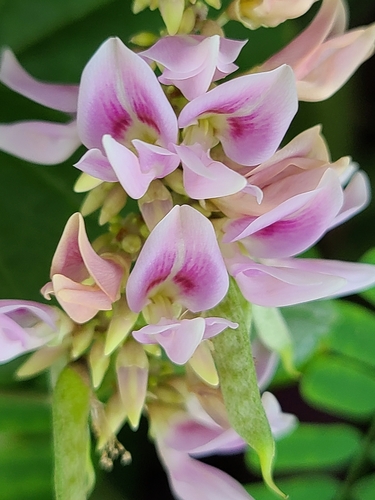
Acacia latescens
Benth.
Ball wattle

(c) Nick Lambert, some rights reserved (CC BY-NC-SA), uploaded by Nick Lambert
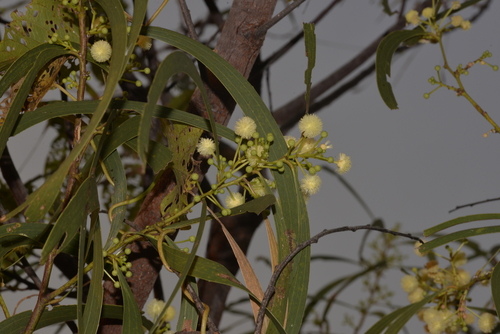
(c) Nick Lambert, some rights reserved (CC BY-NC-SA), uploaded by Nick Lambert
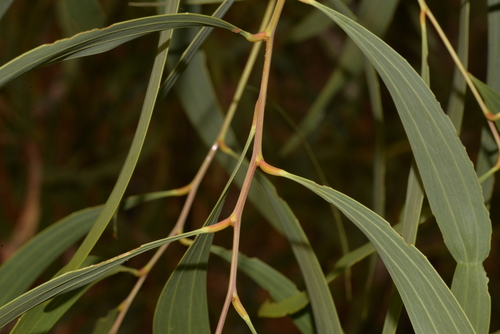
(c) Nick Lambert, some rights reserved (CC BY-NC-SA), uploaded by Nick Lambert
What to Eat
Edible parts: Gum, Sap
The gum and sap are eaten.
Where to Find It
It is a tropical plant and grows in the northern tips of Australia. It often grows under larger trees. It needs well drained soils.
Australia*,
How to Identify
A shrub or small tree. It grows 5 m tall. There are prickles along the stem. The leaves are twice divided and there are 8-18 pairs of pinnae. There are up to 50 pairs of pinnules on each pinnae. The flowers are yellow. They are in large clusters at the ends of branches. The pods are flattened.
How to Grow
It is grown from seed.
Wikipedia
Source ↗Acacia latescens, also known as Ball wattle, is a tree in the genus Acacia (in the family Fabaceae and the subgenus Plurinerves). It is native to the Northern Territory where it is common in the Top End.
Production
Flowers are produced in April to June and pods in July to September.
Notes
There are about 1,350 Acacia species. Over 1,000 occur in Australia. Also as Mimosaceae.
References (7)
- Brock, J., 1993, Native Plants of Northern Australia, Reed. p 64
- Cherikoff V. & Isaacs, J., The Bush Food Handbook. How to gather, grow, process and cook Australian Wild Foods. Ti Tree Press, Australia p 198
- Dunlop, C.R., Leach, G.J. & Cowie, I.D., 1995, Flora of the Darwin Region. Vol 2. Northern Territory Botanical Bulletin No 20. p 13
- Elliot, W.R., & Jones, D.L., 1982, Encyclopedia of Australian Plants suitable for cultivation. Vol 2. Lothian. p 73
- Lazarides, M. & Hince, B., 1993, Handbook of Economic Plants of Australia, CSIRO. p 4
- Levitt, D., 1981, Plants and people. Aboriginal uses of plants on Groote Eylandt. Australian Institute of Aboriginal Studies, Canberra. p 102
- London J. Bot. 1:380. 1842