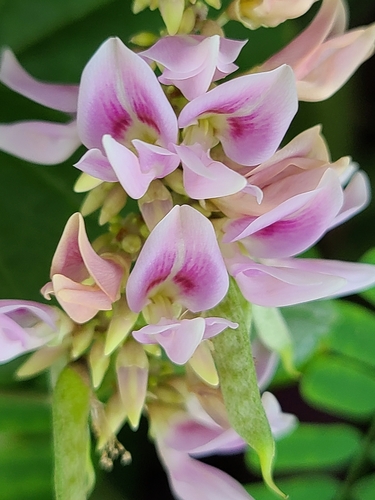
Cullen badocanum
(Blanco) Verdc.

(c) callumjpaul, some rights reserved (CC BY-NC), uploaded by callumjpaul

(c) Callum Blacklaw, some rights reserved (CC BY-NC), uploaded by Callum Blacklaw

(c) geoffbyrne, some rights reserved (CC BY-NC)
What to Eat
Edible parts: Roots
The roots are scraped and roasted, then eaten.
Where to Find It
A tropical plant. It grows in tropical places. In Papua New Guinea it grows from sea level to 120 m altitude. It grows naturally in grassland and on sand dunes.
Asia, Australia, East Timor, Pacific, Papua New Guinea, PNG, Philippines, SE Asia, Timor-Leste,
How to Identify
A strong smelling shrubby herb. It has ridged woolly hairy stems. It grows 1.2-3 m tall. The leaves are oval or sword shaped and 5-10 cm long by 2-5.5 cm wide. The leaf stalks are 3 cm long. The leaves have softly grey hairs over them. The largest leaves have slightly wavy edges. The flowers are 1 cm across and occur in round heads. 1.5-2.5 cm long. There are normally 3 flowers at each node. The outer ring of sepals of the flower have 2 deep lips. The flowers are blue with a white standard. The fruit is an oval pod 3.5 mm long and 2.5 mm wide. It has a network of veins over it and is compressed. It has one seed.
How to Grow
Succeeds in an ordinary garden soil. Requires a well-drained soil in a sunny position. The plant is strongly scented. An extremely variable species due mostly to the pubescence. It can be confused with Cullen martinii which has a shorter lower calyx-tooth and few dentate leaflets or with Cullen virens, which has much shorter leaflets.
Propagation: Seed - it has a hard seedcoat and may benefit from scarification before sowing in order to speed up and improve germination. This can usually be done by pouring a small amount of nearly boiling water on the seeds (being careful not to cook them!) and then soaking them for 12 - 24 hours in warm water. By this time they should have imbibed moisture and swollen - if they have not, then carefully make a nick in the seedcoat (being careful not to damage the embryo) and soak for a further 12 hours before sowing. Sow the seed in individual pots, or pot up the young seedlings as soon as possible in order to avoid root disturbance. Grow them on in the pots until planting out in their final positions. It is usually impossible to transplant this species without fatal damage to the root. Division with great care since the plant resents root disturbance. It is virtually impossible to divide this species successfully.
Other Uses
A fibre used for making cordage is obtained from the stems. For this purpose the plants are pulled up and soaked some hours in water, after which they are taken out of the water and left to dry, when the bark is peeled off, and the fibre manufactured into strong twine and cordage.
Names & Synonyms
Alpu-rara, A-mega
References (6)
- Bailey, F. M., 1913, Comprehensive Catalogue of Queensland Plants. Queensland Government. p 136 (As Psoralea badocana)
- Cribb, A.B. & J.W., 1976, Wild Food in Australia, Fontana. p 160 (As Psoralea badocana)
- Lim, T. K., 2015, Edible Medicinal and Non Medicinal Plants. Volume 9, Modified Stems, Roots, Bulbs. Springer p 69
- Verdcourt, B., 1979, Manual of New Guinea Legumes. Botany Bulletin No 11, Division of Botany, Lae, Papua New Guinea. p 358 (Drawing) (As Psoralea badocana)
- Wheeler, J.R.(ed.), 1992, Flora of the Kimberley Region. CALM, Western Australian Herbarium, p 425 (Drawing) (As Psoralea badocana)
- World Checklist of Useful Plant Species 2020. Royal Botanic Gardens, Kew