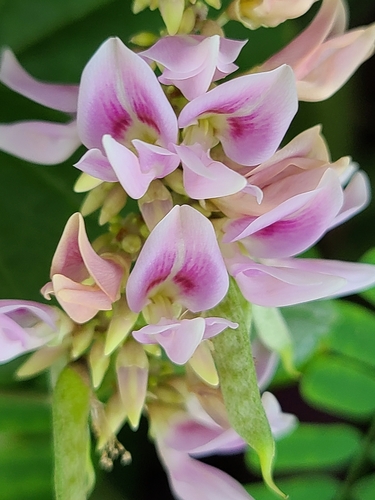
Psoralea castorea
S.Watson
Beaver Indian-breadroot, Beaver Scurfpea

(c) lonnyholmes, some rights reserved (CC BY-NC)
(c) lonnyholmes, some rights reserved (CC BY-NC)
(c) lonnyholmes, some rights reserved (CC BY-NC)
What to Eat
Edible parts: Root
Only the roots of Beaver Dam breadroot are edible — all other parts of the plant are inedible. The roots can be eaten raw or cooked and are starchy, carbohydrate-rich, and generally off-white with brown skins. The skins are bitter and best peeled before eating. Boiling draws out bitterness and highlights the starchy flavour; baking or adding to soups makes them a useful staple food. The root can also be dried and ground into a fine-quality flour, and dried root shavings can be rehydrated or fried in oil as a snack. Quality varies between plants — some roots are too small to be worth harvesting, while others are substantial. Strong, vigorous above-ground growth often signals a more robust root system below. Like other breadroots, the plant stores energy in underground tuberous roots.
Known Hazards
Where to Find It
It is a Mediterranean climate plant. It grows on sandy flats in California between 500-900 m above sea level.
Mexico, North America, USA,
How to Identify
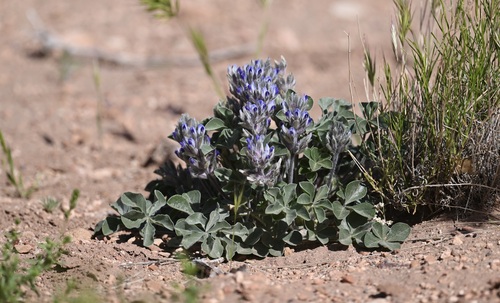
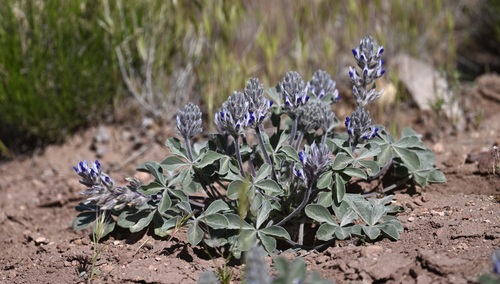
A compact perennial reaching 4 inches tall and wide, suitable for light sandy and medium loamy well-drained soils across a range of pH levels. Hardy to UK zone 5. Requires full sun and tolerates both dry and moist conditions. Hermaphroditic flowers attract insects, and the plant fixes nitrogen in soil.
How to Grow
Succeeds in an ordinary garden soil. Requires a well-drained soil in a sunny position. Plants are very intolerant of root disturbance, they are best planted out into their permanent positions whilst still small. This species has a symbiotic relationship with certain soil bacteria, these bacteria form nodules on the roots and fix atmospheric nitrogen. Some of this nitrogen is utilized by the growing plant, but some can also be used by other plants growing nearby. Habitat & Range: Beaver Dam breadroot is native to arid regions of the Southwest, usually found in dry soils. Its scarcity means it was not a staple food, but it was occasionally used when encountered. USDA Hardiness Zone: 4–8. Weed Potential: Low – a native species with no tendency to become invasive.
Propagation: Pre-soak the seed for 24 hours in warm water, then sow in early to mid spring in a greenhouse. Sow directly into individual pots, or pot up seedlings as soon as possible to avoid root disturbance, growing them on in pots until planting out in their final positions. Transplanting this species almost always causes fatal root damage. Division can be attempted in spring with great care, but the plant strongly resents root disturbance and successful division is virtually impossible.
Medicinal Uses
None known.
Other Uses
The plant is valuable under natural conditions as a soil stabilizer. It is also a nitrogen fixer.
Wikipedia
Source ↗A compact perennial reaching 4 inches tall and wide, suitable for light sandy and medium loamy well-drained soils across a range of pH levels. Hardy to UK zone 5. Requires full sun and tolerates both dry and moist conditions. Hermaphroditic flowers attract insects, and the plant fixes nitrogen in soil.
Names & Synonyms
Beaver Dam breadroot (Pediomelum castoreum (S. Watson) Rydb. = Psoralea castorea S. Watson).
References (4)
- Beckstrom-Sternberg, Stephen M., and James A. Duke. "The Foodplant Database." http://probe.nalusda.gov:8300/cgi-bin/browse/foodplantdb.(ACEDB version 4.0 - data version July 1994)
- Hedrick, U.P., 1919, (Ed.), Sturtevant's edible plants of the world. p 533
- Kermath, B. M., et al, 2014, Food Plants in the Americas: A survey of the domesticated, cultivated and wild plants used for Human food in North, Central and South America and the Caribbean. On line draft. p 725
- Plants for a Future database, The Field, Penpol, Lostwithiel, Cornwall, PL22 0NG, UK. http://www.scs.leeds.ac.uk/pfaf/