Psoralea esculenta
Pursh
Indian breadroot, Breadroot scurf pea

(c) Angus Mossman, some rights reserved (CC BY-NC)

(c) Angus Mossman, some rights reserved (CC BY-NC)

(c) bio3660calder, some rights reserved (CC BY-NC)
What to Eat
Edible parts: Root
The root can be eaten raw or cooked, and is best harvested as the tops die down at the end of the growing season. Raw, it has a sweetish, turnip-like taste and is starchy and glutinous. It contains approximately 70% starch, 9% protein, and 5% sugars. The root can also be dried for later use or ground into a powder and combined with cereals to make cakes and porridges. This root was both a staple food and a luxury item for many Native North American tribes.
Known Hazards
Where to Find It
It is a temperate plant. It grows on poorer soils on plains. It suits hardiness zones 3-7.
Australia, Canada, North America*, USA,
How to Identify
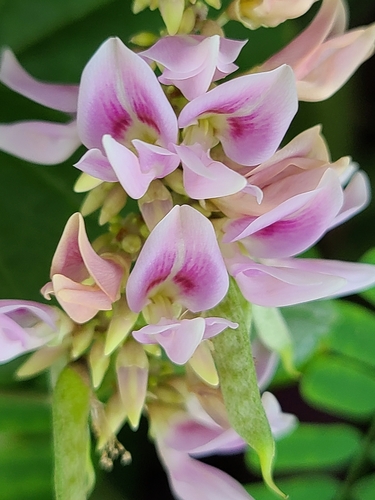
It is a rather stout erect herb. It has some branches and is softly hairy. It keeps growing from year to year. It grows 30-50 cm high and spreads 30-50 cm wide. The roots thicken into potato like tubers or turnips. They are long and have white flesh. These can be 8 cm thick and 15 cm long. The leaves are divided like fingers on a hand and have 5 leaflets. The leaf stalk is usually longer than the blade. The leaflets are fattened oval shape and 2-6 cm long by 0.8-2 cm wide. The flowers are in a dense oblong spike. This can be 10 cm long. The flowers are bluish. The fruit is an oblong hairy pod. It can be 0.5 cm long. It is slightly wrinkled. The seed are brown.
Nutrition Score: 27/100
| Part | Moisture | kJ | kcal | Protein | Vit A | Vit C | Iron | Zinc |
|---|---|---|---|---|---|---|---|---|
| Tubers | 43 | — | — | 4.22 | 28 | 0.4 | — | 3.9 |
How to Grow
Succeeds in an ordinary garden soil. Requires a well-drained soil in a sunny position. Plants are very intolerant of root disturbance, they are best planted out into their permanent positions whilst still small. This plant has been recommended for improvement through breeding and selection for its edible root. It was sent to Europe around the year 1800 as a potential food crop but was not well received. This species has a symbiotic relationship with certain soil bacteria, these bacteria form nodules on the roots and fix atmospheric nitrogen. Some of this nitrogen is utilized by the growing plant but some can also be used by other plants growing nearby.
Propagation: Pre-soak the seed for 24 hours in warm water, then sow in early to mid spring in a greenhouse. Sow directly into individual pots, or pot up seedlings as soon as possible to avoid root disturbance, growing them on in pots until planting out in their final positions. Transplanting this species almost always causes fatal root damage. Division can be attempted in spring with great care, but the plant strongly resents root disturbance and successful division is virtually impossible.
Medicinal Uses
An infusion of the dried roots has been used to treat gastro-enteritis, sore throats, and chest problems. Children chewed the roots as a remedy for bowel complaints. A poultice of chewed roots has been applied to sprains and fractures.
Other Uses
The plant is a good soil stabilizer in its natural environment and is a nitrogen fixer. An oil is also associated with this plant.
Wikipedia
Source ↗A perennial reaching 1 foot tall, flowering from May to July. Hardy to UK zone 4. Grows in light sandy, medium loamy, and heavy clay soils with good drainage and variable pH tolerance. Prefers full sun and tolerates both dry and moist conditions. Hermaphroditic flowers are insect-pollinated, and the plant fixes nitrogen.
Production
The tubers are collected at the end of the growing season when the tops die down.
Other Information
A significant food.
Notes
The tubers have a protein content of 7%.
Names & Synonyms
Breadroot, Indian turnip, Navet de prairie, Pomme blanche, Pomme de prairie, Prairie parsnip, Prairie potato, Prairie turnip, Timpsula, Tipsin
References (24)
- Beckstrom-Sternberg, Stephen M., and James A. Duke. "The Foodplant Database." http://probe.nalusda.gov:8300/cgi-bin/browse/foodplantdb.(ACEDB version 4.0 - data version July 1994)
- Burkill, I.H., 1966, A Dictionary of the Economic Products of the Malay Peninsula. Ministry of Agriculture and Cooperatives, Kuala Lumpur, Malaysia. Vol 2 (I-Z) p 1851
- Cormack, R. G. H., 1967, Wild Flowers of Alberta. Commercial Printers Edmonton, Canada. p 187
- Cundall, P., (ed.), 2004, Gardening Australia: flora: the gardener's bible. ABC Books. p 994 (As Pediomelum esculentum)
- Elias, T.S. & Dykeman P.A., 1990, Edible Wild Plants. A North American Field guide. Sterling, New York p 150
- Esperanca, M. J., 1988. Surviving in the wild. A glance at the wild plants and their uses. Vol. 1. p 137
- Etkin, N.L. (Ed.), 1994, Eating on the Wild Side, Univ. of Arizona. p 72
- Facciola, S., 1998, Cornucopia 2: a Source Book of Edible Plants. Kampong Publications, p 110
- Fl. Amer. sept. 2:475, t. 22. 1813-1814
- Hedrick, U.P., 1919, (Ed.), Sturtevant's edible plants of the world. p 533
- Jackes, D. A., 2007, Edible Forest Gardens
- Kaldy, M.S., Johnston, A and Wilson, D.B., 1980, Nutritive value of Indian Bread-root, Squaw-root and Jerusalem artichoke. Economic Botany 34(4) pp 352-357
- Kermath, B. M., et al, 2014, Food Plants in the Americas: A survey of the domesticated, cultivated and wild plants used for Human food in North, Central and South America and the Caribbean. On line draft. p 624 (As Pediomelum esculentum)
- Kiple, K.F. & Ornelas, K.C., (eds), 2000, The Cambridge World History of Food. CUP p 1738
- Lim, T. K., 2015, Edible Medicinal and Non Medicinal Plants. Volume 9, Modified Stems, Roots, Bulbs. Springer p 63, 69
- MacKinnon, A., et al, 2009, Edible & Medicinal Plants of Canada. Lone Pine. p 265
- Moerman, D. F., 2010, Native American Ethnobotany. Timber Press. p 381 (As Pediomelum esculentum)
- N. Amer. fl. 24:20. 1919 (As Pediomelum esculentum)
- Phillips, K. M., et al, 2014, Nutrient composition of selected traditional United States Northern Plains Native American plant foods. Journal of Food Composition and Analysis 34 (2014) 136–152 141
- Plants for a Future database, The Field, Penpol, Lostwithiel, Cornwall, PL22 0NG, UK. http://www.scs.leeds.ac.uk/pfaf/
- PROSEA handbook Volume 9 Plants yielding non-seed carbohydrates. p 178
- Saunders, C.F., 1948, Edible and Useful Wild Plants. Dover. New York. p 7
- USDA, ARS, National Genetic Resources Program. Germplasm Resources Information Network - (GRIN). [Online Database] National Germplasm Resources Laboratory, Beltsville, Maryland. Available: www.ars-grin.gov/cgi-bin/npgs/html/econ.pl (10 April 2000) (As Pediomelum esculentum)
- Wiersema, J. H. & Leon, B., 2013, World Economic Plants. A Standard Reference CRC Press. 2nd Ed. p 503 (As Pediomelum esculentum)