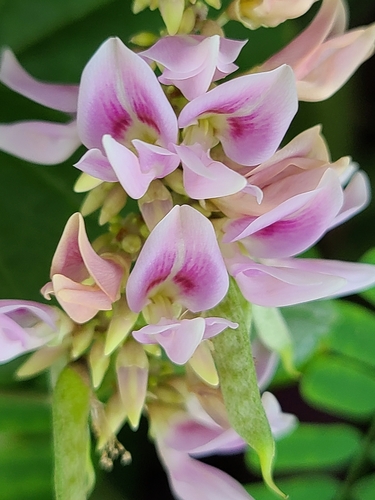
Psoralea macrostachya
DC.
Large leather root

Wikimedia Commons - Botanical Register
What to Eat
Edible parts: Root
The starchy root can be eaten raw, cooked, or dried for winter use.
Known Hazards
Where to Find It
It is a temperate plant.
North America, USA,
How to Identify
A bean family herb. It grows 1-2 m tall and keeps growing from year to year. It loses its leaves during the year. The flowers are in clusters and are pea shaped and purple.
How to Grow
Succeeds in an ordinary garden soil. Intolerant of root disturbance. This is not the case, we have successfully transplanted plants that were three years old. This species has a symbiotic relationship with certain soil bacteria, these bacteria form nodules on the roots and fix atmospheric nitrogen. Some of this nitrogen is utilized by the growing plant but some can also be used by other plants growing nearby.
Propagation: Pre-soak the seed for 24 hours in warm water, then sow in early to mid spring in a greenhouse. Sow directly into individual pots, or pot up seedlings as soon as possible to avoid root disturbance, growing them on in pots until planting out in their final positions. Transplanting this species almost always causes fatal root damage. Division can be attempted in spring with great care, but the plant strongly resents root disturbance and successful division is virtually impossible.
Medicinal Uses
The plant has been used as a salve in the treatment of ulcers and sores.
Other Uses
A fibre obtained from the inner bark of the stem is very fine and strong, suitable for use as thread and for sewing. A separate fibre from the root is very tough and is used to make ropes and bags. Both fibres are aromatic, with a scent that persists for several months. A yellow dye is obtained from the roots. The plant is also a nitrogen fixer.
Wikipedia
Source ↗A robust perennial reaching 1m in height with hermaphroditic flowers blooming July to August, pollinated by insects. Tolerates light sandy, medium loamy, and heavy clay soils with good drainage, thriving in mildly acid to basic pH and even saline conditions. Full sun essential; prefers moist soil. Fixes atmospheric nitrogen.
Names & Synonyms
References (2)
- Plants for a Future database, The Field, Penpol, Lostwithiel, Cornwall, PL22 0NG, UK. http://www.scs.leeds.ac.uk/pfaf/
- Prodr. 2:220. 1825