Pterocarpus angolensis
DC.
Bloodwood
(c) gbmalawi, some rights reserved (CC BY-NC)

(c) National Geographic Okavango Wilderness Project, some rights reserved (CC BY)
(c) Dewald du Plessis, some rights reserved (CC BY-NC)
What to Eat
Edible parts: Leaves, Vegetable
None known
Known Hazards
Where to Find It
A tropical plant. It grows in woodland and wooded grassland. It grows up to 1,250 m altitude. In Tanzania it is only between 300-600 m altitude. It can tolerate acid soils. It must be in a frost free area. It grows on well drained soils. In Zimbabwe it grows between 840-1,620 m above sea level.
Africa, Angola, Botswana, Central Africa, East Africa, Eswatini, Malawi, Mozambique, Namibia, South Africa, Southern Africa, Swaziland, Tanzania, Zambia, Zimbabwe,
How to Identify
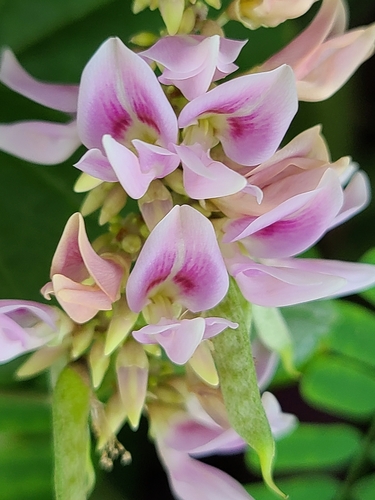
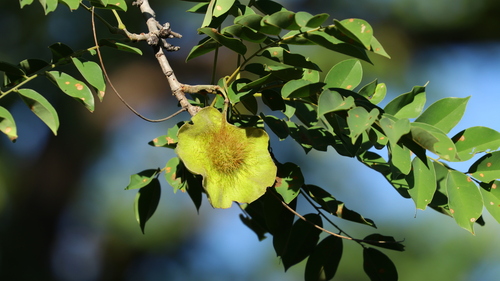
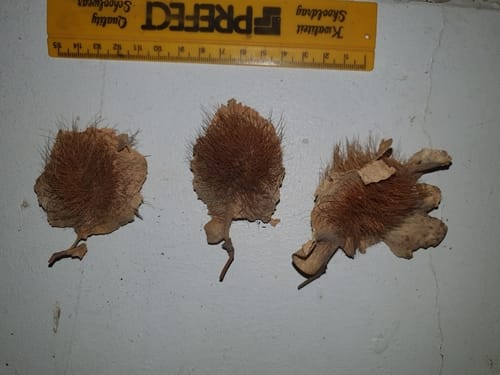
A medium sized tree. It grows to 16 m tall. The bark is dark grey. It has cracks along its length. The leaves are made up of 5-9 almost opposite pairs of leaflets and with one at the end. These are 2.5-7 cm long by 2-4.5 cm wide. The lower surface is hairy. They taper to a point at the tip. The base is rounded. The edges are wavy and tightly rolled under. The flowers are orange-yellow and pea-shaped. They occur in large branched sprays. These are 10-20 cm long. The fruit are a circular pod. The seed case is covered with harsh bristles. There is a broad wavy wing around this. This is up to 3 cm wide.
How to Grow
Ambali is a tree of low to medium elevations in the tropics, where it can be found from sea level to around 1,650 metres. It grows best in areas where annual daytime temperatures are within the range 15 - 32°c, but can tolerate 12 - 38°c. It is not resistant to frost, although older trees survive very light frosts. The plant can survive temperatures down to about -1°c. It prefers a climate with well-defined wet and dry seasons, with a mean annual rainfall in the range 700 - 1,500mm, but tolerates 500 - 2,000mm. Requires a sunny position, even when young. Requires a well-drained, medium to light soil of low to moderate fertility. Tolerates moderate levels of salt in the soil. Prefers a pH in the range 5.5 - 7, tolerating 5 - 7.5. Trees do not coppice well, if at all. Growth is slow and variable for at least the first seven years, making it less suitable for plantation. After germination the seedling rapidly develops several shoots and a strong taproot, which may reach to a depth of 1 metre in the first year. The shoots reach about 15 cm length in the first year and often die back in the dry season. The plants enter a suffrutex stage, in which the root expands in size and lateral roots develop in the top 50 cm of the soil, while shoots usually die back to below ground level in the dry season. New shoots develop in the rainy season. This stage may last for 10 years (sometimes up to 25 years) until the root has sufficiently developed to allow the above-ground part of the sapling to survive the dry season. After the suffrutex stage, the growth is fast, up to 2 metres or more in one year, and the tree rapidly reaches a height where it cannot be reached by most browsing animals. Compared to other trees the saplings with a thick corky bark are extremely fire resistant, sometimes surviving temperatures of up to 450°c, and fires contribute to pruning side branches and multiple stems. Trees start flowering when they have a permanent stem of 15 - 20 years old, but full development of fruits usually only starts when trees are about 35 years old. This species has a symbiotic relationship with certain soil bacteria, these bacteria form nodules on the roots and fix atmospheric nitrogen. Some of this nitrogen is utilized by the growing plant but some can also be used by other plants growing nearby.
Propagation: Seed production can be abundant — up to 10,000 fruits per hectare have been recorded — but germination is poor under natural conditions, with only around 2% of seeds germinating and half of the resulting seedlings dying in the first year. However, another account gives a different picture: seeds left in the pod may have low germination due to physical or mechanical dormancy caused by the pericarp, while the seed itself has only slight physical dormancy. Scarification improves germination, but high germination can be expected even without pre-treatment. Seeds can be sown in seedbeds and seedlings transplanted into pots, or sown directly into pots; sowing in sand is recommended for germination testing. The species forms both rhizobium and mycorrhizal associations, and inoculation is advisable where these microsymbionts are absent from the nursery soil or planting site. At moisture contents of 4–6%, seeds can be stored cold for at least 3 years. The trees can also be grown from large cuttings.
Medicinal Uses
The bark, which exudes a blood-red gummy resin known as 'false dragon's blood' or 'kino', is widely used in traditional medicine. It is a powerful astringent, applied to conditions including diarrhoea, heavy menstruation, nosebleeds, headache, stomach-ache, blood in the urine, and schistosomiasis. Externally, the bark treats sores, skin problems, and mouth ulcers. Heated in water and mixed with figs, it is massaged onto the breast to stimulate lactation. A cold infusion of bark alone is a remedy for nettle rash. A root decoction is used for malaria, blackwater fever, and gonorrhoea, while a root infusion is taken orally for diarrhoea, bilharzia, and abdominal pains. Burnt roots, with the ashes dissolved in water, treat asthma and tuberculosis. Corneal ulcers are bathed in an eyewash made by soaking cleaned roots in water for 6 hours; as follow-up treatment, flowers are placed in boiling water and the patient holds their face over the steam. Burnt ripe seeds are applied as a dressing on wounds, inflammation, psoriasis, and bleeding gums. The sap is reputed to heal sores including ringworm and stab wounds, and is used to treat cataracts and sore eyes by dropping it directly into the eyes. Root extracts have shown lethal activity against adult schistosomes causing bilharzia, with results comparable to the drug praziquantel.
Other Uses
The tree fixes nitrogen and has been used for soil conservation, dune fixation, live fencing, and as an ornamental providing light shade with attractive fruits. It is regarded as an indicator of well-drained soils. Heartwood roots, pounded to a powder, yield a fast brownish-red dye used mainly to colour palm-leaf fibres for basket weaving — palm leaf strips are boiled for about 12 hours in a hot dye bath with the bark, and the resulting red-brown fibres are used for coloured designs in basketry. Dye extracted in alcohol from finely chopped roots or wood colours wool and cotton in shades from brown to bright red. The powder is also mixed with oil or fat to make a cosmetic pomade of great cultural importance, traditionally applied to all exposed parts of the body including hair, face, breasts, arms, and legs. It is used to dye leather clothing — the traditional dress of both men and women — and retains cosmetic, medicinal, and symbolic significance. Inner bark and heartwood of the trunk and branches are also reported to yield dye. Kino resin from the bark is harvested by incising the bark and collecting the exudate; the sap contains 77% tannins and serves as a long-lasting dye. The fibrous inner bark is used in basketry, and the tree shows considerable promise as a firebreak. The heartwood is pale to dark brown or reddish-brown, often streaked, clearly separated from pale grey or yellowish sapwood. Grain is straight to interlocked, texture medium to coarse. The wood is relatively light, dries well but slowly, with little tendency to check, split, or warp, and is very stable once dry. It works well with hand and machine tools, only moderately blunting cutters; straight-grained material planes and finishes well. Bending properties are moderate; the wood peels and slices easily, glues well, and has excellent turning and carving properties. The heartwood is moderately durable and resistant to termites and marine borers, though the sapwood is susceptible to powder-post beetle attack. Heartwood resists preservative treatment; sapwood is moderately resistant. Considered a good substitute for Indian teak, the wood is used for construction, carpentry, high-class furniture, parquet flooring, veneer, and — particularly in South Africa and Namibia — wood carving including bowls, spoons, and walking sticks. Its flexibility, resistance, and light weight make it useful for boats, doors, and windows. The wood is occasionally used as firewood.
Wikipedia
Source ↗Pterocarpus angolensis (African teak, wild teak, Portuguese: Girassonde, Afrikaans: Kiaat, Sotho: Morôtô, Tswana: Mokwa, Venda: Mutondo, Shona: Mukwa, Tsonga: Mvhangase, Ndebele: Umvangazi, Shona: Mubvamaropa, Zulu: Umvangazi) is a species of Pterocarpus native to southern Africa, in Angola, Mozambique, Namibia, South Africa, Eswatini, Tanzania, Democratic Republic of the Congo, Zimbabwe, and Zambia. It is a protected tree in South Africa. The name Kiaat, although Afrikaans, is sometimes used outside South Africa as well. In Zimbabwe, depending on the region, it is known as Mukwa (which it is also called in Zambia) or Mubvamaropa.
Production
It can grow 50-70 cm per year.
Other Information
Leaves are marketed but collected from wild trees. It is sold in local markets.
Notes
There are about 20 Pterocarpus species. They occur in the tropics. The tree is harvested because of its hard wood.
Names & Synonyms
Kiaat, M'bila, Mlombwa, Mokwa, Mtumbati, Mubvamakovo, Mubvamaropa, Mubvinziropa, Mukambira, Mukonambiti, Mukula, Mukurambira, Mukwa, Mulombe, Munkula, Mupyka-kulu, Mutondo, Nkosu, Nkula nkula, Ntete mbula, Padauk, Umbila, Umvagazi
References (16)
- Baidu-Forson, J.J., et al ,2014,. Assessment of agrobiodiversity resources in the Borotse flood plain, Zambia. CGIAR Research Program on Aquatic Agricultural Systems. Penang, Malaysia. Working Paper: AAS-2014-12.
- Bosch, C.H., 2004. Pterocarpus mildbraedii Harms. [Internet] Record from Protabase. Grubben, G.J.H. & Denton, O.A. (Editors). PROTA (Plant Resources of Tropical Africa), Wageningen, Netherlands. < http://database.prota.org/search.htm>. Accessed 22 October 2009.
- Drummond, R. B., 1981, Common Trees of the Central Watershed Woodlands of Zimbabwe, National Herbarium Salisbury. p 92
- Food Composition Tables for use in Africa FAO http://www.fao.org/infoods/directory No. 444
- Fowler, D. G., 2007, Zambian Plants: Their Vernacular Names and Uses. Kew. p 39
- Lautenschläger, T., et al, 2018, First large-scale ethnobotanical survey in the province of Uíge, northern Angola. Journal of Ethnobiology and Ethnomedicine (2018) 14:51
- Martin, F.W. & Ruberte, R.M., 1979, Edible Leaves of the Tropics. Antillian College Press, Mayaguez, Puerto Rico. p 88, 200
- Mawunu, M., et al, 2020, First Survey of the Edible Non-Wood Forest Products Sold in Uige Province, Northern Angola. European Journal of Agriculture and Food Sciences. Vol. 2, No. 6
- Mbuya, L.P., Msanga, H.P., Ruffo, C.K., Birnie, A & Tengnas, B., 1994, Useful Trees and Shrubs for Tanzania. Regional Soil Conservation Unit. Technical Handbook No 6. p 422
- Mokganya, M. G. et al, 2018, An evaluation of additional uses of some wild edible fruit plants of the Vhembe District Municipality in the Limpopo Province, South Africa. Indian Journal of Traditional Knowledge. Vol 17(2) April 2018, pp 276-281
- Palgrave, K.C., 1996, Trees of Southern Africa. Struik Publishers. p 321
- Prodr. 2:419. 1825
- Roodt, V., 1998, Trees & Shrubs of the Okavango Delta. Medicinal Uses and Nutritional value. The Shell Field Guide Series: Part 1. Shell Botswana. p 147
- Swaziland's Flora Database http://www.sntc.org.sz/flora
- Williamson, J., 2005, Useful Plants of Malawi. 3rd. Edition. Mdadzi Book Trust. p 211
- www.zimbabweflora.co.zw 2011