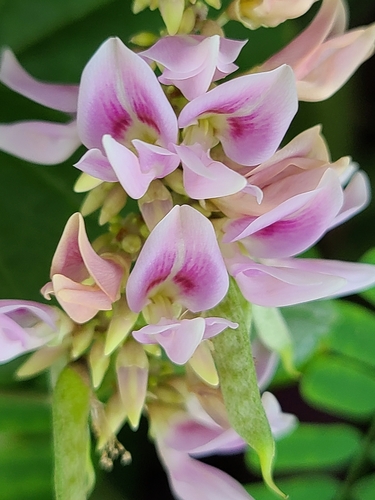
Pterocarpus indicus
Willd., non Baker
Burmese Rosewood
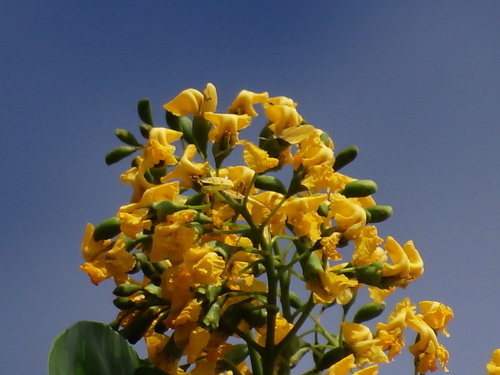
no rights reserved, uploaded by 葉子
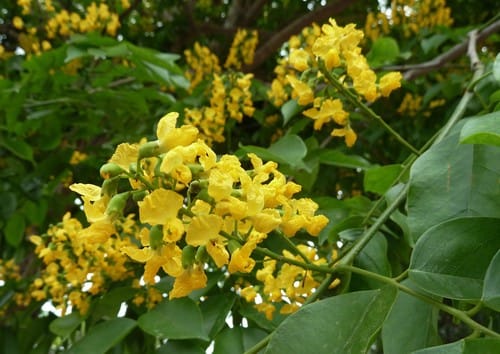
(c) Philippe RABAUTE, some rights reserved (CC BY-NC)
What to Eat
Edible parts: Leaves, Flowers, Vegetable
The young leaves and fragrant flowers are said to be eaten, with such meals likely concentrated during leaf flush and flowering periods.
Where to Find It
A tropical plant. It is native to tropical Asia. It does best in rich, moist, well-drained soils. It needs a protected sunny position. It is damaged by drought and frost. It is often found in coastal swamps along tidal creeks. It usually grows in areas with an annual average temperature of 22-32°C. It can grow in soils with a pH of 4.0-7.4. It suits hardiness zones 11-12. In Yunnan.
Africa, Asia, Australia, Bougainville, Brunei, Cambodia, Caribbean, Carolines, Central Africa, Central America, China, Congo, Cuba, East Africa, East Timor, Fiji, Guam, Guyana, Hawaii, India, Indochina, Indonesia*, Jamaica, Japan, Laos, Malaysia, Maldives, Micronesia, Mozambique, Myanmar, North America, Pacific, Palau, Panama, Papua New Guinea, PNG, Philippines*, Puerto Rico, Samoa, Sao Tome and Principe, SE Asia, Sierra Leone, Singapore, Solomon Islands, Sri Lanka, Taiwan, Tanzania, Thailand, Timor-Leste, Trinidad, USA, Vanuatu, Vietnam, West Africa, West Indies, West Timor, Yap,
How to Identify
A medium sized evergreen tree. It grows to 27-30 m high and spreads to 4 m across. The stem is erect and stout. It branches. The trunk is 60-80 cm across. The leaves are compound with an odd number of leaflets. These are oval. The leaves are 20-45 cm long. The leaflets are 6-10 cm long by 3-5 cm wide. It can lose its leaves. The flowers are yellow and woolly. The sepals forming the outer ring of the flowers are brown. The flowers occur as many in a branched flower arrangement. The flowers are bell shaped. The fruit are round pods. These are 5 cm across. They can have 1 or 2 seeds but sometimes 4.
How to Grow
A plant of the moist to wet tropics, where it is found at elevations up to 750 metres, though it can be cultivated at higher elevations. It grows best in areas where annual daytime temperatures are within the range 24 - 32°c, but can tolerate 12 - 37°c. The plant is not frost tolerant.. It prefers a mean annual rainfall in the range 2,000 - 3,000mm, but tolerates 1,500 - 3,500mm. Amboyna behaves like a pioneer and grows best in an open position. Succeeds in a range of soils from sandy loams to clays with a pH from neutral to very strongly acid. Prefers a fertile, moisture-retentive soil. Tolerates moderate levels of salt in the soil. Prefers a pH in the range 5.5 - 6.5, tolerating 5 - 7.5. As an urban tree, amboyna is relatively wind-firm and seldom suffers branch breakage. Under favourable conditions, trees in Singapore have been known to grow an average of 33 metres in height and 1.55 metres in girth in 11 years, or an average annual increment of 1.2 metres height and 14 cm girth. Open-grown trees usually begin flowering and fruiting between 5 and 10 years of age. The roots can become quite large and grow near the surface, the tree should therefore be planted several metres away from sidewalks and other structures. Seedlings are slower growing than cuttings and exhibit considerable variation in vigour. A strict culling program would be necessary to ensure that only the best stocks are planted out. Rooted cuttings can be established readily on nearly all kinds of soils, from coastal sands to inland clays, in urban and garden situations, and even in quite small planting holes dug into pavements. However, establishment trials in forest areas have had mixed results and some have failed. The reasons are not clear. Trees of all sizes and ages easily regenerate new shoots when lopped or pollarded. In Papua New Guinea, logged forest trees readily regenerate new plants from the roots. This species has a symbiotic relationship with certain soil bacteria, these bacteria form nodules on the roots and fix atmospheric nitrogen. Some of this nitrogen is utilized by the growing plant but some can also be used by other plants growing nearby. Bloom Color: Gold (Yellow-Orange) Bright Yellow. Spacing: over 40 ft. (12 m).
Propagation: Seed germinates readily with no pre-treatment required. Because separating the fragile seeds from the tough pods by hand is difficult and currently impossible mechanically, pods are sown whole. Germination rates of 24–57% have been recorded, with the first seeds germinating after 5 days and the last after 3 months. Pods are lightly covered with potting mixture in germination beds or trays and kept moist until germination; sowing with pods requires thinning plants soon after emergence. When true leaves develop, seedlings are transplanted into nursery bags or pots filled with potting mixture. Seedlings of about 50cm are suitable for most forestry plantings. Air-dried seeds in their pods remain viable after 1 year of storage at room temperature. Cuttings can be rooted; in the Philippines, branch cuttings about 8cm in diameter are rooted after hormone treatment to produce instant trees.
Medicinal Uses
The kino obtained from the trunk is sticky, bitter, and oily. It is said to be antibilious, emetic, and sternutatory, and is used to treat throat ailments and mouth sores, and as a folk remedy for tumours, particularly of the mouth. It was once administered for diarrhoea, often combined with opium. Young leaves are applied externally to boils, prickly heat, and ulcers, and finely powdered leaves are applied to a ruptured vagina. The leaves are reported to significantly inhibit the growth of Ehrlich ascites carcinoma cells. Root juice is used to treat syphilis.
Other Uses
A large flowering tree used as a shade tree, street tree, and in public open spaces. A nitrogen-fixing species recommended for agroforestry systems and as a shade tree for coffee and other crops. A red dye is obtained from the bark, and the wood yields a reddish dye, more fugitive than that of the related Pterocarpus santolinus. The tree is a source of kino — a red resin-like substance obtained by tapping — used locally as an astringent and in tanning. A leaf infusion is used as a shampoo. The heartwood is brick-red to golden brown in colour, aging to a dull brown leather colour. The wood is moderately hard and moderately heavy, easy to work, pleasantly rose-scented, and takes a fine polish, developing rich colours from yellow to red. Conspicuous growth rings impart a fine figure to the wood, developing even in the non-seasonal humid tropics. The wood shapes well, takes a high polish, and resists termites and rot. It is used for high-class furniture and cabinets, decorative sliced veneer, interior wall panelling, feature flooring including strip and parquet, musical instruments, gun stocks, rifle butts, turned articles, knife handles, boat building, and specialised joinery. The highly prized Amboyna burl — one of the rarest and most valued wood products in the world — is marked with twisted curls and knots more varied than bird's-eye maple, and there is a distinctive sweet smell when working the wood. The more red the wood, the heavier it is, with an average density of around 720 kg/m³. Though not typically recommended as firewood, the wood can be used as fuel, and some Pterocarpus species burn green.
Wikipedia
Source ↗Pterocarpus indicus (commonly known as Amboyna wood, Malay padauk, Papua New Guinea rosewood, Philippine mahogany, Andaman redwood, Burmese rosewood, narra (from Tagalog) and asana in the Philippines, angsana, or Pashu padauk) is a species of Pterocarpus in the family Fabaceae native to southeastern Asia, northern Australasia, and the western Pacific Ocean islands, in Cambodia, southernmost China, East Timor, Indonesia, Malaysia, Papua New Guinea, the Philippines, the Ryukyu Islands, the Solomon Islands, Thailand, and Vietnam. Pterocarpus indicus was one of two species (the other being Eysenhardtia polystachya) used as a source for the 16th- to 18th-century traditional diuretic known as lignum nephriticum. Many populations of Pterocarpus indicus are seriously threatened. It is extinct in Vietnam and possibly in Sri Lanka and Peninsular Malaysia. It was declared the national tree of the Philippines in 1934 by Governor-General Frank Murphy of the Insular Government of the Philippine Islands through Proclamation No. 652.
Production
It is fast growing. All trees in one area flower at the same time for just a few days due to the drop in temperature with the first rains.
Other Information
It is only a minor food.
Notes
The timber is an attractive furniture timber.
Names & Synonyms
Amboyna, Angsana, Asana, Bluwota, Chan daeng, Dandara, Danghuong an, Du bai yai, Giang huong, Gioc, Huynh ba rung, Indian padauk, Laga, Las, Ligi, Liki, Malay padauk, Nala, Nana, Nanara, Nanaara, Narra, New Guinea rosewood, Ofi ealy gas, Pan-padauk, Pau-rosa do timor, Pinati, Pra du, Pradu, Rigi, Ringi, Sana kapur, Sana kembang, Sana, Sena, Sonokembang, Udyo, Ujaw, Vangai, Yerravegisa
References (37)
- Ambasta S.P. (Ed.), 2000, The Useful Plants of India. CSIR India. p 501
- Argent, G et al, nd, Manual of the Larger and More important non Dipterocarp Trees of Central Kalimantan Indonesia. Volume 2 Forest Research Institute, Samarinda, Indonesia. p 366
- Barwick, M., 2004, Tropical and Subtropical Trees. A Worldwide Encyclopedic Guide. Thames and Hudson p 349
- Bodkin, F., 1991, Encyclopedia Botanica. Cornstalk publishing, p 847
- Borrell, O.W., 1989, An Annotated Checklist of the Flora of Kairiru Island, New Guinea. Marcellin College, Victoria Australia. p 92
- Burkill, H. M., 1985, The useful plants of west tropical Africa, Vol. 3. Kew.
- Burkill, I.H., 1966, A Dictionary of the Economic Products of the Malay Peninsula. Ministry of Agriculture and Cooperatives, Kuala Lumpur, Malaysia. Vol 2 (I-Z) p 1861
- Cabalion, P. and Morat, P., 1983, Introduction le vegetation, la flore et aux noms vernaculaires de l'ile de Pentcoste (Vanuatu), In: Journal d'agriculture traditionnelle et de botanique appliquee JATBA Vol. 30, 3-4
- Carig, Elizabeth T., 2020, Guidebook on Native Trees within the Quirino Forest Landscape. Plaridel, Bulacan, St. Andrew Publishing House. p 94
- Cowie, I, 2006, A Survey of Flora and vegetation of the proposed Jaco-Tutuala-Lore National Park. Timor-Lests (East Timor) www.territorystories.nt/gov.au p 48
- Cundall, P., (ed.), 2004, Gardening Australia: flora: the gardener's bible. ABC Books. p 1107
- Elevitch, C.R.(ed.), 2006, Traditional Trees of the Pacific Islands: Their Culture, Environment and Use. Permanent Agriculture Resources, Holualoa, Hawaii. p 607
- Engel, D.H., & Phummai, S., 2000, A Field Guide to Tropical Plants of Asia. Timber Press. p 110
- Facciola, S., 1998, Cornucopia 2: a Source Book of Edible Plants. Kampong Publications, p 110
- Foreman, D. B., 1971, A checklist of the Vascular Plants of Bougainville with Descriptions of some Common Forest Trees. Botany Bulletin No. 5. Department of Botany. p 162
- Friday, J. B., 2005, Forestry and Agroforestry Trees of East Timor. http://www.ctahr.hawaii.edu/forestry/data/Timor/Timor trees.html
- Gardner, S., et al, 2000, A Field Guide to Forest Trees of Northern Thailand, Kobfai Publishing Project. p 177
- Grubben, G. J. H. and Denton, O. A. (eds), 2004, Plant Resources of Tropical Africa 2. Vegetables. PROTA, Wageningen, Netherlands. p 564
- Havel, J.J., 1975, Forest Botany, Volume 3 Part 2 Botanical taxonomy. Papua New Guinea Department of Forests, p 109
- Hearne, D.A., & Rance, S.J., 1975, Trees for Darwin and Northern Australia. AGPS, Canberra p 100, Pl 29
- Hibbert, M., 2002, The Aussie Plant Finder 2002, Florilegium. p 243
- Kitalong, A. H., DeMeo, R. A., & Holm, T., 2013, A Field Guide to the Native Trees of Palau. 2nd edition. USDA p138
- Lebot, V. & Sam, C., Green desert or ‘all you can eat’? How diverse and edible was the flora of Vanuatu before human introductions?. Terra australis 52 p 409
- Martin, F.W. & Ruberte, R.M., 1979, Edible Leaves of the Tropics. Antillian College Press, Mayaguez, Puerto Rico. p 88, 200
- McMakin, P.D., 2000, Flowering Plants of Thailand. A Field Guide. White Lotus. p 23
- Peekel, P.G., 1984, (Translation E.E.Henty), Flora of the Bismarck Archipelago for Naturalists, Division of Botany, Lae, PNG. p 241, 240
- Pham-Hoang Ho, 1999, An Illustrated Flora of Vietnam. Nha Xuat Ban Tre. p 889
- Sam, H. V. et al, 2004, Trees of Laos and Vietnam: A Field Guide to 100 Economically or Ecologically Important Species. BLUMEA 49: 201-349
- Selvam, V., 2007, Trees and shrubs of the Maldives. RAP Publication No. 2007/12 p 142
- Sp. pl. 3(2):904. 1802
- Staples, G.W. and Herbst, D.R., 2005, A tropical Garden Flora. Bishop Museum Press, Honolulu, Hawaii. p 324 (Drawing)
- Sujanapal, P., & Sankaran, K. V., 2016, Common Plants of Maldives. FAO & Kerala FRI, p 223
- Sukarya, D. G., (Ed.) 2013, 3,500 Plant Species of the Botanic Gardens of Indonesia. LIPI p 478
- Thaman, R. and W. Clarke, Paper on Agroforestry on Aneityum and Tanna, Vanuatu from Internet
- Trimanto, & Hapsari L., 2016, Botanical survey in thirteen montane forests of Bawean Island Nature Reserve, East Java Indonesia: Conservation status, bioprospecting and potential tourism. Biodiversitas 17: 832-846.
- Van Sam, H. et al, 2004, Trees of Laos and Vietnam: A Field Guide to 100 Economically or Ecologically Important Species. Blumea 29 (2004) 201-349
- www.worldagroforestrycentre.org/treedb/