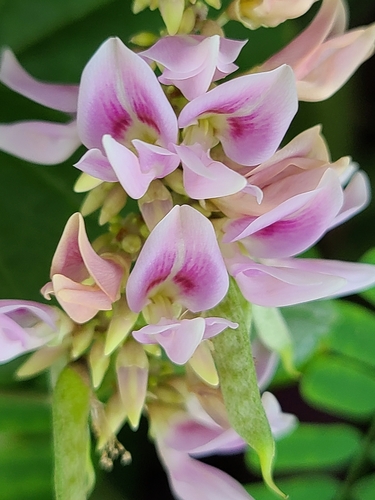
Pterocarpus lucens
Lepr. ex Guill. et Perr.
Small-leaved kiaat, Small-leaved bloodwood

(c) Ehren, some rights reserved (CC BY-NC)

(c) Francois du Randt, some rights reserved (CC BY-NC), uploaded by Francois du Randt
What to Eat
Edible parts: Leaves, Vegetable
The young leaves are used as a vegetable and in sauces.
Known Hazards
Where to Find It
A tropical plant. It grows in low altitude woodland. It is often on deep, sandy soils. It grows in dry savannah between the Sahara and Sahel in West Africa. It needs between 300-700 mm of rain each year. It can grow in arid places.
Africa, Botswana, Burkina Faso, Cameroon, Central Africa, Central African Republic, Chad, Congo, Congo DR, Côte d'Ivoire, East Africa, Ethiopia, Gabon, Gambia, Ghana, Guinea, Guinée, Ivory Coast, Mali, Mozambique, Namibia, Niger, Nigeria, Sahel, Senegal, South Africa, Southern Africa, South Sudan, Sudan, Uganda, West Africa, Zambia, Zimbabwe,
How to Identify
A medium sized tree. It often becomes shrubby. It grows 7-10 m high. The bark is smooth and pale grey and flakes like guava bark. The leaves are made up of 2-4 pairs of opposite leaflets and one leaflet at the end. The leaflets are small and oval. They are 2-3 cm long by 1-2 cm wide. Sometimes they are larger. They are light green and droop. The base is unequal. The flowers are pale yellow and pea-shaped. They are in long slender sprays. These are 7-22 cm long. The fruit is a small oval flattened pod. It is 5 cm long by 3 cm wide. It has a swelling over the seed case. There is a hard wing like a membrane.
How to Grow
Pterocarpus lucens is a plant of the savannah regions of the tropics, where it is found at elevations of 550 - 1,520 metres. Up to 3,000 metres. It grows best in areas where the mean annual temperature is within the range 15 - 32°c, but is tolerant of 12 - 40°c. It prefers a mean annual rainfall in the range 400 - 700mm, but tolerates 250 - 900mm. Requires a sunny position. Prefers a deep, sandy soil, but can also succeed on clay, stony and gravely soils. Prefers a pH in the range 5.5 - 7, tolerating 5 - 7.5. The roots have nodules containing nitrogen-fixing bacteria, but this species is considered to have comparatively low nitrogen fixation potential.
Propagation: Seed - pre-soaking the seed for 12 - 24 hours in warm water is likely to improve germination rates. If the seed has not swollen after this, then carefully scarify it to allow the ingress of moisture by making a small hole in the seed coat without damaging the embryo. Optimum temperatures for germination are in the range of 25 - 35°c. Sow the seed in a sunny position, either in nursery beds or in pots. Scarified seed germinates well in 3 - 4 weeks. The dried seeds can be stored for up to 4 years under favourable conditions.
Medicinal Uses
The bark is a powerful astringent. It is used to treat diarrhoea, dysentery and tapeworm infections. A root decoction is applied against lumbago and to treat kidney complaints. The leaves are used for treating abdominal problems. Applied externally, the leaves are used to heal wounds. Leaf macerations are used to treat headache.
Other Uses
The bark is locally used for tanning. The wood contains a yellowish dye. The heartwood is creamy white and indistinctly demarcated from the sapwood. The grain is straight or interlocked, texture moderately fine. Freshly cut wood has an offensive smell. The wood is hard, moderately heavy to heavy, moderately durable. Although hard and tough, it generally saws and works well, although interlocked grain may cause some picking up in planing. It splits easily, but holds nails and screws well. It turns well. When a filler is used, the results of painting, polishing and varnishing are satisfactory. The wood is locally valuable, used for joinery, flooring, furniture, cabinet making and implements. It is also suitable for heavy construction, mine props, shipbuilding, vehicle bodies, sporting goods, toys, novelties, railway sleepers, veneer and plywood. Locally in the Sahel region it is one of the preferred timbers for posts and light carpentry in houses, huts, cereal stores and shelters. It was formerly used for wagon wheel rims. The wood is commonly used as firewood, giving a hot flame and little smoke.
Names & Synonyms
Dhiek, Doringkiaat, Macuar, Mobungo, Mutembero, Taraya, Tiage
References (15)
- A. Guillemin et al., Fl. Seneg. tent. 1:228. 1832
- Asfaw, Z., Conservation and use of traditional vegetables in Ethiopia. FAO
- Asfaw, Z. and Tadesse, M., 2001, Prospects for Sustainable Use and Development of Wild Food Plants in Ethiopia. Economic Botany, Vol. 55, No. 1, pp. 47-62
- Belem, M., et al, 2017, Strategy of Conservation and Protection of Wild Edible Plants Diversity in Burkina Faso. ANADOLU 27 (2) 2017, 82- 90
- Burkill, H. M., 1985, The useful plants of west tropical Africa, Vol. 3. Kew.
- Fowler, D. G., 2007, Zambian Plants: Their Vernacular Names and Uses. Kew. p 39
- Gallagher, D. E., 2010, Farming beyond the escarpment: Society, Environment, and Mobility in Precolonial Southeastern Burkina Faso. PhD University of Michigan.
- Grubben, G. J. H. and Denton, O. A. (eds), 2004, Plant Resources of Tropical Africa 2. Vegetables. PROTA, Wageningen, Netherlands. p 564
- Jardin, C., 1970, List of Foods Used In Africa, FAO Nutrition Information Document Series No 2.p 96
- Martin, F.W. & Ruberte, R.M., 1979, Edible Leaves of the Tropics. Antillian College Press, Mayaguez, Puerto Rico. p 200
- Maydell, H. von, 1990, Trees and shrubs of the Sahel: their characteristics and uses. Margraf. p 365
- Oryema, C., et al, 2013, Edible wild fruit species of Gulu District, Uganda. International Journal of Biology and Biological Sciences Vol 2(4) pp 068-082
- Palgrave, K.C., 1996, Trees of Southern Africa. Struik Publishers. p 323
- Royal Botanic Gardens, Kew (1999). Survey of Economic Plants for Arid and Semi-Arid Lands (SEPASAL) database. Published on the Internet; http://www.rbgkew.org.uk/ceb/sepasal/internet [Accessed 29th April 2011]
- www.worldagroforestrycentre.org/treedb/