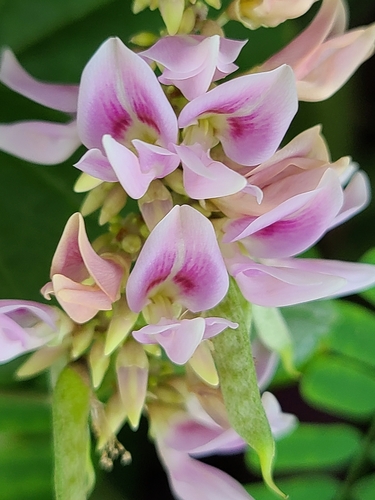
Pueraria phaseoloides
(Roxb.) Benth.
Tropical kudzu

(c) Phan Vũ Phúc Lân, some rights reserved (CC BY-NC)

(c) Phan Vũ Phúc Lân, some rights reserved (CC BY-NC)

(c) Phan Vũ Phúc Lân, some rights reserved (CC BY-NC)
What to Eat
Edible parts: Root, Tuber, Seeds
The tuberous root is edible.
Where to Find It
A tropical plant. It grows in hilly areas.
Africa, Angola, Asia, Australia, Bangladesh, Belize, Bhutan, Brazil, Cambodia, Cameroon, Caribbean, Central Africa, Central African Republic, CAR, Central America, China, Colombia, Cuba, Dominican Republic, East Africa, Ecuador, Fiji, French Guiana, Ghana, Guianas, Guyana, Himalayas, India, Indochina, Indonesia, Laos, Liberia, Malaysia, Maldives, Marquesas, Mauritius, Mozambique, Myanmar, Nepal, Nigeria, Niue, Northeastern India, Pacific, Panama, Papua New Guinea, PNG, Peru, Philippines, Puerto Rico, Reunion, Samoa, SE Asia, Seychelles, Sao Tome and Principe, SE Asia, Sierra Leone, Solomon Islands, South America, Sri Lanka, Suriname, Taiwan, Tanzania, Thailand, Togo, Vietnam, West Africa, West Indies,
How to Identify
A slender, hairy herb. It is a twining vine. It has fattened tuberous roots. The leaves have 3 leaflets. The leaflets are oval or triangular. The flowers are in pairs. They are purple and white. They occur on tall erect stalks. The fruit are long, flat, curved pods. There are about 16 seeds. There are 3 varieties recognised - javanica, phaseoloides, and subspicata. Possibly now Neustanthus
How to Grow
Tropical kudzu is a plant of the wet tropics, where it is found at elevations up to ,1,600 metres. It grows best in areas where annual daytime temperatures are within the range 15 - 30°c, but can tolerate 12 - 35°c. When dormant, the plant can survive temperatures down to about -2°c, but young growth can be severely damaged at -1°c. It prefers a mean annual rainfall in the range 1,200 - 3,200mm, but tolerates 850 - 4,300mm. Requires a sunny position in a well-drained soil. Succeeds in most soils of at least moderate fertility. Prefers a pH in the range 4.5 - 6.5, tolerating 3.5 - 8. The plant can send its roots down 1.5 metres into the soil, which probably explains why it can continue to grow during dry periods. Pueraria phaseoloides has been extensively introduced in tropical and subtropical region of the world for use as forage for livestock, to control soil erosion, and to improve the soil. It is a vigorous, fast-growing vine that is listed as one of the most aggressive weeds that are invading moist habitats in tropical and subtropical regions. It spreads by seeds and by runners, which enable it to multiply rapidly and quickly colonize large areas of forest. It has the potential to degrade other plants by smothering them under a solid blanket of leaves, by girdling woody stems and tree trunks, and by breaking branches or uprooting entire trees and shrubs by the strength of its weight. Currently, it is classified as a ‘noxious weed’ in the United States, and as an invasive species in Costa Rica, Ecuador, Puerto Rico and Pacific Islands including Hawaii, Fiji, French Polynesia, Niue and New Caledonia. Young plants grow away slowly for the first 3 - 4 months, but then grow rapidly and can cover the ground with their sprawling stems to a depth of 60 - 75cm within 12 months. The species has been classified into 3 varieties:- Var phaseoloides is a cultivated strain. It is sometimes naturalized in west Africa and the Americas. Var javanica is another cultivated strain. It is widely naturalized in Africa and the Americas. Var subspicata is truly wild and occurs spontaneously in south and southeast Asia. This species has a symbiotic relationship with certain soil bacteria, these bacteria form nodules on the roots and fix atmospheric nitrogen. Some of this nitrogen is utilized by the growing plant but some can also be used by other plants growing nearby.
Propagation: Pre-soak seed for 12 hours in warm water and sow in a warm greenhouse in early spring; germination should occur within 2 weeks. Prick seedlings into individual pots when large enough to handle and plant out after the last expected frosts, protecting young plants with a frame or cloche until they are growing well.
Medicinal Uses
A poultice of the plant is applied externally to ulcers and boils, particularly in children. A decoction is also taken internally.
Other Uses
This species is used as a forage and cover crop in tropical regions. The seeds have a high protein content of 12–20%, and the fresh whole plant (green parts) contains 3.8% protein and 7.3% sugar. It is commonly grown as a cover crop — often alongside Centro and Calopo — in oil palm, rubber, and coconut plantations. Its main advantages are a comparatively high nitrogen accumulation and improved soil structure due to its deep rooting system. It can be grazed as a forage crop or used as green manure in crop rotations, and helps prevent soil erosion. In Africa it is mainly used as a plantation cover crop, while in tropical America and Southeast Asia it is used as a forage crop in mixed stands and as a cover crop.
Wikipedia
Pueraria phaseoloides is a fast-growing hermaphroditic climber hardy to UK zone 10. Fixes nitrogen and adapts to light sandy, medium loamy, and heavy clay soils with good drainage across mildly acid to mildly alkaline pH ranges. Requires full sun, prefers moist soil, and tolerates drought.
Names & Synonyms
Alan susu, Dau-ma, Jermei-kyn-saw, Jermei-soh-gonsoh, Kachang-kachang, Kuzu-ingen, Pani alu, Riha thui, San day, Suloh, Tampong urat, Taw-pe, Tua-sian-pah
References (17)
- Ambasta S.P. (Ed.), 2000, The Useful Plants of India. CSIR India. p 504
- Burkill, H. M., 1985, The useful plants of west tropical Africa, Vol. 3. Kew.
- Burkill, I.H., 1966, A Dictionary of the Economic Products of the Malay Peninsula. Ministry of Agriculture and Cooperatives, Kuala Lumpur, Malaysia. Vol 2 (I-Z) p 1869
- Facciola, S., 1998, Cornucopia 2: a Source Book of Edible Plants. Kampong Publications, p 110
- ILDIS Legumes of the World http:www:ildis.org/Legume/Web
- J. Linn. Soc., Bot. 9:125. 1867
- Lim, T. K., 2015, Edible Medicinal and Non Medicinal Plants. Volume 9, Modified Stems, Roots, Bulbs. Springer p 71
- McMakin, P.D., 2000, Flowering Plants of Thailand. A Field Guide. White Lotus. p 69
- Nyadanu, D., et al, 2015, Agro-biodiversity and challenges of on-farm conservation: the case of plant genetic resources of neglected and underutilized crop species in Ghana. Genet. Resourc. Crop Evol. 62(7):
- Patiri, B. & Borah, A., 2007, Wild Edible Plants of Assam. Geethaki Publishers. p 39
- Pegu, R., et al, 2013, Ethnobotanical study of Wild Edible Plants in Poba Reserved Forest, Assam, India. Research Journal of Agriculture and Forestry Sciences 1(3):1-10
- Plants for a Future database, The Field, Penpol, Lostwithiel, Cornwall, PL22 0NG, UK. http://www.scs.leeds.ac.uk/pfaf/
- Roa, J. A. G. & Boada, D. S. G., 2018, Fundación para el Fortalecimiento de la Fruticultura y Plantas Alimenticias no Convencionales en Colombia.
- Sarma, H., et al, 2010, Updated Estimates of Wild Edible and Threatened Plants of Assam: A Meta-analysis. International Journal of Botany 6(4): 414-423
- Sujanapal, P., & Sankaran, K. V., 2016, Common Plants of Maldives. FAO & Kerala FRI, p 224
- Van Sam, H. et al, 2008, Uses and Conservation of Plant Species in a National Park. A case study of Ben En, Vietnam. Economic Botany 62:574-593
- World Checklist of Useful Plant Species 2020. Royal Botanic Gardens, Kew p 321 (As Neustanthus phaseoloides)