Pyracantha coccinea
M. J. Roem.
Everlasting Thorn, Coral Tree, Scarlet firethorn
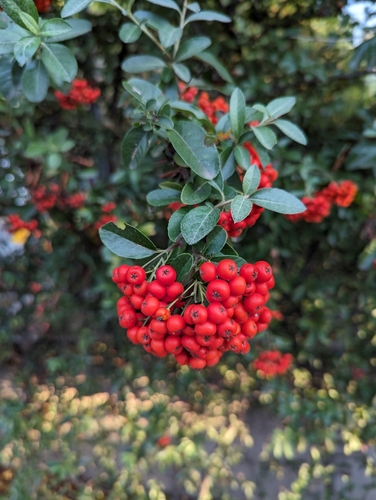
(c) Johnny Roger Pedersen, some rights reserved (CC BY-NC), uploaded by Johnny Roger Pedersen

(c) Nelson Caja Herrera, some rights reserved (CC BY-NC), uploaded by Nelson Caja Herrera

(c) Nelson Caja Herrera, some rights reserved (CC BY-NC), uploaded by Nelson Caja Herrera
What to Eat
Edible parts: Fruit
The fruit is used cooked, particularly for making jellies, marmalade and sauces.
Known Hazards
Where to Find It
TEMPERATE ASIA: Iran (north), Lebanon, Syria, Turkey, Armenia, Azerbaijan, Georgia EUROPE: Switzerland, Czech Republic, Slovakia, Ukraine (Krym), Albania, Bulgaria, Greece, Croatia, North Macedonia, Montenegro, Spain (northeast), France (south)
How to Identify
Evergreen shrub growing rapidly to 4 m tall by 4 m wide with year-round foliage. Hardy to UK zone 6. Flowers in June and attracts bees and wildlife. Establishes in light sandy, medium loamy, and heavy clay soils with good drainage across mildly acid to very alkaline pH. Grows in full shade, semi-shade, or no shade with moist soil preference. Tolerates strong winds and atmospheric pollution but not maritime exposure.
How to Grow
Prefers a good well-drained, moisture-retentive loamy soil. Succeeds in any soil that is warm and not very heavy. Another report says that it grows well in heavy clay soils. Succeeds on chalky soils. Succeeds in sun or part shade and also on a shady wall, though it does not fruit so well in a shady position. Tolerates atmospheric pollution and reasonable exposure. A very ornamental plant, there are a number of named varieties. Susceptible to scab and fireblight, especially when grown on acid sandy soils. This species, especially the cultivar 'Lelandii', is notably resistant to honey fungus. Intolerant of root disturbance except when young. A good bee plant. Birds are particularly attracted to the fruit of this plant.
Propagation: Seed is best sown as soon as ripe in a cold frame with all fruit flesh removed, as this can inhibit germination. Stored seed requires 3 months of cold stratification and should be sown as early in the year as possible in a cold frame. Prick seedlings into individual pots when large enough to handle and grow on in the cold frame through their first winter. Plant out in late spring or early summer after the last expected frosts. Take cuttings of almost mature wood, 5–10cm with a heel, in mid-August in a cold frame. Pot up in October or the following spring.
Medicinal Uses
None known
Other Uses
Tolerant of trimming and reasonable exposure, this shrub can be grown as a hedge and forms a very spiny barrier. Also useful for erosion control and can be trained as an espalier. Attracts wildlife.
Wikipedia
Source ↗Pyracantha coccinea, the scarlet firethorn is the European species of firethorn or red firethorn that has been cultivated in gardens since the late 16th century. The tree has small white flowers. It produces small, bright red berries. Its leaves are slightly toothed and grow opposite to one another. The fruit is bitter and astringent, making it inedible when raw. The fruit can be cooked to make jellies, jams, sauces and marmalade. It ranges from southern Europe to western Asia. It has been introduced to North America and cultivated there as an ornamental plant since the 18th century. In England, since the late 18th century, it has been used to cover unsightly walls.
Production
A thorny evergreen bush. It grows 1-5 m high. It spreads to 4.5 m wide. The leaves are alternate with small irregular teeth around the edge. They are oval to sword shaped. Leaves are dark green and glossy above. The thorns also bear leaves. The leaf stalks are hairy. The flowers are white and occur in dense heads. The fruit are bright red berries.
Names & Synonyms
Ates dikeni, Chit'avasha, Firethorn, Holly spinoso, Mchende, Navadni ognjeni trn
References (16)
- Blamey, M and Grey-Wilson, C., 2005, Wild flowers of the Mediterranean. A & C Black London. p 76
- Bunderson, W. T. et al, 2002, Common Agroforestry Species in Malawi. Malawi Agroforestry Extension Project, Pubication No. 46, Lilongwe. p 48
- Bussman, R. W., et al, 2021, Unity in diversity—food plants and fungi of Sakartvelo (Republic of Georgia), Caucasus. Journal of Ethnobiology and Ethnomedicine (2021) 17:72 p 14
- Cundall, P., (ed.), 2004, Gardening Australia: flora: the gardener's bible. ABC Books. p 1115
- Ertug, F, Yenen Bitkiler. Resimli Türkiye Florası -I- Flora of Turkey - Ethnobotany supplement
- Facciola, S., 1998, Cornucopia 2: a Source Book of Edible Plants. Kampong Publications, p 205
- Fam. nat. syn. monogr. 3:219. 1847
- Harris, E & J., 1983, Field Guide to the Trees and Shrubs of Britain. Reader's Digest. p 51
- Hibbert, M., 2002, The Aussie Plant Finder 2002, Florilegium. p 244
- http://www.botanic-gardens-ljubljana.com/en/plants
- Kremer, B.P., 1995, Shrubs in the Wild and in Gardens. Barrons. p 152. (Listed as fruit thought to be poisonous).
- Lord, E.E., & Willis, J.H., 1999, Shrubs and Trees for Australian gardens. Lothian. p 255
- Plants for a Future database, The Field, Penpol, Lostwithiel, Cornwall, PL22 0NG, UK. http://www.scs.leeds.ac.uk/pfaf/
- Roa, J. A. G. & Boada, D. S. G., 2018, Fundación para el Fortalecimiento de la Fruticultura y Plantas Alimenticias no Convencionales en Colombia.
- Salvi, J. et al, 2016, A review: Underutilized wild edible plants as a potential source of alternative nutrition. International Journal of Botany Studies. Volume 1; Issue 4; May 2016; Page No. 32-36
- Sfikas, G., 1984, Trees and shrubs of Greece. Efstathiadis Group. Athens. p 90
More from Rosaceae


