Pyrus communis
L.
Pear
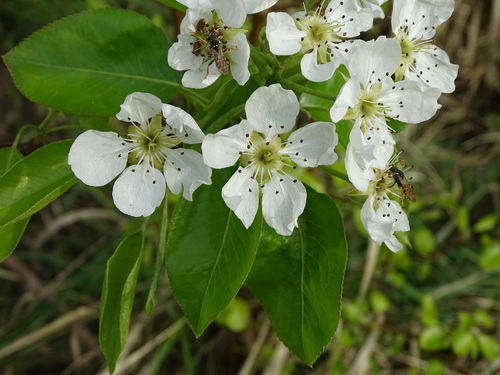
(c) Grzegorz Grzejszczak, some rights reserved (CC BY-SA), uploaded by Grzegorz Grzejszczak

(c) Eddi Bisulli, some rights reserved (CC BY-NC), uploaded by Eddi Bisulli

(c) erinkate, some rights reserved (CC BY-NC)
What to Eat
Edible parts: Fruit
The fruit, up to 5cm long, can be eaten raw or cooked, though wild pear fruit often remains very hard unless bletted and is more suited to use in pies and similar preparations.
Where to Find It
A temperate plant. They grow best in areas with cool to cold winters, mild summers and light spring rainfall. They can grow on a range of soils but do nest of deep, fertile, well-drained clay loams. Low chilling varieties (150 hours) are grown in subtropical climates. Most varieties require a chilling of about 1200 hours below 7°C. Most pears do best when temperatures are 15-21°C at fruiting time. It suits hardiness zones 2-9. Arboretum Tasmania.
Africa, Albania, Andorra, Argentina, Armenia, Asia, Australia, Austria, Azerbaijan, Balkans, Belgium, Bhutan, Brazil, Britain, Bulgaria, Canada, Cape Verde, Caucasus, Central America, Central Asia, Chile, China, Colombia, Costa Rica, Croatia, Cuba, Czech, Denmark, East Africa, Ecuador, Estonia, Eurasia, Europe, Finland, France, Georgia, Germany, Greece, Haiti, Hawaii, Himalayas, Hungary, India, Indonesia, Iran, Italy, Japan, Kazakhstan, Kyrgyzstan, Lithuania, Macedonia, Mediterranean, Mexico, Middle East, Moldova, Myanmar, Nepal, North America, Northeastern India, Pacific, Pakistan, Palestine, Philippines, Poland, Portugal, Romania, Russia, Scandinavia, SE Asia, Serbia, Sikkim, Slovenia, South Africa, Southern Africa, South America, Spain, Sri Lanka, Sweden, Switzerland, Tajikistan, Tasmania, Turkey, Türkiye, Turkmenistan, Ukraine, Uruguay, USA, Uzbekistan, Vietnam, West Indies, Yugoslavia, Zimbabwe,
How to Identify
A medium to large tree. It grows to 20 m tall. It often has suckers around the base. It loses its leaves during the year. The leaves have stalks. The leaves are 5-14 cm long by 4-9 cm wide. They are oval to sword shaped. They taper to the tip. They have fine teeth around the edge. They are glossy and dark green above. The flowers are white. They occur in short shoots at the ends of branches. The fruit is pear shaped. It is rough with close, raised specks. They are yellowish green when ripe. The pulp is gritty. The thorns have been bread out of cultivated pears. There are many named varieties.
Nutrition Score: 20/100
| Part | Moisture | kJ | kcal | Protein | Vit A | Vit C | Iron | Zinc |
|---|---|---|---|---|---|---|---|---|
| Fruit - raw | 83.8 | 247 | 59 | 0.4 | 2 | 4 | 0.3 | 0.1 |
How to Grow
Prefers a good well-drained loam in full sun. Grows well in heavy clay soils. Tolerates light shade but does not fruit so well in such a position. Tolerates atmospheric pollution, excessive moisture and a range of soil types, if they are moderately fertile, avoiding only the most acid soils. Dislikes very exposed positions. Established plants are drought tolerant. A very hardy plant, tolerating temperatures down to below -15°c. Plants often sucker and can form dense thickets. A parent of the cultivated pear, possibly by crossing with P. nivalis and P. cordata. There are many hundreds of varieties of cultivated pears and they are widely cultivated in the temperate zone for their edible fruits. By selection of varieties fresh fruits can be obtained from late July to April or May of the following year. In garden design, as well as the above-ground architecture of a plant, root structure considerations help in choosing plants that work together for their optimal soil requirements including nutrients and water. Some pear species and varieties are self-fertile, but many require cross-pollination with another compatible pear variety to produce fruit. Pears are generally harvested in late Summer to early Autumn, depending on the variety and climate. Pear trees usually flower in Spring, typically around April to May (Northern Hemisphere), depending on the region. Pear trees typically grow at a moderate rate, reaching maturity in about 4 to 6 years, with some varieties taking longer.
Propagation: Seed is best sown in a cold frame as soon as it is ripe in autumn, when it will typically germinate in mid to late winter. Stored seed requires 8–10 weeks of cold stratification at 1°c and should be sown as early in the year as possible. Temperatures above 15–20°c can induce secondary dormancy. Prick out seedlings into individual pots once large enough to handle, and grow on in light shade in a cold frame or greenhouse for their first year. Plant out in late spring or early summer the following year.
Medicinal Uses
The fruit is astringent, febrifuge, and sedative.
Other Uses
Pear trees can be used in agroforestry systems for shade and windbreaks, contributing to biodiversity and providing food for wildlife. A yellow-tan dye can be obtained from the leaves. Trees are sometimes included in shelterbelt plantings. The wood is heavy, tough, durable, fine-grained, and hard, weighing 51lb per cubic foot; it is used by cabinet makers and instrument makers, and when covered with black varnish makes an excellent ebony substitute. Pear flowers are rich in nectar and pollen, attracting bees and other pollinators. The fruit provides food for birds and small mammals, the foliage offers shelter, and the tree structure can be used by birds for perching or nesting. Rough bark and leaf litter provide overwintering sites for invertebrates, and fallen leaves create habitat for ground-dwelling organisms.
Wikipedia
Source ↗Pyrus communis, the common pear, is a species of pear native to central and eastern Europe, and western Asia. It is one of the most important fruits of temperate regions, being the species from which most orchard pear cultivars grown in Europe, North America, and Australia have been developed. Two other species of pear, the Nashi pear (Pyrus pyrifolia) and the hybrid Chinese white or ya pear (Pyrus × bretschneideri, Chinese: 白梨; pinyin: báilí) are more widely grown in East Asia.
Production
Seedling trees can take 20-80 years to commence bearing. Grafted trees take 6-8 years to bear. Trees live for about 45 years.
Other Information
It is a cultivated food plant.
Names & Synonyms
Bagugosha, Birne, Herim, Metspirnipuu, Nashi, Nashpati, Naspati, Pera blanca, Pera caravella, Pera-europeia, Pera-manteigosa, Peral, Pir eropa, Poire, Querc, Sekok, Soh-phoh
References (75)
- Ambasta S.P. (Ed.), 2000, The Useful Plants of India. CSIR India. p 507
- Ashton, M. S., et al 1997, A Field Guide to the Common Trees and Shrubs of Sri Lanka. WHT Publications Ltd. pdf p 317
- Awan, M. R., et al, 2011, Studies on traditional knowledge of economically important plants of Kaghan Valley, Mansehra District, Pakistan. Journal of Medicinal Plants Research Vol. 5(16), pp. 3958-3967
- Bianchini, F., Corbetta, F., and Pistoia, M., 1975, Fruits of the Earth. Cassell. p 130
- Bodkin, F., 1991, Encyclopedia Botanica. Cornstalk publishing, p 858
- Brickell, C. (Ed.), 1999, The Royal Horticultural Society A-Z Encyclopedia of Garden Plants. Convent Garden Books. p 852
- Bussman, R. W., et al, 2016, A comparative ethnobotany of Khevsureti, Samtskhe-Javakheti, Tusheti, Svaneti, and Racha-Lechkhumi, Republic of Georgia (Sakartvelo), Caucasus. Journal of Ethnobiology and Ethnomedicine.
- Bussman, R. W. et al, 2017, Ethnobotany of Samtskhe-Javakheti, Sakartvelo (Republic of Georgia), Caucasus. Indian Journal of Traditional Knowledge Vol. 16(1) pp 7-24
- Bussman, R. W., et al, 2021, Unity in diversity—food plants and fungi of Sakartvelo (Republic of Georgia), Caucasus. Journal of Ethnobiology and Ethnomedicine (2021) 17:72 p 14
- Chandrashekara, U. M., 2009, Tree species yielding edible fruit in the coffee-based homegardens of Kerala, India: their diversity, uses and management. Food Sec. 1:361-370
- Cheifetz, A., (ed), 1999, 500 popular vegetables, herbs, fruits and nuts for Australian Gardeners. Random House p 235
- Coombes, A.J., 2000, Trees. Dorling Kindersley Handbooks. p 273
- Coronel, R.E., 1982, Fruit Collections in the Philippines. IBPGR Newsletter p 8 (As Pyrus sp.)
- Cruz, I. M., et al, 2015, Edible fruits and seeds in the State of Mexico. Revista Mexicana de Ciencias Agricolas. Vol. 6. Num. 2 pp 331-346
- Cundall, P., (ed.), 2004, Gardening Australia: flora: the gardener's bible. ABC Books. p 1118
- Dashorst, G.R.M., and Jessop, J.P., 1998, Plants of the Adelaide Plains & Hills. Botanic Gardens of Adelaide and State Herbarium. p 74
- Dogan, Y., et al, 2004, The Use of Wild Edible Plants in Western and Central Anatolia (Turkey). Economic Botany 58(4) pp. 684-690
- Dzhangaliev, A. D., et al, 2003, The Wild Fruit and Nut Plants of Kazakhstan, Horticultural Reviews, Vol. 29. pp 305-371
- Ethnobotanical Study of Tehsil Kabal, Swat District, KPK, Pakistan, Table 1
- Facciola, S., 1998, Cornucopia 2: a Source Book of Edible Plants. Kampong Publications, p 205
- Flowerdew, B., 2000, Complete Fruit Book. Kyle Cathie Ltd., London. p 26
- Glowinski, L., 1999, The Complete Book of Fruit Growing in Australia. Lothian. p 29
- Gouldstone, S., 1983, Growing your own Food-bearing Plants in Australia. Macmillan p 117
- Haj, F., et al, 2012, Species Diversity and Ethno Botanical Classes of the Flora of Allai Valley District Battagram Pakistan. International Journal of Plant Research 2012, 2(4): 111-123
- Hamayun, M., Ethnobotanical Studies of some Useful Shrubs and Trees of District Buner, NWFP, Pakistan
- Harris, E & J., 1983, Field Guide to the Trees and Shrubs of Britain. Reader's Digest. p 83
- Hedrick, U.P., 1919, (Ed.), Sturtevant's edible plants of the world. p 538
- Heywood, V. H. & Zohary, D.,1995, A Catalogue of the Wild Relatives of Cultivated Plants Native to Europe. Flora Mediterranea 5 - 1995, p 392
- Hibbert, M., 2002, The Aussie Plant Finder 2002, Florilegium. p 244
- Hinnawi, N. S. A., 2010, An ethnobotanical study of wild edible plants in the Northern West Bank "Palestine". An-Najah National University. p 96
- Hu, Shiu-ying, 2005, Food Plants of China. The Chinese University Press. p 450
- INFOODS:FAO/INFOODS Databases
- Jabeen, A., et al, 2009, Indigenous uses of economically important flora of Margallah Hills National Park, Islamabad, Pakistan. African Journal of Biotechnology Vol. 8 (5), pp. 763-784
- John, L., & Stevenson, V., 1979, The Complete Book of Fruit. Angus & Robertson p 223
- Kapelle, M., et al, 2000, Useful plants within a Campesino Community in a Costa Rican Montane Cloud Forest. Mountain Research and Development, 20(2): 162-171
- Khan, D. & Shaukat, S.S., 2006, The Fruits of Pakistan: Diversity, Distribution, Trends of Production and Use. Int. J. Biol. Biotech., 3(3):463-499
- Kiple, K.F. & Ornelas, K.C., (eds), 2000, The Cambridge World History of Food. CUP p 1831
- Lazarides, M. & Hince, B., 1993, Handbook of Economic Plants of Australia, CSIRO. p 202
- Little, E.L., 1980, National Audubon Society Field Guide to North American Trees. Alfred A. Knopf. p 509
- Lorenzi, H., Bacher, L., Lacerda, M. & Sartori, S., 2006, Brazilian Fruits & Cultivated Exotics. Sao Paulo, Instituto Plantarum de Estuados da Flora Ltda. p 513
- Luczaj, L. et al, 2014, Wild Food Plants of Dalmatia (Croatia). in A. Pieroni, C. L. Quave (eds.), Ethnobotany and Biocultural Diversities in the Balkans, p 138
- Mabey, R., 1973, Food for Free. A Guide to the edible wild plants of Britain, Collins. p 180
- Macmillan, H.F. (Revised Barlow, H.S., et al) 1991, Tropical Planting and Gardening. Sixth edition. Malayan Nature Society. Kuala Lumpur. p 318
- Manandhar, N.P., 2002, Plants and People of Nepal. Timber Press. Portland, Oregon. p 387
- Medsger, O. P., 1939, Edible Wild Plants. Macmillan Company. p 31
- Moerman, D. F., 2010, Native American Ethnobotany. Timber Press. p 458
- Paczkowska, G . & Chapman, A.R., 2000, The Western Australian Flora. A Descriptive Calatogue. Western Australian Herbarium. p 512
- Pieroni, A., 1999, Gathered wild food plants in the Upper Valley of the Serchio River (Garfagnana), Central Italy. Economic Botany 53(3) pp 327-341
- Pieroni A, Nebel S, Santoro RF, Heinrich M., 2005, Food for two seasons: culinary uses of non-cultivated local vegetables and mushrooms in a south Italian village. Int J Food Sci Nutr. 56(4):245-72
- Pieroni, A. & Soukand, R., 2017, The disappearing wild food and medicinal plant knowledge in a few mountain villages of North-Eastern Albania. Journal of Applied Botany and Food Quality 90, 58 - 67
- Plants for a Future database, The Field, Penpol, Lostwithiel, Cornwall, PL22 0NG, UK. http://www.scs.leeds.ac.uk/pfaf/ (Also as Pyrus communis var. sativa)
- Plants of Haiti Smithsonian Institute http://botany.si.edu/antilles/West Indies
- Polat, R., et al, 2017, Survey of wild food plants for human consumption in Bingol, (Turkey). Indian Journal of Traditional Knowledge. Vol. 16(3) July 2017, pp. 378-384
- Polunin, O., & Stainton, A., 2006, Flowers of the Himalaya, Oxford India Paperbacks. p 121
- Postman, J. D., et al, 2012, Recent NPGS Coordinated Expeditions in the Trans-Caucasus Region to Collect Wild Relatives of Temperate Fruit and Nut Crops. In Acta Horticulturae Number 948 p 191-198
- Roa, J. A. G. & Boada, D. S. G., 2018, Fundación para el Fortalecimiento de la Fruticultura y Plantas Alimenticias no Convencionales en Colombia.
- Ruiters-Welcome, A. K., 2019, Food plants of southern Africa. Ph.D. thesis. Univ. of Johannesburg p 95
- Sawian, J. T., et al, 2007, Wild edible plants of Meghalaya, North-east India. Natural Product Radiance Vol. 6(5): p 421
- Segura, S., et al, 2018, The edible fruit species in Mexico. Genet Resour Crop Evol (2018) 65:1767–1793
- Sfikas, G., 1984, Trees and shrubs of Greece. Efstathiadis Group. Athens. p 62
- Small, E., 2009, Top 100 Food Plants. The world's most important culinary crops. NRC Research Press. p 415
- Sp. pl. 1:479, 2:1200. 1753
- Staples, G.W. and Herbst, D.R., 2005, A tropical Garden Flora. Bishop Museum Press, Honolulu, Hawaii. p 477
- Stryamets, N., et al, 2015, From economic survival to recreation: contemporary uses of wild food and medicine in rural Sweden, Ukraine and NW Russia. Journal of Ethnobiology and Ethnomedicine 11:53
- Sukarya, D. G., (Ed.) 2013, 3,500 Plant Species of the Botanic Gardens of Indonesia. LIPI p 696
- Torre, de la, L., et al, 2008, Enciclopedia de las Plantas Útiles del Ecuador. Herbario QCA. Pontificia Universidad Católica del Ecuador. p 537
- Upreti, K., et al, 2010, Diversity and Distribution of Wild Edible Fruit Plants of Uttarakhand. Bioversity Potentials of the Himalaya. p 182
- USDA, ARS, National Genetic Resources Program. Germplasm Resources Information Network - (GRIN). [Online Database] National Germplasm Resources Laboratory, Beltsville, Maryland. Available: www.ars-grin.gov/cgi-bin/npgs/html/econ.pl (10 April 2000)
- van Wyk, B., 2005, Food Plants of the World. An illustrated guide. Timber press. p 317
- Watkins, R., 1979, Apple and Pear, in Simmonds, N.W., (ed), Crop Plant Evolution. Longmans. London. p 247
- Welcome, A. K. & Van Wyk, B.-E., 2019, An inventory and analysis of the food plants of southern Africa. South African Journal of Botany 122 (2019) 136–179
- Wiersema, J. H. & Leon, B., 2013, World Economic Plants. A Standard Reference CRC Press. 2nd Ed. p 574
- World Checklist of Useful Plant Species 2020. Royal Botanic Gardens, Kew
- www.efloras.org Flora of China Volume 9 (As Pyrus communis var. sativa)
- www.worldagroforestrycentre.org/treedb/
More from Rosaceae


