Pyrus cordata
Desv.
Plymouth pear, Algerian pear

(c) Natural England, some rights reserved (CC BY-NC-ND)
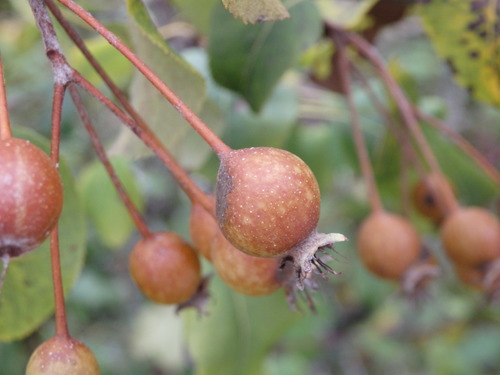
(c) Beatriz Machado, some rights reserved (CC BY-NC), uploaded by Beatriz Machado

(c) Miguel A. Casado, some rights reserved (CC BY-NC), uploaded by Miguel A. Casado
What to Eat
Edible parts: Fruit
The fruit, which is fairly small at around 10–18mm long, can be eaten raw or cooked.
Where to Find It
It is a temperate or Mediterranean plant. Arboretum Tasmania.
Africa*, Algeria, Australia, Britain, Europe, France, Mediterranean, Morocco, North America, Portugal, Spain, Tasmania, USA,
How to Identify
A small tree. It grows 4 m tall. It loses its leaves during the year. The leaves are oval. The flowers are white and have a scent. The fruit are small and round.
How to Grow
Prefers a good well-drained loam in full sun. Grows well in heavy clay soils. Tolerates light shade but does not fruit so well in such a position. Tolerates atmospheric pollution, excessive moisture and a range of soil types if they are moderately fertile. Established plants are drought tolerant. Plants are hardy to about -15°c.
Propagation: Seed is best sown in a cold frame as soon as it is ripe in autumn, when it will typically germinate in mid to late winter. Stored seed requires 8–10 weeks of cold stratification at 1°c and should be sown as early in the year as possible. Temperatures above 15–20°c can induce secondary dormancy. Prick out seedlings into individual pots once large enough to handle, and grow on in light shade in a cold frame or greenhouse for their first year. Plant out in late spring or early summer the following year.
Medicinal Uses
None known
Other Uses
None known
Wikipedia
Source ↗Pyrus cordata, the Heart-leaved pear or Plymouth pear, is a rare wild species of pear belonging to the family Rosaceae. It gets its name in Spanish, Portuguese and French from the shape of its leaves. In the UK, it is known as Plymouth Pear after the city of Plymouth in Devon, where it was originally found in 1870 The Plymouth pear was one of the British trees to be funded under English Natures Species Recovery Programme. It is a small tree, that grows in hedgerows or at the edge of woods. The Plymouth pear is considered to be either a subspecies of Pyrus pyraster (European wild pear) or a distinct species. It is one of the rarest trees in the UK and it is protected under Schedule 8 of the Wildlife and Countryside Act and seeds have been deposited at Kew's Millennium Seed Bank.
Names & Synonyms
Basomakatza, Peras cermenas, Peras modorras, Perojo, Peruyes
References (7)
- Menendez-Baceta, G., et al, 2012, Wild edible plants traditionally gathered in Gorbeialdea (Biscay, Basque Country) Genetic Resources and Crop Evolution 59:1329-1347
- Observ. pl. Angers 152. 1818
- Pardo-de-Santayana, M., et al, 2007, Traditional knowledge of wild edible plants used in the northwest of the Iberian Peninsula (Spain and Portugal): a comparative study. Journal of Ethnobiology and Ethnomedicine 2007, 3:27
- Plants for a Future database, The Field, Penpol, Lostwithiel, Cornwall, PL22 0NG, UK. http://www.scs.leeds.ac.uk/pfaf/
- Rivera, C., et al, 2005, The Ethnobotanical Study of Local Mediterranean Food Plants as Medicinal Resources in Southern Spain. Journal of Physiologyand Pharmacology. 56, Suppl. 1, 97-114
- Rivera, D. et al, 2006, Gathered Mediterranean Food Plants - Ethnobotanical Investigations and Historical Development, in Heinrich M, Müller WE, Galli C (eds): Local Mediterranean Food Plants and Nutraceuticals. Forum Nutr. Basel, Karger, 2006, vol 59, pp 18–74
- Tardio, J., et al, Ethnobotanical review of wild edible plants in Spain. Botanical J. Linnean Soc. 152 (2006), 27-71
More from Rosaceae


