Pyrus pyraster
(L.) Burgsd.
Wild pear
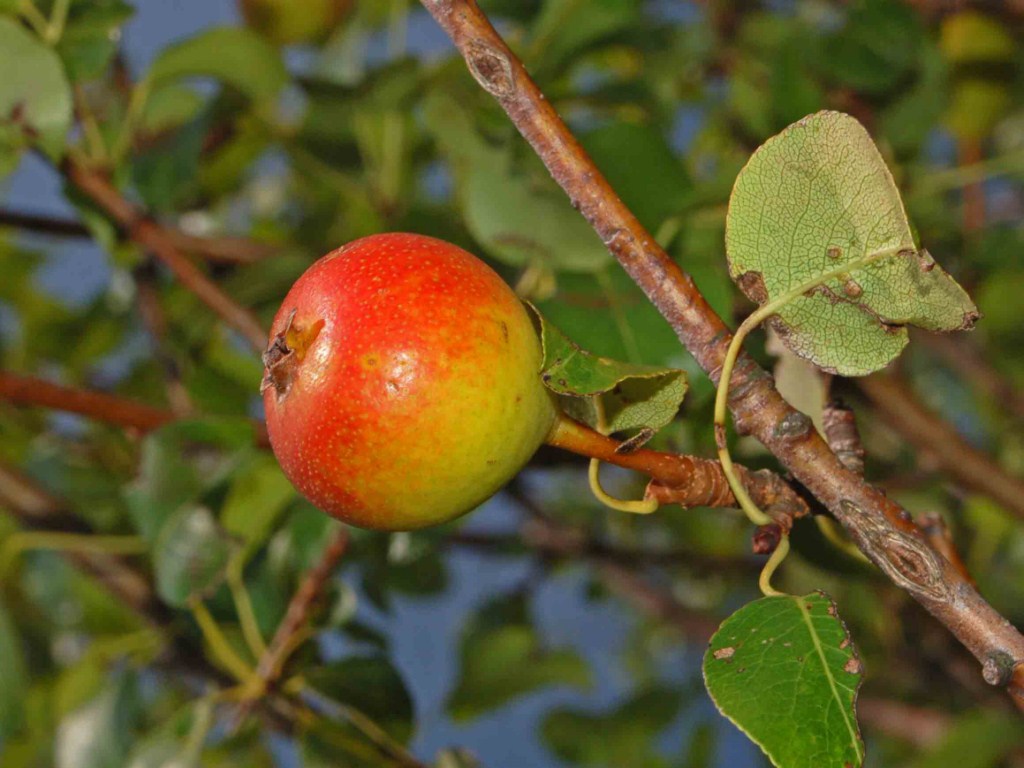
Wikimedia Commons - Rosaceae_-_Pyrus_pyraster_-_Perastro-1.JPG

(c) konstantin_m, some rights reserved (CC BY-NC)

(c) konstantin_m, some rights reserved (CC BY-NC)
What to Eat
Edible parts: Fruit, Flowers - tea
The fruit can be eaten raw or cooked and is often borne in abundance, reaching up to 35mm in diameter. It ripens from late summer into early autumn. Freshly picked fruit is rather hard and astringent, but once it falls from the tree it bletts quickly, developing a good flavour and becoming soft and quite juicy.
Where to Find It
It is a temperate plant. It is native to Central and SW Europe. It suits hardiness zones 4-9. Arboretum Tasmania.
Albania, Asia, Australia, Balkans, Belarus, Bosnia, Britain, Bulgaria, China, Estonia, Europe, Hungary, India, Italy, Lithuana, Luxembourg, Macedonia, Mediterranean, Poland, Portugal, Romania, San Marino, Slovenia, Tasmania, Turkey, Türkiye, Ukraine,
How to Identify
A spreading tree. It grows 9 m high and spreads 9 m wide. The branches and twigs have thorns. The leaves are thin and oval. They are 5 cm long. The flowers are small and white. They have a scent. The fruit are small and pear shaped. They occur in clusters. They have brown speckles when ripe.
How to Grow
Prefers a good well-drained loam in full sun. Grows well in heavy clay soils. Tolerates light shade but does not fruit so well in such a position. Tolerates atmospheric pollution, excessive moisture and a range of soil types if they are moderately fertile. Established plants are drought tolerant. Plants are hardy to about -15°c.
Propagation: Seed is best sown in a cold frame as soon as it is ripe in autumn, when it will typically germinate in mid to late winter. Stored seed requires 8–10 weeks of cold stratification at 1°C and should be sown as early in the year as possible. Temperatures above 15–20°C can induce a secondary dormancy. Prick out seedlings into individual pots once large enough to handle, and grow on in light shade in a cold frame or greenhouse through their first year. Plant out in late spring or early summer the following year.
Medicinal Uses
None known
Other Uses
None known
Wikipedia
Source ↗Pyrus pyraster (syn. Pyrus communis subsp. pyraster), also called European wild pear, is a species of pear of the family Rosaceae. This wild pear and Pyrus caucasica (syn. P. communis subsp. caucasica) are thought to be the ancestors of the cultivated European pear (Pyrus communis subsp. communis). Both the wild pears are interfertile with domesticated pears. It is sometimes difficult to distinguish Pyrus pyraster from a common pear. Pyrus pyraster can reach an age of 100 to 150 years.
Notes
Name used for European wild relative of the cultivated pear
Names & Synonyms
Diva krusha, Divlja kruska, Drobnica, Grusza, Hroshka, Hrusa, Kriause, Metsik pirnipuu, Par salbatic, Pero selvatico
References (19)
- Anleit. Erzieh. Holzarten 2:193. 1787
- Cerne, M., 1992, Wild Plants from Slovenia used as Vegetables. Acta Horticulturae 318
- Cundall, P., (ed.), 2004, Gardening Australia: flora: the gardener's bible. ABC Books. p 1119
- Denes, A., et al, 2012, Wild plants used for food by Hungarian ethnic groups living in the Carpathian Basin. Acta Societatis Botanicorum Poloniae 81 (4): 381-396
- http://www.botanic-gardens-ljubljana.com/en/plants
- Irving, M., 2009, The Forager Handbook, A Guide to the Edible Plants of Britain. Ebury Press p 275
- Kremer, B.P., 1995, Shrubs in the Wild and in Gardens. Barrons. p 153
- Luczaj, L. et al, 2013, Wild edible plants of Belarus: from Rostakinski's questionnaire of 1883 to the present. Journal of Ethnobiology and Ethnomedicine 9:21
- Plants for a Future database, The Field, Penpol, Lostwithiel, Cornwall, PL22 0NG, UK. http://www.scs.leeds.ac.uk/pfaf/
- Nedelcheva A., 2013, An ethnobotanical study of wild edible plants in Bulgaria. EurAsian Journal of BioSciences 7, 77-94
- Pieroni, A. & Soukand, R., 2018, Forest as Stronghold of Local Ecological Practice: Currently Used Wild Food Plants in Polesia, Northern Ukraine. Economic Botany, XX(X) pp. 1-21
- Prakofjewa, J., et al, 2023, Boundaries Are Blurred: Wild Food Plant Knowledge Circulation across the Polish-Lithuanian-Belarusian Borderland. Biology 2023, 12, 571.
- Redzic, S. J., 2006, Wild Edible Plants and their Traditional Use in the Human Nutrition in Bosnia-Herzegovina. Ecology of Food and Nutrition, 45:189-232
- Redzic, S., 2010, Use of Wild and Semi-Wild Edible Plants in Nutrition and Survival of People in 1430 Days of Siege of Sarajevo during the War in Bosnia and Herzegovina (1992–1995). Coll. Antropol 34 (2010) 2:551-570
- Sansanelli, S., et al, 2014, Wild food plants traditionall consumed in the area of Bologna (Emilia Romagna region, Italy). Journal of Ethnobiology and Ethnomedicine 10:69
- Sansanelli, S., et al, 2017, Ethnobotanical survey of wild food plants traditionally collected and consumed in the Middle Agri Valley (Basilicata region, southern Italy). Journal of Ethnobiology and Ethnomedicine (2017) 13:50
- Soukand, R. & Kalle, R., 2016, Perceiving the Biodiversity of Food at Chest-height: use of the Fleshy Fruits of Wild Trees and Shrubs in Saaremaa, Estonia. Hum Ecol 44:265–272
- Soukand, R., et al, 2017, Multi-functionality of the few: current and past uses of wild plants for food and healing in Liubań region, Belarus. Journal of Ethnobiology and Ethnomedicine (2017) 13:10
- Vari, A., et al, 2020, Berries, greens, and medicinal herbs—mapping and assessing wild plants as an ecosystem service in Transylvania (Romania). Journal of Ethnobiology and Ethnomedicine (2020) 16:13
More from Rosaceae


