Pyrus syriaca
Boiss.
Wild pear
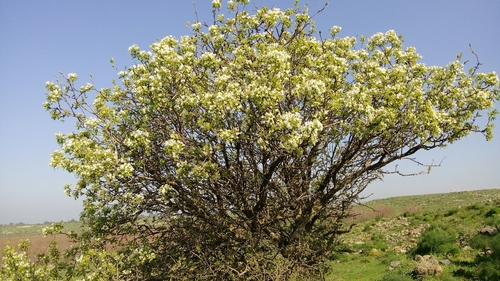
(c) עומר וינר, some rights reserved (CC BY-NC), uploaded by עומר וינר
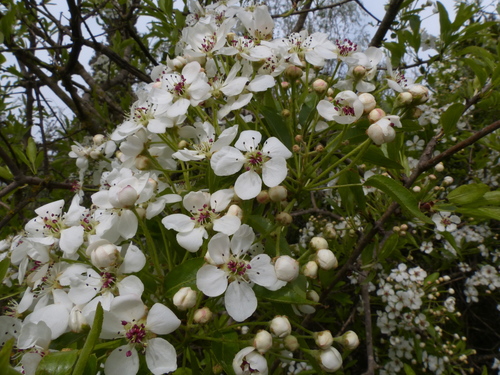
(c) Ron Frumkin, some rights reserved (CC BY-NC), uploaded by Ron Frumkin
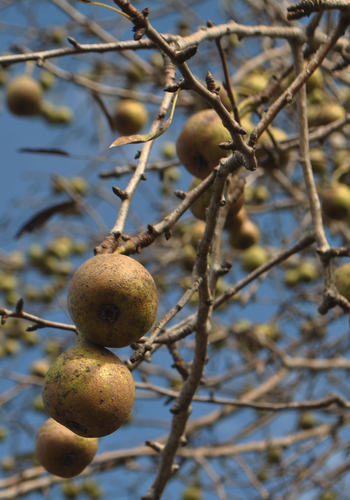
(c) M. Salimeh, some rights reserved (CC BY-NC), uploaded by M. Salimeh
What to Eat
Edible parts: Fruit
The fruit, which grows to about 3cm long, can be eaten raw or cooked.
Where to Find It
A temperate plant.
Armenia, Balkans, Caucasus, Cyprus, Europe, Iran, Iraq, Jordan, Lebanon, Mediterranean, Middle East, Palestine, Syria, Turkey, Türkiye,
How to Identify
A tree. It grows 13 m tall. The crown is broad. The leaves are narrow oval and 1-10 cm long by 0.8-4 cm wide. The fruit is round or pear shaped and 1.5-3.5 cm long by 1.5-3.5 cm wide.
How to Grow
Prefers a good well-drained loam in full sun. Grows well in heavy clay soils. Tolerates light shade but does not fruit so well in such a position. Tolerates atmospheric pollution, excessive moisture and a range of soil types if they are moderately fertile. Established plants are drought tolerant. Plants are hardy to about -15°c. Trees are locally cultivated in Europe and occasionally naturalized in Hungary.
Propagation: Seed is best sown in a cold frame as soon as it is ripe in autumn, when it will typically germinate in mid to late winter. Stored seed requires 8–10 weeks of cold stratification at 1°c and should be sown as early in the year as possible. Temperatures above 15–20°c can induce secondary dormancy. Prick out seedlings into individual pots when large enough to handle and grow on in light shade in a cold frame or greenhouse for their first year. Plant out in late spring or early summer the following year.
Medicinal Uses
None known
Other Uses
None known
Wikipedia
Source ↗Pyrus syriaca, commonly known as the Syrian pear, is a deciduous tree in the family Rosaceae. The tree grows up to 13 metres tall with a broad, sometimes irregular crown. It features reddish-brown to grey branches marked by small lenticels, elliptic to ovate leaves with toothed margins, and white five-petalled flowers that appear in loose clusters during late April to early May. Its fruits are greenish-yellow pomes ranging from nearly spherical to broadly pear-shaped, maturing from late August through October. Native to the eastern Mediterranean region and adjacent areas, its range extends from southern Turkey and the Transcaucasus through Cyprus, western Syria, northeastern Iraq, Lebanon, western Jordan, and into southwestern Iran. The species favours dry, well-drained habitats, often growing on sun-exposed, rocky slopes and in open oak forests, sometimes forming nearly pure stands alongside almond, maple, and hawthorn trees.
Other Information
It is cultivated.
Names & Synonyms
Ajas barri, Adi armut, Cakal armudu, Injas barri, Kroskakiiwilka, Najas barri, Reli, Sekok
References (20)
- Ali-Shtayeh, M. S., et al, 2008, Traditional knowledge of wild edible plants used in Palestine (Northern West Bank): A comparative study. J Ethnobiol Ethnomed. 4: 13
- Al-Qura'n, S. A., 2010, Ethnobotanical and Ecological Studies of Wild Edible Plants in Jordan. Libyan Agriculture Research Center Journal International 1(4):231-243
- Arora, R. K., 2014, Diversity in Underutilized Plant Species - An Asia-Pacific Perspective. Bioversity International. p 84
- Della, A., et al, 2006, An ethnobotanical survey of wild edible plants of Paphos and Larnaca countryside of Cyprus. J. Ethnobiol. Ethnomed. 2:34
- Diagn. pl. orient. ser. 1, 10:1. 1849
- Dogan, A. & Tuzlaci, E., 2015, Wild Edible Plants of Pertek (Tunceli-Turkey). Marmara Pharmaceutical Journal 19: 126-135
- Ertug, F, Yenen Bitkiler. Resimli Türkiye Florası -I- Flora of Turkey - Ethnobotany supplement
- Galalaey, A. M. K., et al, 2021, Ethnobotanical study of some wild edible plants in Hujran Bason, Kurdistan Region of Iraq. ZANCO Journal of Pure and Applied Sciences. Salahaddin University-Erbil p 28
- Hedrick, U.P., 1919, (Ed.), Sturtevant's edible plants of the world. p 544
- Mukemre, M., et al, 2016, Survey of wild food plants for human consumption in villages of Catak, (Van-Turkey), Indian Journal of Traditional Knowledge. Vol. 15(2) pp. 183-191
- Oran, S. A. S., 2015, Selected wild plant species with exotic flowers from Jordan. International Journal of Bioversity and Conservation. Vol. 7(5), pp 308-320
- Oran, S. A. S., 2015, Selected Wild Aromatic Plants in Jordan. International Journal of Medicinal Plants. Photon 108 (2015) 686-699
- Plants for a Future database, The Field, Penpol, Lostwithiel, Cornwall, PL22 0NG, UK. http://www.scs.leeds.ac.uk/pfaf/
- Postman, J. D., et al, 2012, Recent NPGS Coordinated Expeditions in the Trans-Caucasus Region to Collect Wild Relatives of Temperate Fruit and Nut Crops. In Acta Horticulturae Number 948 p 191-198
- Rivera, D. et al, 2006, Gathered Mediterranean Food Plants - Ethnobotanical Investigations and Historical Development, in Heinrich M, Müller WE, Galli C (eds): Local Mediterranean Food Plants and Nutraceuticals. Forum Nutr. Basel, Karger, 2006, vol 59, pp 18–74
- Tukan, S. K., et al, 1998, The use of wild edible plants in the Jordanian diet. International Journal of Food Sciences and Nutrition. 49:225-235
- Wild Edible Plants in Lebanon. Promoting dietary diversity in poor communities in Lebanon. http://www.wildedibleplants.org/
- Yesil, Y., et al, 2019, Traditional knowledge of wild edible plants in Hasankeyf (Batman Province, Turkey). Acta Societatis Botanicorum Poloniae. 88(3):3633
- Zamani, A., et al, 2012, A synopsis of the genus Pyrus (Rosaceae) in Iran. Nordic Journal of Botany 30: 310–332
- Zeven, A. C. & de West, J. M. J., 1982, Dictionary of cultivated plants and their regions of diversity. Wageningen. p 101
More from Rosaceae


