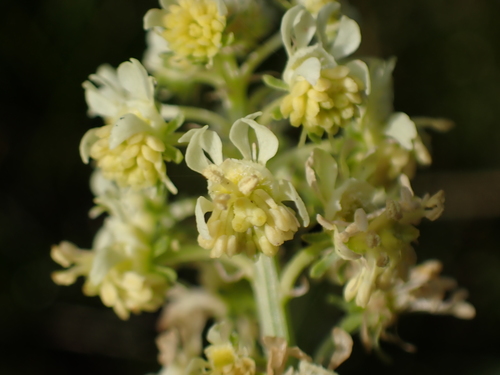
Reseda villosa
Coss.
ResedaceaeSeeds/Nuts

iNaturalist · cc-by-nc
(c) leo_mrn, some rights reserved (CC BY-NC)
(c) leo_mrn, some rights reserved (CC BY-NC)

iNaturalist · cc-by
(c) Karim Haddad, some rights reserved (CC BY)
(c) Karim Haddad, some rights reserved (CC BY)
What to Eat
Edible parts: Seeds
The seeds are edible.
Where to Find It
It is a Mediterranean plant. It grows in desert places.
Africa, Algeria, Mali, Mediterranean, Morocco, North Africa, Sahara, Sudan, West Africa,
Countries: Albania, Angola, Bosnia & Herzegovina, Burkina Faso, Burundi, Benin, Botswana, Congo (DRC), Central African Republic, Congo (Republic), Cote d'Ivoire, Cameroon, Cape Verde, Cyprus, Djibouti, Algeria, Egypt, Eritrea, Spain, Ethiopia, France, Gabon, Ghana, Gambia, Guinea, Equatorial Guinea, Greece, Guinea-Bissau, Croatia, Israel, Italy, Kenya, Comoros, Lebanon, Liberia, Lesotho, Libya, Morocco, Monaco, Montenegro, Madagascar, Mali, Mauritania, Malta, Mauritius, Malawi, Mozambique, Namibia, Niger, Nigeria, Rwanda, Seychelles, Sudan, Slovenia, Sierra Leone, Senegal, Somalia, South Sudan, Sao Tome & Principe, Syria, Eswatini, Chad, Togo, Tunisia, Turkey, Tanzania, Uganda, South Africa, Zambia, Zimbabwe
How to Identify
A herb. It grows 60-70 cm tall. The leaves are long and large and have teeth along the edge. The flowers are white. They are on a long flower stalk.
Notes
There are between 55 and 60 Reseda species.
Names & Synonyms
Abbellengat, Bu sraysra, Timerna
Reseda sudanica A. Chev.
References (3)
- Burkill, H.M. 1985. The useful plants of west tropical Africa, Vol. 4
- Jardin, C., 1970, List of Foods Used In Africa, FAO Nutrition Information Document Series No 2.p 47
- Heywood, V.H., Brummitt, R.K., Culham, A., and Seberg, O. 2007, Flowering Plant Families of the World. Royal Botanical Gardens, Kew. p 277