Rhagodia spinescens
R. Br.
Hedge Saltbush, Spiny saltbush, Thorny saltbush
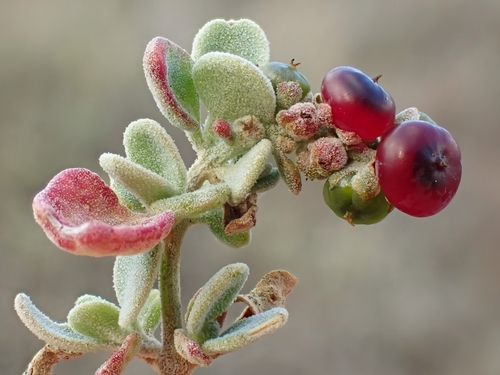
(c) cinclosoma, some rights reserved (CC BY-NC), uploaded by cinclosoma
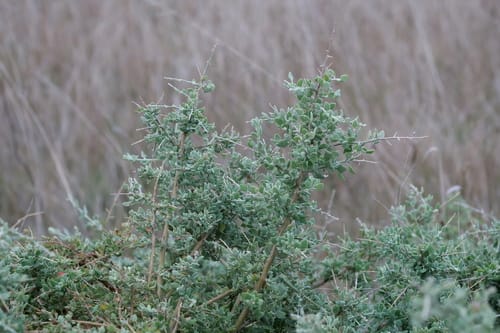
(c) Bernadette Lingham, some rights reserved (CC BY-NC)
What to Eat
Edible parts: Fruit, Leaves
Young leaves can be cooked and have a salty flavour. The fruit is eaten raw and is sweet and palatable.
Where to Find It
It grows in temperate regions. It can grow in the subtropics. It needs well drained soil. It can grow in full sun or light shade. It can stand light frosts. It can stand drought and high temperatures. It suits Mediterranean climates.
Australia*, Tasmania,
How to Identify
A spreading ground cover. It branches freely. The branches often produce roots at the node. It grows 60-75 cm high. It spreads 1-1.5 m wide. The leaves are silvery. They are small and triangle shaped. They can be spiny. The flowers are small.
How to Grow
We have very little information on this species and do not know if it will be hardy in Britain. It tolerates temperatures down to about -7°c in Australian gardens, though this cannot be translated directly to British gardens due to our cooler summers and longer colder and wetter winters. This species is unlikely to be hardy anywhere other than the mildest parts of the country. Requires a sunny position and a well-drained soil.
Propagation: Sow seed in spring in a greenhouse, barely covering it. Germination should occur within a week. Prick out seedlings into individual pots once large enough to handle, and plant out after the last expected frosts.
Medicinal Uses
None known
Other Uses
None known
Wikipedia
Source ↗Evergreen shrub reaching 0.5 m tall. Hardy to UK zone 9. Grows in light sandy, medium loamy, and heavy clay soils with good drainage. Tolerates mildly acid, neutral, and basic soils. Requires full sun and prefers moist conditions.
Notes
Also put in the family Chenopodiaceae.
Names & Synonyms
References (9)
- Elliot, R., 2003, Australian Plants for Mediterranean Climate gardens. Rosenberg. p 35
- Hibbert, M., 2002, The Aussie Plant Finder 2002, Florilegium. p 246
- Lord, E.E., & Willis, J.H., 1999, Shrubs and Trees for Australian gardens. Lothian. p 191
- Molyneux, B. and Forrester, S., 1997, The Austraflora A-Z of Australian Plants. Reed. p 148
- Paczkowska, G. & Chapman, A.R., 2000, The Western Australian Flora. A Descriptive Catalogue. Western Australian Herbarium. p 208
- Plants for a Future database, The Field, Penpol, Lostwithiel, Cornwall, PL22 0NG, UK. http://www.scs.leeds.ac.uk/pfaf/
- Prodr. 408. 1810
- Williams, K.A.W., 1999, Native Plants of Queensland Volume 4. Keith A.W. Williams North Ipswich, Australia. p 340
- Williams A. & Sides, T., 2008, Wiradjuri Plant Use in the Murrumbidgee Catchment. Murrumbidgee Catchment Management Authority. Wagga Wagga, p 66