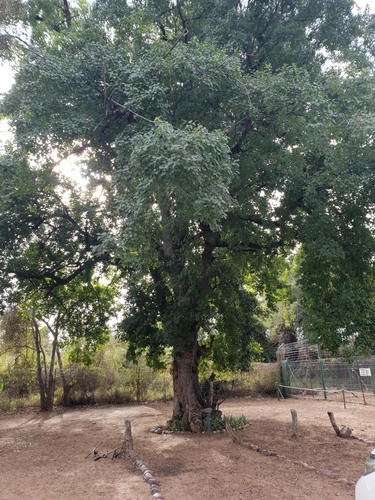
Rhamnella franguloides
(Maxim.) Weberb.
Mao run
(c) Amaël Borzée, some rights reserved (CC BY-NC)
(c) green_finger, some rights reserved (CC BY-NC)
(c) 北马兜铃, some rights reserved (CC BY-NC)
What to Eat
Edible parts: Fruit
The fruit is edible and turns dark purple when fully ripe, reaching up to 10mm in length.
Where to Find It
It is a temperate plant. It grows on forest slopes below 1,100 m in China.
Asia, China, Japan, Korea,
How to Identify
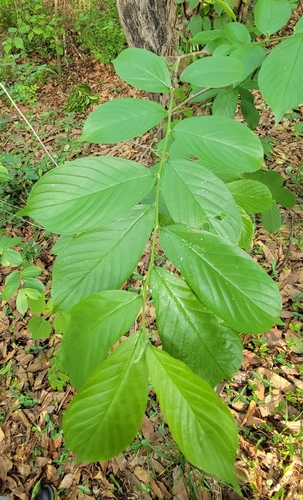
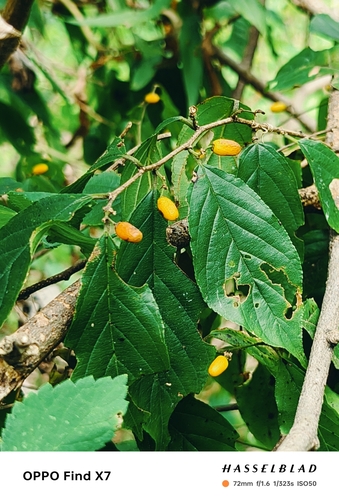
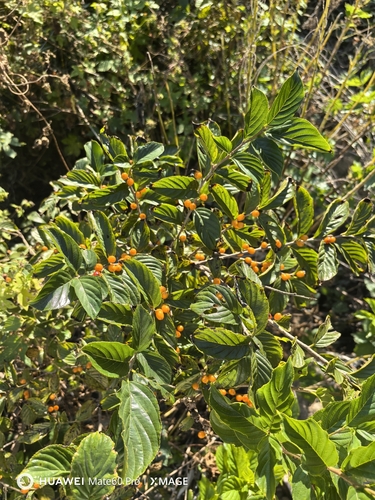
A shrub or small tree. It grows 2-9 m tall. It loses its leaves during the year. The young branches are green and densely hairy. The leaves are green above and yellow-green underneath. They are 4-12 cm long by 2-5 cm wide. The flowers are yellowish-green. The fruit is fleshy and has a stone inside. The fruit are red or orange when ripe. They are 7-9 mm long by 2-5 mm wide.
How to Grow
Propagation: Seed is best sown in autumn in a cold frame. Stored seed requires 1–2 months of stratification and should be sown as early in the year as possible in a cold frame. Prick seedlings out into individual pots when large enough to handle and grow on in the greenhouse for at least their first winter. Plant out into permanent positions in late spring or early summer, after the last expected frosts. Cuttings of half-ripe wood can be taken in July/August in a frame, or cuttings of mature wood from the current year's growth in autumn in a frame. Layering can be done in early spring.
Medicinal Uses
None known
Other Uses
None known
Wikipedia
Deciduous shrub growing to 6 m tall. Flowers May to June with seeds ripening August to October. Hermaphrodite species. Tolerates light sandy, medium loamy, and heavy clay soils with mildly acid to basic pH. Grows in semi-shade or full sun and prefers moist soil.
Other Information
Eaten especially by children.
Notes
There are 9 or 10 Rhamnella species.
Names & Synonyms
References (4)
- Altschul, S.V.R., 1973, Drugs and Foods from Little-known Plants. Notes in Harvard University Herbaria. Harvard Univ. Press. Massachusetts. no. 2630
- Flora of China, 2007, 12:131-133
- H. G. A. Engler & K. A. E. Prantl, Nat. Pflanzenfam. 3(5):406. 1895
- Plants for a Future database, The Field, Penpol, Lostwithiel, Cornwall, PL22 0NG, UK. http://www.scs.leeds.ac.uk/pfaf/