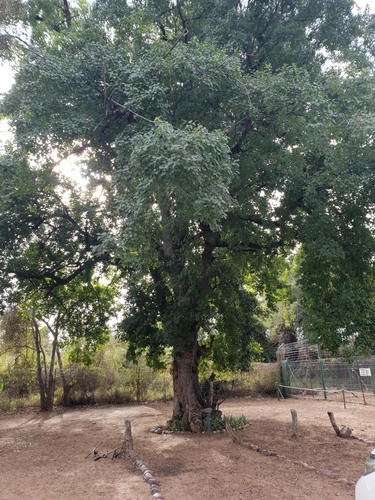
Rhamnus crocea
Nutt.
Holly-leaf Buckthorn, Spiny red berry

(c) Preserve Wild Poway, some rights reserved (CC BY-NC), uploaded by Preserve Wild Poway

(c) klicklo, some rights reserved (CC BY)

(c) 2009 Keir Morse, some rights reserved (CC BY-NC-SA)
What to Eat
Edible parts: Fruit
The edible fruit was consumed by Native Americans in the Western United States. When eaten in large quantities, it reportedly imparts a red tint to the consumer's entire body.
Where to Find It
It is a temperate to subtropical plant. It suits hardiness zones 7-11.
Australia, Central America, Mexico, North America, USA,
How to Identify
An evergreen shrub. It grows 1.8 m high and spreads 2 m wide. There are thorns on the twigs. The leaves are glossy and oval. There are small teeth along the edge. The flowers are small and in clusters. The fruit is red.
Wikipedia
Source ↗Rhamnus crocea, the spiny redberry, is a species of plant in the family Rhamnaceae. It is native from California to northern Mexico. As of March 2024, five subspecies are recognized.
Notes
There are over 100 Rhamnus species.
Names & Synonyms
Red berry
References (10)
- Beckstrom-Sternberg, Stephen M., and James A. Duke. "The Foodplant Database." http://probe.nalusda.gov:8300/cgi-bin/browse/foodplantdb.(ACEDB version 4.0 - data version July 1994)
- Cundall, P., (ed.), 2004, Gardening Australia: flora: the gardener's bible. ABC Books. p 1139
- Facciola, S., 1998, Cornucopia 2: a Source Book of Edible Plants. Kampong Publications, p 191
- Hedrick, U.P., 1919, (Ed.), Sturtevant's edible plants of the world. p 555
- Kermath, B. M., et al, 2014, Food Plants in the Americas: A survey of the domesticated, cultivated and wild plants used for Human food in North, Central and South America and the Caribbean. On line draft. p 740
- Kiple, K.F. & Ornelas, K.C., (eds), 2000, The Cambridge World History of Food. CUP p 1739
- Moerman, D. F., 2010, Native American Ethnobotany. Timber Press. p 470
- Plants for a Future database, The Field, Penpol, Lostwithiel, Cornwall, PL22 0NG, UK. http://www.scs.leeds.ac.uk/pfaf/
- Saunders, C.F., 1948, Edible and Useful Wild Plants. Dover. New York. p 91
- www.desert-tropicals.com