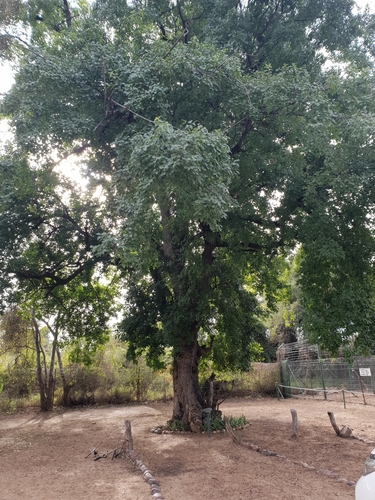
Rhamnus virgata
Roxb.
Buckthorn, Indian buckthorn

(c) Phuentsho, some rights reserved (CC BY-NC), uploaded by Phuentsho
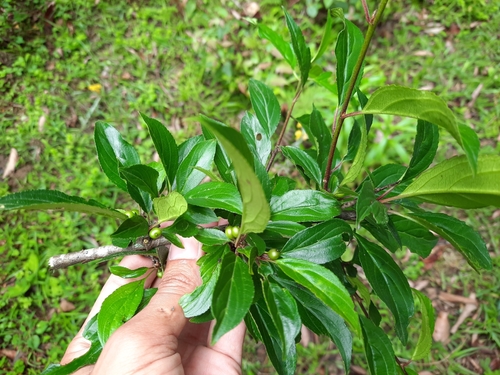
(c) Phuentsho, some rights reserved (CC BY-NC), uploaded by Phuentsho
What to Eat
Edible parts: Leaves
The leaves are boiled and eaten with salt and oil.
Where to Find It
It is a subtropical plant. In China it grows on mountain slopes between 1,200-3,800 m above sea level. In Sichuan and Yunnan.
Afghanistan, Asia, Bhutan, China, Himalayas, India, Indochina, Myanmar, Nepal, Northeastern India, Pakistan, SE Asia, Thailand, Tibet,
How to Identify
A shrub or small tree. It has many branches. The branches usually end in a sharp thorn. The leaves are almost opposite and 2-10 cm long by 1-6 cm wide. They are narrowly sword shaped. There can be teeth along the edge. The flowers are of one sex and are in the axils of leaves. The flowers are 4-5 mm long. The fruit are oval and 7 mm long. They have 2-4 seeds. The seeds are shiny and have a groove on the back. They are dark brown and 5 mm long by 2 mm wide.
Notes
There are over 100 Rhamnus species.
Names & Synonyms
Chato, Chadua, Chandul, Chaurda, Chetain, Chetula, Kanji, Tadru
References (5)
- Ambasta S.P. (Ed.), 2000, The Useful Plants of India. CSIR India. p 519
- Plants for a Future database, The Field, Penpol, Lostwithiel, Cornwall, PL22 0NG, UK. http://www.scs.leeds.ac.uk/pfaf/
- READ,
- Fl. ind. 2:351. 1824
- Tsering, J., et al, 2017, Ethnobotanical appraisal on wild edible plants used by the Monpa community of Arunchal Pradesh. Indian Journal of Traditional Knowledge. Vol 16(4), October 2017, pp 626-637