Rhodomyrtus macrocarpa
Benth.
Finger cherry

(c) ryanthughes, some rights reserved (CC BY-NC)

(c) djwitherall, some rights reserved (CC BY-NC)

(c) ryanthughes, some rights reserved (CC BY-NC)
What to Eat
Edible parts: Fruit, Caution
The fruit may be edible in small amounts.
Known Hazards
Where to Find It
A tropical and subtropical plant. It grows naturally in the rainforest. In tropical Queensland it grows from sea level to 800 m altitude.
Asia, Australia*, Indonesia, Pacific, Papua New Guinea, PNG, SE Asia,
How to Identify
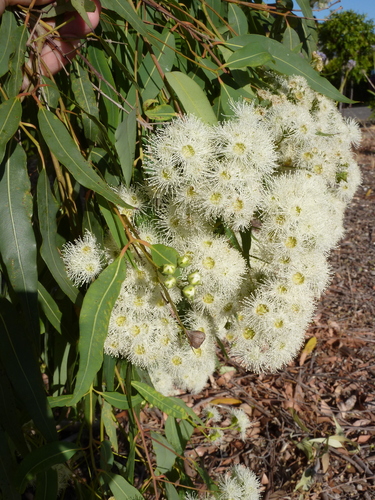
It is a shrub or small tree. It grows to 8 m tall. The bark is brown and papery. The young shoots are covered with grey hairs. The leaves are oblong and 20 cm long by 5 cm wide. They are dull green on the upper surface and paler underneath. The flowers are white or pink. They are about 2.5 cm across. The stamens are easy to see. The flowers occur in clusters in the axils of leaves. The fruit are long and red when ripe. They are 3.5 cm long.
How to Grow
Plants can be grown from fresh seed.
Wikipedia
Source ↗Rhodomyrtus macrocarpa, commonly known as finger cherry, Cooktown loquat, or wannakai, is a species of plant in the family Myrtaceae native to New Guinea, the Aru Islands, and the Australian state of Queensland. Eating the fruits is reputed to cause blindness.
Production
In Australia, flowering occurs from January to June and fruit is ripe from September to October.
Notes
There are about 20 Rhodomyrtus species. They grow in the tropics.
Names & Synonyms
Mumu, Pohon ceri jari
References (12)
- Cooper W & Cooper W T, 1994, Fruits of the Rain Forest. RD Press p 244
- Cooper, W. and Cooper, W., 2004, Fruits of the Australian Tropical Rainforest. Nokomis Editions, Victoria, Australia. p 354
- Cribb, A.B. & J.W., 1976, Wild Food in Australia, Fontana. p 53
- Fell, D.G. & Stanton, D.J., 2015: The vegetation and flora of Mabuyag, Torres Strait, Queensland. Memoirs of the Queensland Museum – Culture 8(1):1-33. Brisbane. ISSN 1440-4788.
- Fl. austral. 3:273. 1867
- Isaacs, J., 1987, Bush Food, Aboriginal Food and Herbal Medicine. Weldons. p 63
- Jackes, B.R., 2001, Plants of the Tropics. Rainforest to Heath. An Identification Guide. James Cook University. p 69
- Jones D, L, 1986, Ornamental Rainforest Plants in Australia, Reed Books, p 73
- Lazarides, M. & Hince, B., 1993, Handbook of Economic Plants of Australia, CSIRO. p 204
- Nicholson, N & H., 1994, Australian Rainforest Plants 4, Terania Rainforest Publishing. NSW. p 59
- Plants of Papua New Guinea LAE herbarium record
- Sukarya, D. G., (Ed.) 2013, 3,500 Plant Species of the Botanic Gardens of Indonesia. LIPI p 490