Rhynchotechum ellipticum
(Wall. ex D. Dietrich) A. DC.
(c) Leung Pak keung, some rights reserved (CC BY-NC), uploaded by Leung Pak keung

(c) 郭伯川, some rights reserved (CC BY-NC)
What to Eat
Edible parts: Leaves, Fruit
The leaves are cooked and eaten as a vegetable, often prepared with meat or fish, and are sold in local markets. The ripe fruit are eaten raw.
Where to Find It
A tropical plant. In China it grows in shaded places near streams between 100-1800 m altitude in southern regions.
Asia, Bhutan, Cambodia, China, Himalayas, India, Indochina, Laos, Malaysia, Myanmar, Nepal, Northeastern India, SE Asia, Thailand, Vietnam,
How to Identify
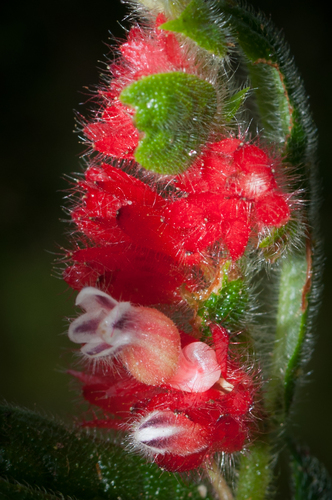
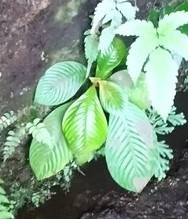
A small shrub. The stems are 0.7-2 m long. There are rusty brown hairs near the tip. The leaves are opposite. The leaf stalk is 0.8-5 cm long. The leaf blade is oval and 9.5-32 cm long by 3-10 cm wide. It is woolly. They are red-brown. There are teeth along the edge. In a flower cluster there are 15-70 flowers. The flower stalk is 0.9-4 cm long. Flowers are white or tinged pink. The fruit is a white berry 2-6 mm across.
Other Information
Leaves are sold in local markets.
Notes
There are 13 Rhynchotechum species.
Names & Synonyms
Chenkup, Endroigi, Ja-kharia, Japang esing, Jongku, Jooke, Kosabio, Mebitchi, Mehek, Mimalai, Re-gong, Telhlep, Theshuvi, Tiarep, Xian zhu ju tai
References (23)
- Ambasta S.P. (Ed.), 2000, The Useful Plants of India. CSIR India. p 526
- Ethnobotany of Karbis. Chapter 4 in p 100
- Kar, A., et al, 2013, Wild Edible Plant Resources used by the Mizos of Mizoram, India. Kathmandu University Journal of Science, Engineering and Technology. Vol. 9, No. 1, July, 2013, 106-126
- Luo, B., et al, 2019, Wild edible plants collected by Hani from terraced rice paddy agroecosystem in Honghe Prefecture, Yunnan, China. Journal of Ethnobiology and Ethnomedicine 15:56 (As Rhynchotechum obovatum)
- Maikhuri, R, K, and Gangwar, A. K., 1993, Ethnobiological Notes on the Khasi and Garo Tribes of Meghalaya, Northeast India, Economic Botany, Vol. 47, No. 4, pp. 345-357
- Medhi, P. & Borthakur, S. K., 2012, Phytoresources from North Cachur Hills of Assam -3: Edible plants sold at Hflong market. Indian Journal or Natural Products and Resources. 3(1) pp 84-109
- Medhi, P. & Borthakur, S. K., 2013, Wild edible plants sold by the Zeme Nagas at the makeshift market of Mahur, Dima Hasao district of Assam. Pleione 7(1): 84 - 93. 2013
- Medhi, P., Sarma, A and Borthakur, S. K., 2014, Wild edible plants from the Dima Hasao district of Assam, India. Pleione 8(1): 133-148
- Murtem, G. & Chaudhrey, P., 2016, An ethnobotanical note on wild edible plants of Upper Eastern Himalaya, India. Brazilian Journal of Biological Sciences, 2016, v. 3, no. 5, p. 63-81
- Neogi, B., Prasad, M. N. V. and Rao, R. R., 1989, Ethnobotany of Some Weeds of Khasi and Garo Hills, Meghalaya, Northeastern India. Economic Botany 43(4): 471-479
- Patiri, B. & Borah, A., 2007, Wild Edible Plants of Assam. Geethaki Publishers. p 93
- Pfoze, N. L., et al, 2012, Assessment of Local Dependency on Selected Wild Edible Plants and fruits from Senapati district, Manipur, Northeast India. Ethnobotany Research & Applications 10:357-367
- Pfoze, N. L., et al, 2012, Survey and assessment of floral diversity on wild edible plants from Senapati district of Manipur, Northeast India. Journal or Biodiversity and Environmental Sciences. 1(6):50-52
- Phangchopi, U., et al, 2015, Diversity of wild edible plants in Marat Longri Wildlife Sanctuary, Assam. Indian Journal of Natural Products and Resources Vol. 6(4), December 2015 pp. 305-313
- Sangma, A. j. T., 2018, Non-timber forest products (NTFPs) used by Garo tribe of Rongram block in West Garo Hills, Meghalaya. Indian Journal of Traditional Knowledge Vol 18 (1), pp 151-161
- Salvi, J. et al, 2016, A review: Underutilized wild edible plants as a potential source of alternative nutrition. International Journal of Botany Studies. Volume 1; Issue 4; May 2016; Page No. 32-36
- Sarma, H., et al, 2010, Updated Estimates of Wild Edible and Threatened Plants of Assam: A Meta-analysis. International Journal of Botany 6(4): 414-423
- Sawian, J. T., et al, 2007, Wild edible plants of Meghalaya, North-east India. Natural Product Radiance Vol. 6(5): p 421
- Singh, H.B., Arora R.K.,1978, Wild edible Plants of India. Indian Council of Agricultural Research, New Delhi. p 34
- Taram, M., et al, 2018, Wild Food Plant Resources of Komkar Adi Tribe of Upper Siang District in Arunachal Pradesh, India. Bulletin of Arunachal Forest Research, Vol. 33(2), 27-35
- Terangpi, R., et al, 2013, Utilization of less known plants, Gnetum gnemon L. and Rhynchotechum ellipticum (Dietr.)A. DC. among the Karbis, Northeast India. Journal of Scientific and Innovative Research 2013; 2 (5): 943-949
- Teron, R. & Borthakur, S. K., 2016, Edible Medicines: An Exploration of Medicinal Plants in Dietary Practices of Karbi Tribal Population of Assam, Northeast India. In Mondal, N. & Sen, J.(Ed.) Nutrition and Health among tribal populations of India. p 152
- Wang Wentsai, Pan Kaiyu, Li Zhenyu, Weitzmann, A.L., Skog, L.E., Gesneraceae. Flora of China p