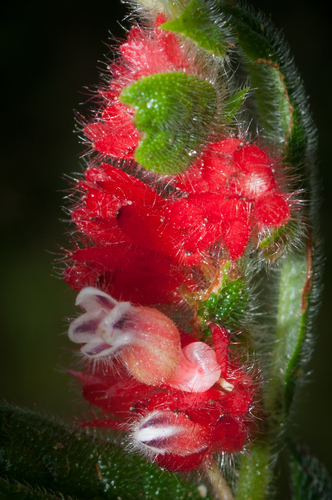
Rhynchotechum vestitum
Wall. ex C. B. Clarke
Re-gong-chu, Mao xian zhu ju tai

(c) Phuentsho, some rights reserved (CC BY-NC-SA), uploaded by Phuentsho

President and Fellows of Harvard College
What to Eat
Edible parts: Leaves
The leaves are cooked as a vegetable, mixed with sodium bicarbonate.
Where to Find It
It grows in shaded forests near streams between 800-1300 m altitude in China. In Yunnan.
Asia, Bhutan, China, Himalayas, India, Myanmar, Northeastern India, SE Asia, Sikkim, Tibet,
How to Identify
A small shrub. The stems are 1-2 m high. The base of the stems is smooth and creamy yellow. The leaves are opposite. The leaf stalk is 2-4.5 cm long. The leaf blade is oval and 13-28.5 cm long by 54.-12 cm wide. It has a rough surface. There are teeth along the edge. It tapers to the tip. There are 5-15 flowers in the flowering cluster. The flower stalk is 0.8-1.5 cm long. The flowers are red. The fruit is a white berry 305 mm long.
References (3)
- Comm. Et Cyrt. Beng. T. 92. 1874
- Maikhuri, R, K, and Gangwar, A. K., 1993, Ethnobiological Notes on the Khasi and Garo Tribes of Meghalaya, Northeast India, Economic Botany, Vol. 47, No. 4, pp. 345-357
- Wang Wentsai, Pan Kaiyu, Li Zhenyu, Weitzmann, A.L., Skog, L.E., Gesneraceae. Flora of China p