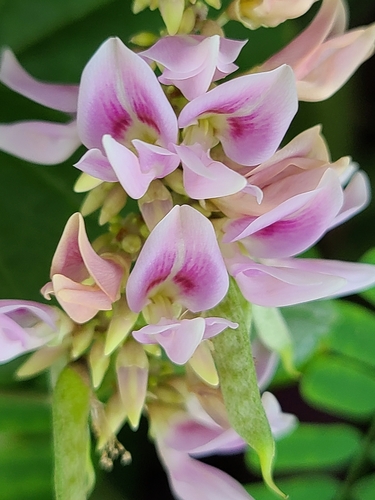
Robinia flava
Lour.

Famartin (via Wikimedia Commons)

Greg Hume (via Wikimedia Commons)

John P Salvatore (via Wikimedia Commons)
What to Eat
Edible parts: Root, Seeds
The seeds are edible, though no preparation details are given. The root is sweet and mucilaginous and has been used as a food during times of famine.
Where to Find It
It is a temperate plant.
Asia, China,
How to Identify
A deciduous tree. Hermaphroditic with nitrogen-fixing capability. Grows in light sandy, medium loamy, and heavy clay soils, tolerating nutritionally poor soil. Suitable for mildly acid, neutral, and basic pH. Can grow in semi-shade or full sun. Tolerates dry or moist soil and drought. Can tolerate atmospheric pollution.
How to Grow
We have very little information on this species and do not know if it will be hardy in Britain, though judging by its native range it should succeed outdoors in many parts of the country. This species is not recognised in the International Legume Database. The following notes are based on the general needs of the genus. Succeeds in a hot dry position. Succeeds in any soil, preferring one that is not too rich. Requires a well-drained soil, succeeding on dry barren sites. Plants are tolerant of drought and atmospheric pollution. The branches are brittle and very liable to wind damage. When plants are grown in rich soils they produce coarse and rank growth which is even more liable to wind damage. Plants sucker freely, the suckers have vicious thorns. Any pruning should be done in late summer in order to reduce the risk of bleeding. Plants in this genus are notably resistant to honey fungus. This species has a symbiotic relationship with certain soil bacteria, these bacteria form nodules on the roots and fix atmospheric nitrogen. Some of this nitrogen is utilized by the growing plant but some can also be used by other plants growing nearby.
Propagation: Pre-soak seed for 48 hours in warm water, then sow in late winter in a cold frame. A short stratification improves both germination rates and speed. Prick seedlings out into individual pots when large enough to handle and grow on in the greenhouse through their first winter, then plant out into permanent positions the following summer. Seed remains viable for over 10 years. Suckers can also be taken during the dormant season.
Medicinal Uses
None known
Other Uses
The plant produces an extensive suckering root system that makes it useful for soil stabilization on banks and similar sites. It is also a nitrogen fixer.
Wikipedia
Source ↗A deciduous tree. Hermaphroditic with nitrogen-fixing capability. Grows in light sandy, medium loamy, and heavy clay soils, tolerating nutritionally poor soil. Suitable for mildly acid, neutral, and basic pH. Can grow in semi-shade or full sun. Tolerates dry or moist soil and drought. Can tolerate atmospheric pollution.
Other Information
It is a famine food.
Notes
There are about 20 Robinia species. Also as Papilionaceae. The name is ambiguous.
References (2)
- Hedrick, U.P., 1919, (Ed.), Sturtevant's edible plants of the world. p 571
- Plants for a Future database, The Field, Penpol, Lostwithiel, Cornwall, PL22 0NG, UK. http://www.scs.leeds.ac.uk/pfaf/