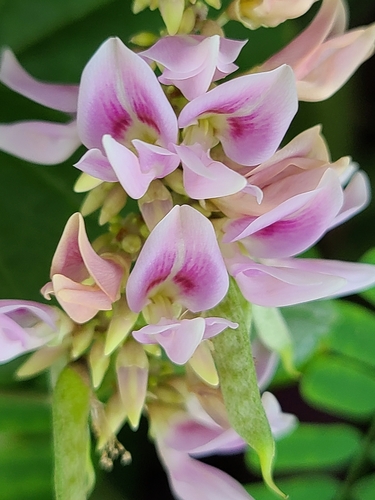
Apios fortunei
Maximowicz
Ground pear, Potato bean
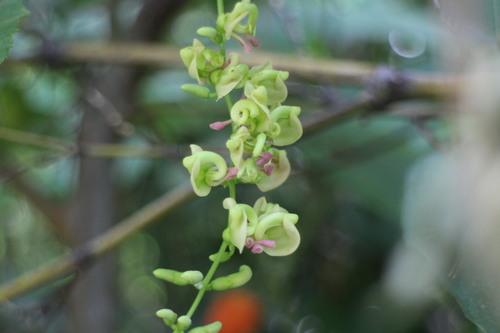
(c) 羅元甫, some rights reserved (CC BY-NC), uploaded by 羅元甫
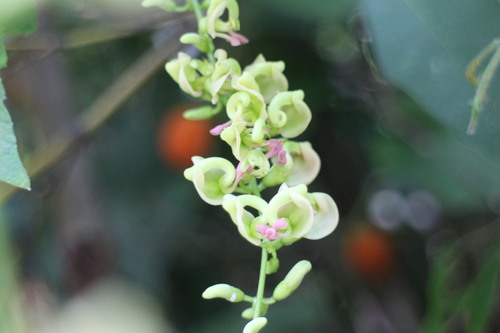
(c) 羅元甫, some rights reserved (CC BY-NC)
What to Eat
Edible parts: Root, Tuber
Edible Parts: Root Edible Uses: Tuber - raw or cooked. It has a delicious flavour somewhat like sweet potatoes when roasted. The tuber can also be dried and ground into a powder. The tuber contains about 4.2% protein, 0.2% fat, 18.3% starch, 6% other carbohydrate, 1.3% ash. References More on Edible Uses Composition Figures in grams (g) or miligrams (mg) per 100g of food. Root (Fresh weight) 0 Calories per 100g Water : 0% Protein: 4.2g; Fat: 0.2g; Carbohydrate: 24.3g; Fibre: 0g; Ash: 1.3g; Minerals - Calcium: 0mg; Phosphorus: 0mg; Iron: 0mg; Magnesium: 0mg; Sodium: 0mg; Potassium: 0mg; Zinc: 0mg; Vitamins - A: 0mg; Thiamine (B1): 0mg; Riboflavin (B2): 0mg; Niacin: 0mg; B6: 0mg; C: 0mg; Reference: Notes:
Where to Find It
It is a temperate plant. It grows in sunny damp soils. In China it grows between 300-1,000 m above sea level. In Sichuan.
Asia, China, Japan, USA,
How to Identify
A herb. It is a climbing plant. It keeps growing from year to year. It has tuberous roots. The small branches have a few soft hairs. The leaves have leaflets along the stalk. There are 3-7 leaflets. They are oval or sword shaped. They are 3-7 cm long by 2 cm wide. The flowers are greenish-white. They are 6-8 mm long. They are in groups 6-27 cm long at the end of branches. The fruit are narrow pods 7-8 cm long and 5-6 mm wide.
Nutrition Score: 1/100
| Part | Moisture | kJ | kcal | Protein | Vit A | Vit C | Iron | Zinc |
|---|---|---|---|---|---|---|---|---|
| Tuber | — | — | 4.2 | — | — | — | — | — |
How to Grow
We have very little information on this species and do not know if it will be hardy in Britain, though judging by its native range it should succeed outdoors in many parts of this country. The following notes are based on the general needs of the genus. Prefers a light rich soil and a sunny position. Another report says that it prefers light dappled shade. Tolerates acid soils. This species has a symbiotic relationship with certain soil bacteria, these bacteria form nodules on the roots and fix atmospheric nitrogen. Some of this nitrogen is utilized by the growing plant but some can also be used by other plants growing nearby. Growth habit is a single or multiple shooting vine from a crown. Herbaceous.
Propagation: Seed - pre-soak for 3 hours in tepid water and sow February/March in a cold frame. The seed usually germinates in 1 - 3 months at 15°c. When large enough to handle, prick the seedlings out into individual pots and grow them on in light shade in the greenhouse for their first winter, planting them out in late spring or early summer. Division can be carried out at almost any time of the year, though spring is probably the best time. Simply dig up the roots, harvest the tubers and replant them where you want the plants to grow. It is also possible to harvest the tuber in winter, store them in a cool fairly dry but frost-free place over the winter and then plant them out in the spring. The tubers lose moisture rapidly once they have been harvested, so make sure that you store them in a damp medium such as leafmold.
Medicinal Uses
Tonic The root is tonic.
Other Uses
None known Special Uses Food Forest Nitrogen Fixer
Wikipedia
Source ↗Apios fortunei, commonly known as hodo, hodoimo, groundnut, or potatobean, is a tuber-forming member of the bean family. The plant is a perennial climbing vine. The leaves are ovate or lanceolate, pinnate with 3–7 leaflets, and 3–7 centimetres (1–3 in) long. The flowers are whitish green, sometimes tinted light yellowish with a red-to-purple wing petal edge, or sulphurous green with rosy wing petals; they form pseudoracemes or terminal panicles, 6–26 centimetres (2+1⁄2–10 in) long. The fruit is a linear legume, 7–8 cm long and 5–6 millimetres (3⁄16–1⁄4 in) wide. Chemically, the tubers contain starch as their predominant carbohydrate, along with smaller amounts of sucrose and glucose, and almost no fructose. The species is native to Eastern China and Japan. In the wild, it is often found near brooks. It is one of three species in the genus known to produce edible tubers, although it has generally been considered an emergency food source as well as a medicinal plant. The flowers are showy and have ornamental potential.
Other Information
They are an emergency or famine food.
Notes
There are 10 Apios species. Chemical composition: Protein = 4.2%. Fat = 0.2%. Carbohydrate (starch) = 18.3%. Carbohydrate (other) = 6%. Ash = 1.3%.
Names & Synonyms
Hodo, Hodoimo, groundnut, or potatobean
References (11)
- Bircher, A. G. & Bircher, W. H., 2000, Encyclopedia of Fruit Trees and Edible Flowering Plants in Egypt and the Subtropics. AUC Press. p 35
- Bull. Acad. Imp. Sci. Saint-Petersbourg 18:396. 1873 (Diagn. pl. nov. jap.)
- Chen, B. & Qiu, Z., Consumer's Attitudes towards Edible Wild Plants, Ishikawa Prefecture, Japan. p 22 www.hindawi.com/journals/ijfr/aip/872413.pdf
- Hu, Shiu-ying, 2005, Food Plants of China. The Chinese University Press. p 465
- ILDIS Legumes of the World http:www;ildis.org/Legume/Web
- Jackes, D. A., Edible Forest Gardens
- Lim, T. K., 2015, Edible Medicinal and Non Medicinal Plants. Volume 9, Modified Stems, Roots, Bulbs. Springer p 10
- Plants for a Future database, The Field, Penpol, Lostwithiel, Cornwall, PL22 0NG, UK. http://www.scs.leeds.ac.uk/pfaf/
- READ
- World Checklist of Useful Plant Species 2020. Royal Botanic Gardens, Kew
- www.efloras.org Flora of China Volume 10