Rosa acicularis
Lindl.
Wild rose, Prickly rose
(c) keairareischauer, some rights reserved (CC BY-NC)
(c) Gennadiy Okatov, some rights reserved (CC BY-NC), uploaded by Gennadiy Okatov

(c) Alla Verkhozina, some rights reserved (CC BY-NC), uploaded by Alla Verkhozina
What to Eat
Edible parts: Flowers, Fruit, Tea, Seeds, Stem
The fruit can be eaten raw or cooked, used in syrups and purees, or dried for use in teas and soups. It contains about 2–3% vitamin C by dry weight, rising to as much as 7% in some varieties. The ripe fruit has a rich, sweet flavour that is best after frosting. The fruit is about 25mm in diameter, but has only a thin layer of flesh surrounding the many seeds — care should be taken when eating it (see known hazards). Leaves make a vitamin C-rich tea. Young shoots can be peeled and eaten in spring. Petals are edible raw — remove the bitter white base before eating. The seeds are a good source of vitamin E and can be ground and mixed with flour or added to foods as a supplement; be sure to remove the seed hairs first.
Known Hazards
Where to Find It
It grows in subarctic regions. They prefer rich well drained soil. In north China it grows between 400-1,800 m above sea level. Melbourne Botanical gardens. It suits hardiness zones 2-9.
Asia, Alaska, Australia, Canada, Central Asia, China, Europe, Japan, Kazakhstan, Korea, Mongolia, North America, Russia, Siberia, USA,
How to Identify
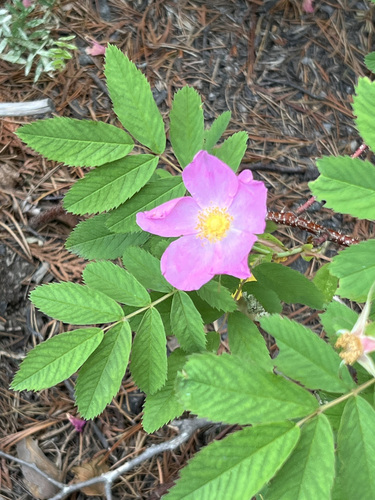
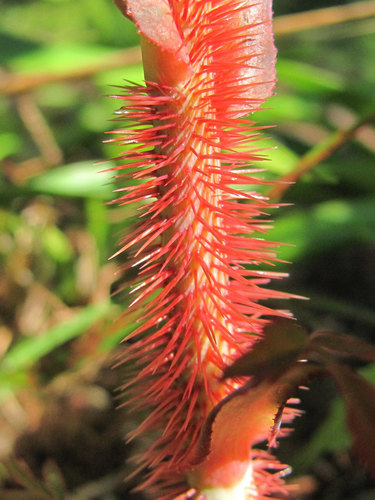
A shrub. It grows 1.8 m high and spreads 1.2 m wide. It has many prickles. The leaves are greyish-green. There are commonly five leaflets. The flowers are deep pink and have a mild scent. They occur singly. The fruit are bright red, pear shaped hips.
How to Grow
Rosa acicularis is a very cold-hardy plant, being able to tolerate temperatures down to around -40°c when fully dormant. Succeeds in most soils, preferring a circumneutral soil and a sunny position. Prefers a slightly acid soil. Grows well in heavy clay soils. Dislikes water-logged soils. Grows well with alliums, parsley, mignonette and lupins. Garlic planted nearby can help protect the plant from disease and insect predation. Grows badly with boxwood. The flowers are fragrant. Hybridizes freely with other members of this genus. Produces its fruit abundantly in Britain. This plant is the floral emblem of Alberta. Plants in this genus are notably susceptible to honey fungus.
Propagation: Rose seed often takes two years to germinate, as it may need a warm period following a cold one to mature the embryo and soften the seedcoat. To speed this up, scarify the seed and place it in damp peat at 27–32°c for 2–3 weeks until imbibed, then hold at 3°c for four months, by which time germination should begin. Alternatively, seed harvested green — fully developed but not yet dried on the plant — and sown immediately may germinate in late winter, though this method had not been fully tested as of 1988. Seed sown as soon as ripe in a cold frame sometimes germinates in spring, but may take 18 months. Stored seed should be sown as early as possible and stratified for 6 weeks at 5°c; germination may still take 2 years. Prick seedlings into individual pots when large enough to handle. Plant out in summer if over 25cm tall; otherwise overwinter in a cold frame and plant out in late spring. Half-ripe cuttings with a heel taken in July in a shaded frame, overwintered and planted out in late spring, give a high success rate. Hardwood cuttings of pencil-thick shoots, 20–25cm long, taken in early autumn and planted in a sheltered spot outdoors or in a cold frame, take up to 12 months to establish but normally succeed at a high rate. Suckers can be divided and replanted directly in their permanent positions during the dormant season. Layering takes 12 months.
Medicinal Uses
The plant is rich in tannins and used as an astringent. A decoction of the root serves as a cough remedy. An infusion of the roots can be used as a wash for sore eyes, and an infusion of leaves and bark has been used as eye drops for snow blindness. A decoction of the stems and branches has been used as a blood tonic and to treat stomach complaints, colds, and fevers. A poultice of chewed leaves has been applied to relieve the pain of bee stings. The fruit is a very rich source of vitamins A, C, and E, flavonoids, and other bio-active compounds, and is also a fairly good source of essential fatty acids, which is unusual for a fruit. It is being investigated for its potential to reduce the incidence of cancer and to halt or reverse cancer growth.
Other Uses
An orange dye is obtained from the fruit. The plant can be grown as an informal hedge.
Wikipedia
Source ↗Rosa acicularis is a flowering plant in the Rosaceae family. It is commonly known as the prickly wild rose, prickly rose, bristly rose, wild rose or Arctic rose. It is a species of wild rose with a Holarctic distribution in northern regions of Asia, Europe, and North America.
Other Information
The rose hips are eaten fresh especially by children.
Notes
There are about 150 Rosa species and many cultivated varieties. The seeds are high in Vitamin E.
Names & Synonyms
Neechee, Nichih, Tuutaruaq
References (28)
- Aipeisova S.A., et al, 2019, Wild useful herbs of Aktobe Region (Western Kazakhstan). Ukrainian Journal of Ecology, 9(3), 329-331
- Beckstrom-Sternberg, Stephen M., and James A. Duke. "The Foodplant Database." http://probe.nalusda.gov:8300/cgi-bin/browse/foodplantdb.(ACEDB version 4.0 - data version July 1994)
- Bowser, M., 2017, Handout on Edible Plants of the Kenai Peninsula. USFWS Kenai National Wildlife Refuge p 18
- Cormack, R. G. H., 1967, Wild Flowers of Alberta. Commercial Printers Edmonton, Canada. p 158
- Crate, S. A., 2008, "Eating Hay": The Ecology, Economy and Culture of Viliui Sakha Smallholders of Northeastern Siberia. Human Ecology 36:161-174
- Cundall, P., (ed.), 2004, Gardening Australia: flora: the gardener's bible. ABC Books. p 1212
- Dzhangaliev, A. D., et al, 2003, The Wild Fruit and Nut Plants of Kazakhstan, Horticultural Reviews, Vol. 29. pp 305-371
- Facciola, S., 1998, Cornucopia 2: a Source Book of Edible Plants. Kampong Publications, p 206
- Fisk, J. R. & Hoover, E., 2015, Wild Fruits of Minnesota. A Field Guide. University of Minnesota p 29
- Flora of China @ efloras.org Volume 9
- Hedrick, U.P., 1919, (Ed.), Sturtevant's edible plants of the world. p 572
- Heller, C. A., 1962, Wild Edible and Poisonous Plants of Alaska. Univ. of Alaska Extension Service. p 42
- Hibbert, M., 2002, The Aussie Plant Finder 2002, Florilegium. p 252
- Holloway, P. S. & Alexander, G., 1990, Ethnobotany of the Fort Yukon Region, Alaska. Economic Botany, Vol. 44, No. 2 pp. 214-225
- Jernigan, K. (Ed.), 2012, A Guide to the Ethnobotany of the Yukon-Kuskokwim Region. Draft.
- Jones, A., 2010, Plants that we eat. University of Alaska Press. p 125
- Kuhnlein, H. V., et al, 2009, Indigenous Peoples' food systems. FAO Rome p 53
- MacKinnon, A., et al, 2009, Edible & Medicinal Plants of Canada. Lone Pine. p 84
- Moerman, D. F., 2010, Native American Ethnobotany. Timber Press. p 482
- Plants for a Future database, The Field, Penpol, Lostwithiel, Cornwall, PL22 0NG, UK. http://www.scs.leeds.ac.uk/pfaf/
- Porsild, A.E., 1974, Rocky Mountain Wild Flowers. Natural History Series No. 2 National Museums of Canada. p 244
- Rosa monogr. 44, t. 8. 1820
- Scotter, G. W., & Flygare, H., 1993, Wildflowers of the Canadian Rockies. Hurtig. p 120
- Shikov, A. N. et al, 2017, Traditional and Current Food Use of Wild Plants Listed in the Russian Pharmacopoeia. Frontiers in Pharmacology. Vol. 8 Article 841
- Turner, N., 1997, Food Plants of Interior First Peoples. Royal BC Museum Handbook p 149
- Turner, N., et al, 2011, "Up on the Mountain": Ethnobotanical Important of Montane Sites in Pacific Coastal North America. Journal of Ethnobiology 31(1): 4-43
- Urgamal, M., Oyuntsetseg, B., Nyambayar, D. & Dulamsuren, Ch. 2014. Conspectus of the vascular plants of Mongolia. (Editors: Sanchir, Ch. & Jamsran, Ts.). Ulaanbaatar, Mongolia. “Admon“ Press. 334pp. (p. 143-158).
- Zhang, Y., et al, Yunatov’s Records of Wild Edible Plant Used by the Mongols in Mongolia During 1940- 1951: Ethnobotanical Arrangements and Discussions. Inner Mongolia Normal University. p 12
More from Rosaceae


