Rosa canina
L.
Dog rose, Brier rose
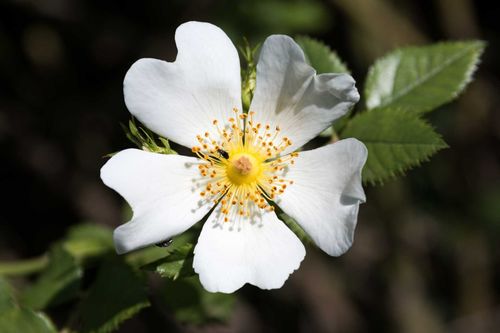
(c) Mathieu Massaviol, some rights reserved (CC BY-NC-ND), uploaded by Mathieu Massaviol

(c) Athina, some rights reserved (CC BY-NC), uploaded by Athina

(c) Douglas Goldman, some rights reserved (CC BY-SA), uploaded by Douglas Goldman
What to Eat
Edible parts: Fruit, Flowers, Herb, Leaves - tea
The fruit can be eaten raw or cooked and makes excellent jams and syrups; the syrup is used as a nutritional supplement, particularly for babies. The fruit can also be dried for use as a tea. Frost softens and sweetens the flesh. The fruit is up to 30mm in diameter but has only a thin layer of flesh surrounding the many seeds — care should be taken when eating it (see known hazards). The seeds are a good source of vitamin E and can be ground and mixed with flour or added to foods as a supplement; be sure to remove the seed hairs first. Dried leaves can be used as a tea substitute, and one report also mentions their use as a coffee substitute. Petals are edible raw or cooked — the base may be bitter and is best removed. In China the petals are eaten as a vegetable and are also used to make a scented jam.
Known Hazards
Where to Find It
It is a temperate plant. It does best in dry loamy soils and an open sunny position. It suits hardiness zones 3-10. Tasmania Herbarium. Arboretum Tasmania.
Africa, Albania, Andorra, Argentina, Armenia, Asia, Australia, Azerbaijan, Balkans, Belarus, Bosnia, Britain, Bulgaria, Caucasus, Central Asia, Chile, Croatia, Czech Republic, Dominican Republic, Europe*, Falklands, Georgia, Greece, Haiti, Himalayas, Hungary, India, Iran, Iraq, Ireland, Italy, Jordan, Kazakhstan, Kosovo, Kyrgyzstan, Lebanon, Lithuania, Luxembourg, Macedonia, Mediterranean, Mexico, Middle East, Moldova, Morocco, Nepal, New Zealand, North Africa, North America, Norway, Portugal, Romania, Russia, San Marino, Scandinavia, Serbia, Sicily, Slovakia, Slovenia, South America, Spain, Switzerland, Tajikistan, Tasmania, Turkey, Türkiye, USA, Uzbekistan, West Indies,
How to Identify
A prickly creeping shrub. It develops suckers. It grows 3 m high and spreads 3 m wide. The stems are prickly. The leaves are opposite and have leaflets along the stalk. The leaves have 5-7 leaflets. The flowers have a scent. The flowers are pale pink and occur singly. The fruit are orange-red hips.
Nutrition Score: 37/100
| Part | Moisture | kJ | kcal | Protein | Vit A | Vit C | Iron | Zinc |
|---|---|---|---|---|---|---|---|---|
| Fruit | 39.7 | — | — | 2.9 | — | 468 | 3.3 | 0.3 |
How to Grow
Succeeds in most soils. Grows well in heavy clay soils. Prefers a circumneutral soil and a sunny position with its roots in the shade. When grown in deep shade it usually fails to flower and fruit. Succeeds in wet soils but dislikes water-logged soils or very dry sites. Tolerates maritime exposure. The fruit attracts many species of birds, several gall wasps and other insects use the plant as a host A very polymorphic species, it is divided into a great number of closely related species by some botanists. The leaves, when bruised, have a delicious fragrance. The flowers are also fragrant. Grows well with alliums, parsley, mignonette and lupins. Garlic planted nearby can help protect the plant from disease and insect predation. Grows badly with boxwood. Hybridizes freely with other members of this genus. Plants in this genus are notably susceptible to honey fungus. Rose hips are typically harvested in late summer to early autumn, usually from August to October (Northern Hemisphere), depending on the species. Roses usually flower from late spring to early autumn, typically between May and September (Northern Hemisphere). Growth rates vary by species, but many roses can grow moderately fast, reaching maturity within 2 to 3 years, depending on the care and conditions provided. Some species of roses are self-fertile, while others require cross-pollination with different varieties for optimal fruit (hip) production.
Propagation: Rose seed often takes two years to germinate, as it may need a warm period following a cold one to mature the embryo and soften the seedcoat. To speed this up, scarify the seed and place it in damp peat at 27–32°c for 2–3 weeks until imbibed, then hold at 3°c for four months, by which time germination should begin. Alternatively, seed harvested green — fully developed but not yet dried on the plant — and sown immediately may germinate in late winter, though this method had not been fully tested as of 1988. Seed sown as soon as ripe in a cold frame sometimes germinates in spring, but may take 18 months. Stored seed should be sown as early as possible and stratified for 6 weeks at 5°c; germination may still take 2 years. Prick seedlings into individual pots when large enough to handle. Plant out in summer if over 25cm tall; otherwise overwinter in a cold frame and plant out in late spring. Half-ripe cuttings with a heel taken in July in a shaded frame, overwintered and planted out in late spring, give a high success rate. Hardwood cuttings of pencil-thick shoots, 20–25cm long, taken in early autumn and planted in a sheltered spot outdoors or in a cold frame, take up to 12 months to establish but normally succeed at a high rate. Suckers can be divided and replanted directly in their permanent positions during the dormant season. Layering takes 12 months.
Medicinal Uses
The petals, hips, and galls are astringent, carminative, diuretic, laxative, ophthalmic, and tonic. Hips are taken internally to treat colds, influenza, minor infectious diseases, scurvy, diarrhoea, and gastritis. A hip syrup is used as a pleasant flavouring in medicines and added to cough mixtures. A distilled water made from the plant is slightly astringent and used as a lotion for delicate skin. The seeds have been used as a vermifuge. The plant is used in Bach flower remedies, with the prescribing keywords 'Resignation' and 'Apathy'. The fruit is a very rich source of vitamins A, C, and E, flavonoids, and other bio-active compounds, and is also a fairly good source of essential fatty acids, which is unusual for a fruit. It is being investigated for its potential to reduce the incidence of cancer and to halt or reverse cancer growth. Vitamin C content in dog rose shells ranges from 0.2 to 2.4%.
Other Uses
Roses are beneficial in agroforestry systems, providing ground cover, attracting pollinators, and improving biodiversity. Plants form a dense, stock-proof hedge when trimmed and can also serve as windbreaks. The flowers are rich in nectar and pollen, making them excellent for attracting bees, butterflies, and other pollinators. The hips are a food source for birds and mammals, and the dense structure of the bushes provides shelter and nesting spots for birds and small animals. The rough stems, leaf litter, and dense growth also offer overwintering sites for beneficial invertebrates.
Wikipedia
Source ↗Rosa canina, the dog rose, is a variable climbing, wild rose species native to Europe, northwest Africa, and western Asia.
Other Information
It is sold in local markets.
Notes
There are about 150 Rosa species and many cultivated varieties. It can be invasive. The fruit have high antioxidant capacity.
Names & Synonyms
Ask'ili, Common briar, Dikenbasi, Eglantier, Escalambrojo, Escaramujo, Giarrauta, Grata-tu, Grattacu, Grattacul, Gulab, Gulabax, Gularaz, Gulsilan, Gulsilav, Hundsrose, Iprim, Itburnu, Itburun, Jangli gulaab, Kaca, Kopekgulu, Kuin, Kusbasi, Kusburnu, Maces, Masreni, Masur, Navadni šipek, Okuzgotu, Peterlenga, Pibura, Pittellenga, Rosa selvatico, Rosa sarvaggia, Rosa silvestre, Shilan, Shipinka, Shipka, Silan, Silank, Sipurak, Sirgul, Steinnype, Sverboritki, Tabgha, Tapaculos, Tighfrt, Ward barri, Yabanigul
References (103)
- Abbet, C., et al, 2014, Ethnobotanical survey on wild alpine food plants in Lower and Central Valais (Switzerland). Journal of Ethnopharmacology 151 (2014) 624–634
- Aipeisova S.A., et al, 2019, Wild useful herbs of Aktobe Region (Western Kazakhstan). Ukrainian Journal of Ecology, 9(3), 329-331
- Ari, S., et al, 2015, Ethnobotanical survey of plants used in Afyonkarahisar-Turkey. Journal of Ethnobiology and Ethnomedicine 11:84
- Bianchini, F., Corbetta, F., and Pistoia, M., 1975, Fruits of the Earth. Cassell. p 136 (As Rosa selvatica)
- Bodkin, F., 1991, Encyclopedia Botanica. Cornstalk publishing, p 888
- Bremness, L., 1994, Herbs. Collins Eyewitness Handbooks. Harper Collins. p 120
- Bussman, R. W., et al, 2016, A comparative ethnobotany of Khevsureti, Samtskhe-Javakheti, Tusheti, Svaneti, and Racha-Lechkhumi, Republic of Georgia (Sakartvelo), Caucasus. Journal of Ethnobiology and Ethnomedicine.
- Bussman, R. W. et al, 2017, Ethnobotany of Samtskhe-Javakheti, Sakartvelo (Republic of Georgia), Caucasus. Indian Journal of Traditional Knowledge Vol. 16(1) pp 7-24
- Bussman, R. W., et al, 2021, Unity in diversity—food plants and fungi of Sakartvelo (Republic of Georgia), Caucasus. Journal of Ethnobiology and Ethnomedicine (2021) 17:72 p 14
- Cakir, E. A., 2017, Traditional knowledge of wild edible plants of Iğdır Province (East Anatolia, Turkey). Acta Soc Bot Pol. 2017;86(4):3568
- Cerne, M., 1992, Wild Plants from Slovenia used as Vegetables. Acta Horticulturae 318
- Ciocarlan, N. & Ghendov, V., 2015, Ethnobotanical and Ecological Studies of Wild Edible Plants from Bugeac Steppe, Republic of Moldova. Journal of EcoAgriTourism. Cailta terra Vol. 11(2):
- Cruz, I. M., et al, 2015, Edible fruits and seeds in the State of Mexico. Revista Mexicana de Ciencias Agricolas. Vol. 6. Num. 2 pp 331-346
- Cundall, P., (ed.), 2004, Gardening Australia: flora: the gardener's bible. ABC Books. p 1213
- Curtis, W.M., 1956, The Students Flora of Tasmania Vol 1 p 174
- Dashorst, G.R.M., and Jessop, J.P., 1998, Plants of the Adelaide Plains & Hills. Botanic Gardens of Adelaide and State Herbarium. p 74
- Demir, I. & Ayaz, N., 2022, Wild edible plants contributing to the traditional foods of Mardin (Turkey) Province. Indian Journal of Traditional Knowledge Vol 21(3), July 2022, pp 569-582
- Denes, A., et al, 2012, Wild plants used for food by Hungarian ethnic groups living in the Carpathian Basin. Acta Societatis Botanicorum Poloniae 81 (4): 381-396
- Dogan, A. & Tuzlaci, E., 2015, Wild Edible Plants of Pertek (Tunceli-Turkey). Marmara Pharmaceutical Journal 19: 126-135
- Dogan, Y., et al, 2004, The Use of Wild Edible Plants in Western and Central Anatolia (Turkey). Economic Botany 58(4) pp. 684-690
- Dzhangaliev, A. D., et al, 2003, The Wild Fruit and Nut Plants of Kazakhstan, Horticultural Reviews, Vol. 29. pp 305-371
- Egea, I., et al., 2010, Six Edible Wild fruits as potential Antioxidant Additives or Nutritional Supplements. Plant Foods for Human Nutrition. 65:121-129
- Ertug, F., 2000, An Ethnobotanical Study in Central Anatolia (Turkey). Economic Botany Vol. 54. No. 2. pp. 155-182
- Ertug, F, Yenen Bitkiler. Resimli Türkiye Florası -I- Flora of Turkey - Ethnobotany supplement
- Facciola, S., 1998, Cornucopia 2: a Source Book of Edible Plants. Kampong Publications, p 206
- Flowerdew, B., 2000, Complete Fruit Book. Kyle Cathie Ltd., London. p 174
- Galalaey, A. M. K., et al, 2021, Ethnobotanical study of some wild edible plants in Hujran Bason, Kurdistan Region of Iraq. ZANCO Journal of Pure and Applied Sciences. Salahaddin University-Erbil p 28
- Geraci, A., et al, 2018, The wild taxa utilized as vegetables in Sicily (Italy): a traditional component of the Mediterranean diet. Journal of Ethnobiology and Ethnomedicine (2018) 14:14
- Ghanimi, R., et al, 2022, Ethnobotanical study on wild edible plants traditionally used by Messiwa people, Morocco. Journal of Ethnobiology and Ethnomedicine. 18:16
- Girard, N. J., 2020, Sustainable Foraging of Wild Edible Plants in Norway. A Biocultural Approach. M. Sc. thesis Norwegian University. p 134
- Gonzalez, J. A., et al, 2011, The consumption of wild and semi-domesticated edible plants in the Arribes del Duero (Salamanca-Zamora, Spain): an ananalysis of traditional knowledge. Genetic Resources and Crop Evolution 58:991-1006
- Gunes, S. et al, 2018, Survey of wild food plants for human consumption in Karaisali (Adana-Turkey). Indian Journal of Traditional Knowledge. Vol. 17(2), April 2018, pp 290-298
- Hancer, C. K., et al, 2020, Traditional Knowledge of Wild Edible Plants of Biga (Çanakkale), Turkey. Acta Societatis Botanicorum Poloniae / 2020 / Volume 89 / Issue 1 / Article 8914
- Hedrick, U.P., 1919, (Ed.), Sturtevant's edible plants of the world. p 572
- Hibbert, M., 2002, The Aussie Plant Finder 2002, Florilegium. p 254
- http://www.botanic-gardens-ljubljana.com/en/plants
- Hussey, B.M.J., Keighery, G.J., Cousens, R.D., Dodd, J., Lloyd, S.G., 1997, Western Weeds. A guide to the weeds of Western Australia. Plant Protection Society of Western Australia. p 209
- Huxley, A. (Ed.), 1977, The Encyclopedia of the Plant Kingdom. Chartweil Books. p 228
- Irving, M., 2009, The Forager Handbook, A Guide to the Edible Plants of Britain. Ebury Press p 275
- Janaćković, P. et al, 2019, Traditional knowledge on plant use from Negotin Krajina (Eastern Serbia): An ethnobotanical study. Indian Journal of Traditional Knowledge Vol 18 (1), pp 25-33
- John, L., & Stevenson, V., 1979, The Complete Book of Fruit. Angus & Robertson p 257
- Kargioglu, M., et al, 2008, An Ethnobotanical Survey of Inner-West Anatolia, Turkey. Human Ecology 36:763-777
- Kargioglu, M. et al, 2010, Traditional Uses of Wild Plants in the Middle Aegean Region. Human Ecology 38:429-450
- Kayabasi, N. P., et al, 2018, Wild edible plants and their traditional use in the human nutrition in Manyas (Turkey). Indian Journal of Traditional Knowledge. Vol. 17(2), April 2018, pp 299-306
- Kermath, B. M., et al, 2014, Food Plants in the Americas: A survey of the domesticated, cultivated and wild plants used for Human food in North, Central and South America and the Caribbean. On line draft. p 753
- Khojimatov, O. K. et al, 2015, Some wild growing plants in traditional foods of Uzbekistan. Journal of Ethnic Foods. 2 (2015) 25-28
- Kiple, K.F. & Ornelas, K.C., (eds), 2000, The Cambridge World History of Food. CUP p 1844
- Kizilarslan, C. & Ozhatay, N., 2012, An ethnobotanical study of the useful and edible plants of İzmit. Marmara Pharmaceutical Journal 16: 134-140, 2012.
- Kremer, B.P., 1995, Shrubs in the Wild and in Gardens. Barrons. p 176
- Kybal, J., 1980, Herbs and Spices, A Hamlyn Colour Guide, Hamlyn Sydney p 168
- Lazarides, M. & Hince, B., 1993, Handbook of Economic Plants of Australia, CSIRO. p 206
- Lentini, F. and Venza, F., 2007, Wild food plants of popular use in Sicily. J Ethnobiol Ethnomedicine. 3: 15
- Licata, M., et al, 2016, A survey of wild plant species for food use in Sicily (Italy) – results of a 3-year study in four Regional Parks. Journal of Ethnobiology and Ethnomedicine 12:12
- Low, T., 1992, Bush Tucker. Australia’s Wild Food Harvest. Angus & Robertson. p 73
- Luczaj, L., 2012, Ethnobotanical review of wild edible plants of Slovakia. Acta Societatis Botanicorum Poloniae 81(4):245-255
- Luczaj, L. et al, 2012, Wild food plant use in 21st century Europe: the disappearance of old traditions and the search for new cuisines involving wild edibles. Acta Soc Bot Pol 81(4):359–370
- Luczaj, L., et al, 2015, Wild food plants and fungi used by Ukrainians in the western part of the Maramureş region in Romania. Acta Soc Bot Pol 84(3):339–346
- Mabey, R., 1973, Food for Free. A Guide to the edible wild plants of Britain, Collins. p 150, 166
- Marinelli, J. (Ed), 2004, Plant. DK. p 467
- Masoodi, H. U. R. & Sundriyal, R. C., 2020, Richness of non-timber forest products in Himalayan communities—diversity, distribution, use pattern and conservation status. Journal of Ethnobiology and Ethnomedicine 16:56
- Mattalia, G., et al, 2012, Traditional uses of wild food and medicinal plants among Brigasc, Kye ́, and Provenc ̧al communities on the Western Italian Alps. Genet Resour Crop Evol. Springer
- Michael, P., 2007, Edible Wild Plants and Herbs. Grub Street. London. p 181
- Miskoska-Milevska, E. et al, 2020, Traditional uses of wild edible plants in the Republic of North Macedonia. PHYTOLOGIA BALCANICA 26(1): 155–162, Sofia, 2020 p 159
- Mukemre, M., et al, 2016, Survey of wild food plants for human consumption in villages of Catak, (Van-Turkey), Indian Journal of Traditional Knowledge. Vol. 15(2) pp. 183-191
- Nanagulyan, S., et al, 2020, Wild plants and fungi sold in the markets of Yerevan (Armenia). Journal of Ethnobiology and Ethnomedicine 16:26
- Nathan, A., & Wong Y Chee, 1987, A Guide to Fruits and Seeds, Singapore Science Centre. p 101
- Nebel, S., Pieroni, A. & Heinrich, M., 2006, Ta cho`rta: Wild edible greens used in the Graecanic area in Calabria, Southern Italy. Appetite 47 (2006) 333–342
- Nedelcheva A., 2013, An ethnobotanical study of wild edible plants in Bulgaria. EurAsian Journal of BioSciences 7, 77-94
- Oran, S. A. S., 2015, Selected Wild Aromatic Plants in Jordan. International Journal of Medicinal Plants. Photon 108 (2015) 686-699
- Özdemir, E. and Kültür, S., 2017, Wild Edible Plants of Savaştepe District (Balıkesir, Turkey), Marmara Pharm J 21/3: 578-589
- Paczkowska, G . & Chapman, A.R., 2000, The Western Australian Flora. A Descriptive Calatogue. Western Australian Herbarium. p 512
- Pardo-de-Santayana, M., et al, 2005, The gathering and consumption of wild edible plants in the Campoo (Cantabria, Spain). International Journal of Food Sciences and Nutrition. 56(7): 529-542
- Pardo-de-Santayana, M., et al, 2007, Traditional knowledge of wild edible plants used in the northwest of the Iberian Peninsula (Spain and Portugal): a comparative study. Journal of Ethnobiology and Ethnomedicine 2007, 3:27
- Pasta, S., et al, 2020, An Updated Checklist of the Sicilian Native Edible Plants: Preserving the Traditional Ecological Knowledge of Century-Old Agro-Pastoral Landscapes. Frontiers in Plant Science. Volume 11|Article 388
- Pieroni, A., 1999, Gathered wild food plants in the Upper Valley of the Serchio River (Garfagnana), Central Italy. Economic Botany 53(3) pp 327-341
- Pieroni, A., 2001, Evaluation of the Cultural Significance of Wild Food Botanicals traditionally Consumed in Northwestern Tuscany, Italy, Journal of Ethnobiology 21(1):89-104
- Pieroni A, Nebel S, Santoro RF, Heinrich M., 2005, Food for two seasons: culinary uses of non-cultivated local vegetables and mushrooms in a south Italian village. Int J Food Sci Nutr. 56(4):245-72
- Pieroni, A.,& Giusti, M. E., 2009, Alpine Ethnobotany in Italy: Journal of Ethnobiology and Ethnomedicine. 5:32
- Pieroni, A. et al, 2013, One century later: the folk botanical knowledge of the last remaining Albanians of the upper Reka Valley, Mount Korab, Western Macedonia. Journal of Ethnobiology and Ethnomedicine. 9:22
- Pieroni, A. & Soukand, R., 2017, The disappearing wild food and medicinal plant knowledge in a few mountain villages of North-Eastern Albania. Journal of Applied Botany and Food Quality 90, 58 - 67
- Pieroni, A., et al, 2020, Wild food plants traditionally gathered in central Armenia: archaic ingredients or future sustainable foods? Environment, Development and Sustainability. Springer p 10
- Plants for a Future database, The Field, Penpol, Lostwithiel, Cornwall, PL22 0NG, UK. http://www.scs.leeds.ac.uk/pfaf/
- Plants of Haiti Smithsonian Institute http://botany.si.edu/antilles/West Indies
- Polat, R., et al, 2015, Survey of wild food plants for human consumption in Elazig (Turkey). Indian Journal of Traditional Knowledge. Vol. 1(1): 69-75
- Polat, R., et al, 2017, Survey of wild food plants for human consumption in Bingol, (Turkey). Indian Journal of Traditional Knowledge. Vol. 16(3) July 2017, pp. 378-384
- Redzic, S. J., 2006, Wild Edible Plants and their Traditional Use in the Human Nutrition in Bosnia-Herzegovina. Ecology of Food and Nutrition, 45:189-232
- Redzic, S., 2010, Use of Wild and Semi-Wild Edible Plants in Nutrition and Survival of People in 1430 Days of Siege of Sarajevo during the War in Bosnia and Herzegovina (1992–1995). Coll. Antropol 34 (2010) 2:551-570
- Rexhepi, B., et al, 2018, Ethnobotanical Study of Wild Edible Plants in Pelagonia Region (Southwestern Macedonia) International Journal of Advances in Science Engineering and Technology, Vol. 6 (1) p 57
- Rivera, C., et al, 2005, The Ethnobotanical Study of Local Mediterranean Food Plants as Medicinal Resources in Southern Spain. Journal of Physiologyand Pharmacology. 56, Suppl. 1, 97-114
- Senkardes, I & Tuzlaci, E., 2016, Wild Edible Plants of Southern Part of Nevsehir inTurkey. Marmara Pharmaceutical Journal 20:34-43
- Sfikas, G., 1984, Trees and shrubs of Greece. Efstathiadis Group. Athens. p 84
- Shikov, A. N. et al, 2017, Traditional and Current Food Use of Wild Plants Listed in the Russian Pharmacopoeia. Frontiers in Pharmacology. Vol. 8 Article 841
- Simkova, K. et al, 2014, Ethnobotanical review of wild edible plants used in the Czech Republic. Journal of Applied Botany and Food Quality 88, 49-67
- Skinner, G. & Brown, C., 1981, Simply Living. A gatherer's guide to New Zealand's fields, forests and shores. Reed. p 51
- Sp. pl. 1:491. 1753
- Tasmanian Herbarium Vascular Plants list p 51
- Tardio, J., et al, Ethnobotanical review of wild edible plants in Spain. Botanical J. Linnean Soc. 152 (2006), 27-71
- Upson, R., & Lewis R., 2014, Updated Vascular Plant Checklist and Atlas for the Falkland Islands. Falklands Conservation and Kew.
- van Wyk, B., 2005, Food Plants of the World. An illustrated guide. Timber press. p 325
- Vari, A., et al, 2020, Berries, greens, and medicinal herbs—mapping and assessing wild plants as an ecosystem service in Transylvania (Romania). Journal of Ethnobiology and Ethnomedicine (2020) 16:13
- Wild Edible Plants in Lebanon. Promoting dietary diversity in poor communities in Lebanon. http://www.wildedibleplants.org/
- Yesil, Y., et al, 2019, Wild edible plants in Yeşilli (Mardin-Turkey), a multicultural area. Journal of Ethnobiology and Ethnomedicine (2019) 15:52
- Yesil, Y., et al, 2019, Traditional knowledge of wild edible plants in Hasankeyf (Batman Province, Turkey). Acta Societatis Botanicorum Poloniae. 88(3):3633
More from Rosaceae


