Rosa centifolia
L.
Provence rose, Cabbage rose

Wikimedia Commons - Joydeep
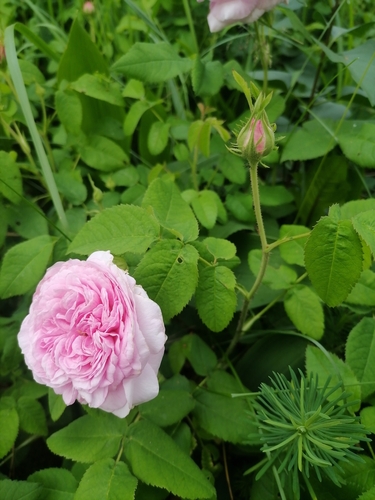
(c) Aliaksandr Mialik, some rights reserved (CC BY-NC)

Wikimedia Commons - Joydeep
What to Eat
Edible parts: Flowers, Fruit, Seeds
The fruit can be eaten raw or cooked and has a pulpy flesh. It is best after frost has softened and sweetened it. There is only a thin layer of flesh surrounding the many seeds — care should be taken when eating it (see known hazards). The seeds are a good source of vitamin E and can be ground and mixed with flour or added to foods as a supplement; be sure to remove the seed hairs first. The blossoms are used to scent tea. Petals preserved in sugar are used as a delicacy, and can also be added to fruit pies as a flavouring.
Known Hazards
Where to Find It
It is a temperate and subtropical plant. It suits hardiness zones 5-9.
Asia, Australia, Balkans, Britain, Caucasus, Central America, China, Croatia, Dominican Republic, Europe, France, Germany, Haiti, India, Iraq, Italy, Kurdistan, Mediterranean, Mexico, Middle East, Myanmar, North America, Palestine, Puerto Rico, SE Asia, Slovenia, Turkey, Türkiye, West Indies,
How to Identify
A shrub. It grows 1.5 m tall. The leaves are greyish-green. They are compound and have leaflets along the stalk and one at the end. There are 5-7 leaflets. The flowers are usually pink and have many petals. The rose hips are round and fleshy with small seeds.
How to Grow
Succeeds in most soils, preferring a circumneutral soil and a sunny position. Grows well in heavy clay soils. Dislikes water-logged soils. A very ornamental plant, there are many named forms developed for their ornamental value. The flowers are fragrant. The Provence rose is often cultivated for its essential oil in southern France and Morocco. It is closely related to R. damascena and R. gallica. Grows well with alliums, parsley, mignonette and lupins. Garlic planted nearby can help protect the plant from disease and insect predation. Grows badly with boxwood. Plants produce a few suckers. Hybridizes freely with other members of this genus. Plants in this genus are notably susceptible to honey fungus.
Propagation: Rose seed often takes two years to germinate, as it may need a warm period following a cold one to mature the embryo and soften the seedcoat. To speed this up, scarify the seed and place it in damp peat at 27–32°c for 2–3 weeks until imbibed, then hold at 3°c for four months, by which time germination should begin. Alternatively, seed harvested green — fully developed but not yet dried on the plant — and sown immediately may germinate in late winter, though this method had not been fully tested as of 1988. Seed sown as soon as ripe in a cold frame sometimes germinates in spring, but may take 18 months. Stored seed should be sown as early as possible and stratified for 6 weeks at 5°c; germination may still take 2 years. Prick seedlings into individual pots when large enough to handle. Plant out in summer if over 25cm tall; otherwise overwinter in a cold frame and plant out in late spring. Half-ripe cuttings with a heel taken in July in a shaded frame, overwintered and planted out in late spring, give a high success rate. Hardwood cuttings of pencil-thick shoots, 20–25cm long, taken in early autumn and planted in a sheltered spot outdoors or in a cold frame, take up to 12 months to establish but normally succeed at a high rate. Suckers can be divided and replanted directly in their permanent positions during the dormant season. Layering takes 12 months.
Medicinal Uses
The root is astringent. The petals are laxative, and a syrup made from them is used to treat constipation in infants. The fruit is a very rich source of vitamins A, C, and E, flavonoids, and other bio-active compounds, and is also a fairly good source of essential fatty acids, which is unusual for a fruit. It is being investigated for its potential to reduce the incidence of cancer and to halt or reverse cancer growth. An essential oil from the flowers is used in aromatherapy, with the keyword 'Cleansing'.
Other Uses
An essential oil obtained from the flowers is used in perfumery. The dried petals are used in pot-pourri.
Wikipedia
Deciduous shrub reaching 1.5 m tall, hardy to UK zone 6. Flowers appear June to July with seeds ripening August to November. Hermaphroditic and self-fertile, pollinated by insects. Tolerates light sandy, medium loamy, and heavy clay soils with good drainage. Grows in mildly acid to basic soil pH. Adapts to semi-shade or full sun and prefers consistently moist conditions.
Other Information
It is cultivated.
Notes
There are about 150 Rosa species and many cultivated varieties.
Names & Synonyms
Burgundy rose, Centifolia, Hnin-si, Pale rose, Stolistna vrtnica, Vonjaca, Ward jouri
References (15)
- Ali-Shtayeh, M. S., et al, 2008, Traditional knowledge of wild edible plants used in Palestine (Northern West Bank): A comparative study. J Ethnobiol Ethnomed. 4: 13
- Dolina, K. & Luczaj, L., 2014, Wild food plants used on the Dubrovnik coast (south-eastern Croatia) Acta Soc Bot Pol 83(3):175–181
- Facciola, S., 1998, Cornucopia 2: a Source Book of Edible Plants. Kampong Publications, p 206
- Hedrick, U.P., 1919, (Ed.), Sturtevant's edible plants of the world. p 572
- Hibbert, M., 2002, The Aussie Plant Finder 2002, Florilegium. p 257
- http://www.botanic-gardens-ljubljana.com/en/plants
- Kermath, B. M., et al, 2014, Food Plants in the Americas: A survey of the domesticated, cultivated and wild plants used for Human food in North, Central and South America and the Caribbean. On line draft. p 754
- Morley, B.D., & Toelken, H.R., (Eds), 1983, Flowering Plants in Australia. Rigby. p 146
- Morton,
- Plants for a Future database, The Field, Penpol, Lostwithiel, Cornwall, PL22 0NG, UK. http://www.scs.leeds.ac.uk/pfaf/
- Plants of Haiti Smithsonian Institute http://botany.si.edu/antilles/West Indies
- Tanaka,
- van Wyk, B., 2005, Food Plants of the World. An illustrated guide. Timber press. p 325
- Wiersema, J. H. & Leon, B., 2013, World Economic Plants. A Standard Reference CRC Press. 2nd Ed. p 594
- Zeven, A. C. & de West, J. M. J., 1982, Dictionary of cultivated plants and their regions of diversity. Wageningen. p 101
More from Rosaceae


