Rosa corymbifera
Borkh.
Corymb Rose
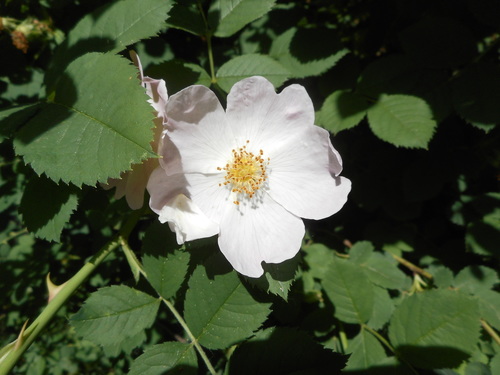
(c) Claudio Flamigni, some rights reserved (CC BY-NC), uploaded by Claudio Flamigni
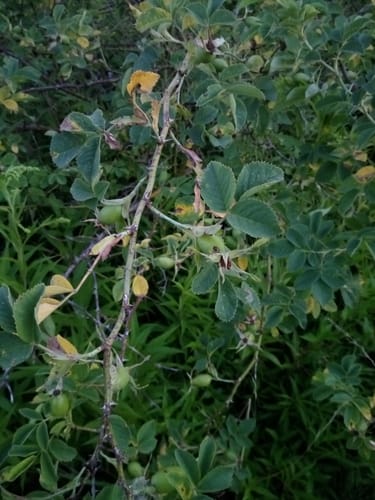
(c) Vladimír Fuka, some rights reserved (CC BY)
What to Eat
Edible parts: Fruit, Seeds, Flowers
The fruit can be eaten raw or cooked and is rich in vitamin C. It is sweet and delicious when fully ripe, particularly after a frost, though the flesh is thin relative to the quantity of seed, and irritant hairs beneath the flesh make it more difficult to eat. Fruit can be up to 20mm in diameter. The seeds are a good source of vitamin E and can be ground and mixed with flour or added to other foods as a supplement; seed hairs must be removed before use.
Known Hazards
Where to Find It
It is a temperate plant. It suits hardiness zones 6-10.
Africa, Armenia, Asia, Australia, Britain, Caucasus, Central Asia, Europe, Hungary, Kazakhstan, North Africa, Russia, Tajikistan,
How to Identify
A shrub. It grows 3 m high and spreads 3 m wide. It has curved thorns. The leaves are compound with 5-7 leaflets. The leaflets are rounded and downy. The flowers are white or pink. They usually occur singly and are 2-8 cm across. The fruit are orange-red hips.
How to Grow
Succeeds in most soils, preferring a circumneutral soil and a sunny position. Grows well in heavy clay soils. Dislikes water-logged soils. Grows well with alliums, parsley, mignonette and lupins. Garlic planted nearby can help protect the plant from disease and insect predation. Grows badly with boxwood. Very closely related to R. canina and considered to be a part of that aggregate species. According to this species is no more than a synonym of R. dumalis. Hybridizes freely with other members of this genus. Plants in this genus are notably susceptible to honey fungus.
Propagation: Rose seed often takes two years to germinate, as it may require a warm period following a cold spell to mature the embryo and break down the seedcoat. One way to reduce this time is to scarify the seed and place it for 2–3 weeks in damp peat at 27–32°c until it has imbibed, then keep it at 3°c for the following 4 months, by which time germination should begin. Seed harvested green — fully developed but before drying on the plant — and sown immediately may germinate in late winter, though this method had not been fully tested as of 1988. Seed sown fresh in a cold frame sometimes germinates in spring but may take 18 months. Stored seed should be sown as early in the year as possible and stratified for 6 weeks at 5°c; it may still take 2 years to germinate. Prick out seedlings into individual pots when large enough to handle. Plant out in summer if plants exceed 25cm, otherwise overwinter in a cold frame and plant out in late spring. Half-ripe cuttings with a heel taken in July in a shaded frame give a high success rate; overwinter in the frame and plant out in late spring. Mature cuttings of the current season's growth, selected as pencil-thick shoots around 20–25cm long in early autumn, can be planted in a sheltered spot outdoors or in a cold frame; they take up to 12 months to establish but succeed at a high rate. Suckers can be divided during dormancy and planted directly into permanent positions. Layering takes 12 months.
Medicinal Uses
The fruit is a very rich source of vitamins and minerals, particularly vitamins A, C and E, flavanoids, and other bio-active compounds. It is also a fairly good source of essential fatty acids, which is unusual for a fruit. It is being investigated for its potential to reduce the incidence of cancer and to halt or reverse cancer growth.
Other Uses
None known.
Wikipedia
Source ↗Rosa corymbifera, the thicket dog rose, is a species of flowering plant in the family Rosaceae. It is native to northwestern Africa, nearly all of Europe, the Caucasus, the Middle East, and Central Asia. It primarily differs from the dog rose Rosa canina in having downier leaves, particularly on the abaxial surfaces (the undersides). The most widely used rootstock in Europe for garden roses is its cultivar 'Laxa'.
Notes
There are about 150 Rosa species and many cultivated varieties.
Names & Synonyms
Masreni
References (5)
- Cundall, P., (ed.), 2004, Gardening Australia: flora: the gardener's bible. ABC Books. p 1214
- Denes, A., et al, 2012, Wild plants used for food by Hungarian ethnic groups living in the Carpathian Basin. Acta Societatis Botanicorum Poloniae 81 (4): 381-396
- Nanagulyan, S., et al, 2020, Wild plants and fungi sold in the markets of Yerevan (Armenia). Journal of Ethnobiology and Ethnomedicine 16:26
- Plants for a Future database, The Field, Penpol, Lostwithiel, Cornwall, PL22 0NG, UK. http://www.scs.leeds.ac.uk/pfaf/
- Shikov, A. N. et al, 2017, Traditional and Current Food Use of Wild Plants Listed in the Russian Pharmacopoeia. Frontiers in Pharmacology. Vol. 8 Article 841
More from Rosaceae


