Rosa macrophylla
Lindley
Himalayan musk rose
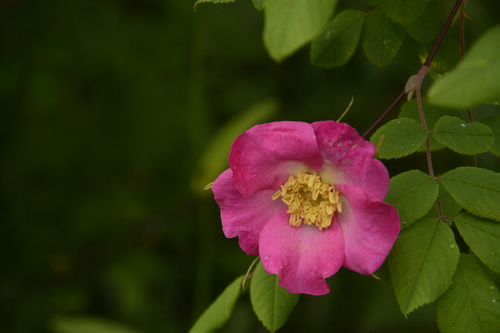
(c) Siddarth Machado, some rights reserved (CC BY), uploaded by Siddarth Machado

(c) jcavicch, some rights reserved (CC BY-NC)
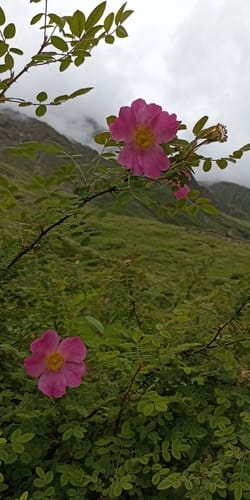
(c) Rajendra Koranga, some rights reserved (CC BY-NC)
What to Eat
Edible parts: Fruit, Seeds, Flowers
The bottle-shaped fruit, around 4cm long and occasionally up to 7cm, can be eaten raw or cooked. It is said to be very sweet when bletted — eaten overripe but before it begins to rot. Only a thin layer of flesh surrounds the many seeds, and care should be taken when eating the fruit regarding the known hazards. The seeds are a good source of vitamin E and can be ground and mixed with flour or added to other foods as a supplement — be sure to remove the seed hairs before use.
Known Hazards
Where to Find It
It is a temperate to subtropical plant. In Nepal it grows between 2100-3800 m altitude. They grow in open, rocky places. Melbourne Botanical gardens. It suits hardiness zones 7-10.
Afghanistan, Asia, Australia, Bhutan, China, India, Himalayas,* Nepal, Northeastern India, Pakistan, Sikkim, Tibet,
How to Identify
A shrub. It grows 2 m high. It has few prickles. The prickles are straight with a broad, expanded base. The leaves have stalks. The leaves are divided into 5-9 leaflets with an odd number. These are divided along the stalk without leaflet stalks. They have fine teeth and are hairy underneath. The flowers are large and occur singly. They are pinkish red and at the ends of branches. The fruit are very large. They can be 5 cm long. They are red, bristly and flask shaped. They are edible.
Nutrition
| Part | Moisture | kJ | kcal | Protein | Vit A | Vit C | Iron | Zinc |
|---|---|---|---|---|---|---|---|---|
| Fruit | — | — | — | — | 787 | — | — | — |
How to Grow
Succeeds in most soils, preferring a circumneutral soil and a sunny position. Prefers light shade according to another report. Grows well in heavy clay soils. Dislikes water-logged soils. Grows well with alliums, parsley, mignonette and lupins. Garlic planted nearby can help protect the plant from disease and insect predation. Grows badly with boxwood. A very ornamental plant. Hybridizes freely with other members of this genus. Plants in this genus are notably susceptible to honey fungus.
Propagation: Rose seed often takes two years to germinate, as it may need a warm period following a cold one to mature the embryo and reduce the seedcoat. One way to reduce this time is to scarify the seed and place it for 2–3 weeks in damp peat at 27–32°c until imbibed, then keep it at 3°c for the next 4 months until germination begins. Alternatively, green-harvested seed — fully developed but not yet dried on the plant — sown immediately may germinate in late winter, though this had not been fully tested as of 1988. Seed sown fresh in a cold frame sometimes germinates in spring but may take 18 months. Stored seed should be sown as early as possible and stratified for 6 weeks at 5°c; it may take 2 years to germinate. Prick seedlings into individual pots when large enough, plant out in summer if over 25cm tall, or overwinter in a cold frame and plant out in late spring. Half-ripe heel cuttings taken in July in a shaded frame, overwintered and planted out in late spring, yield a high success rate. Pencil-thick mature cuttings of the current season's growth, 20–25cm long, taken in early autumn and placed in a sheltered spot or cold frame, take around 12 months to establish but normally succeed at a high rate. Suckers can be divided during dormancy and planted directly into permanent positions. Layering takes around 12 months.
Medicinal Uses
A paste made from the fruit is ingested in the belief that it benefits eyesight. The fruit of many members of this genus is a very rich source of vitamins and minerals, particularly vitamins A, C and E, flavanoids and other bio-active compounds. It is also a fairly good source of essential fatty acids, which is unusual for a fruit. It is being investigated as a food capable of reducing the incidence of cancer and as a means of halting or reversing cancer growth.
Other Uses
Plants can be grown as a hedge.
Wikipedia
Source ↗Rosa macrophylla, the big-hip rose, is a species of flowering plant in the family Rosaceae, native to the Himalayan region. There are a number of cultivars, including 'Doncasteri', 'Glaucescens', 'Master Hugh', and 'Rubricaulis'. 'Master Hugh' has the largest hips of any readily available rose.
Other Information
The fruit are eaten especially by children.
Notes
There are about 150 Rosa species and many cultivated varieties.
Names & Synonyms
Amdoga, Ban-gulab, Bella, Benyl, Bhainsi kanda, Bhaunra kujoi, Breri, Dan-Kunja, Dandkunj, Dhur-kunj, Ghor sepala, Gulabi khwarach, Jangali gulab, Kesar, Kuja, Kunja bhaunra, Phelalo, Se ba, Seghu, Segoe, Segoe-fo, Shingari, Trind, Tumbi, Yal
References (30)
- Agarwal, R. & Chandra, V., 2019, Diversity of wild edible plants in the Mandal-Chopta forest, Uttarakhand. Journal of Medicinal Plants Studies 2019; 7(1): 89-92
- Ambasta S.P. (Ed.), 2000, The Useful Plants of India. CSIR India. p 529
- Bajracharya, D., 1980, Nutritive Values of Nepalese Edible Wild Fruits. Z. Lebensm. Unters. Forsch. 171: 363-366
- Bhattarai, S and Chaudary, R. P., 2009, Wild Edible Plants Used by the People of Manang District, Central Nepal. Ecology of Food and Nutrition, 48:1-20
- Boesi, A., 2014, Traditional knowledge of wild food plants in a few Tibetan communities. Journal of Ethnobiology and Ethnomedicine 10:75
- Brickell, C. (Ed.), 1999, The Royal Horticultural Society A-Z Encyclopedia of Garden Plants. Convent Garden Books. p 902
- Cundall, P., (ed.), 2004, Gardening Australia: flora: the gardener's bible. ABC Books. p 1216
- Facciola, S., 1998, Cornucopia 2: a Source Book of Edible Plants. Kampong Publications, p 207
- Flora of China @ efloras.org Volume 9
- Gautam, R. S., et al, 2020, Wild Edible Fruits of Nepal. Int. J. Appl. Sci. Biotechnol. Vol 8(3): 289-304
- Ghimire, S. K., et al, 2008, Non-Timber Forest Products of Nepal Himalaya. WWF Nepal p 131
- GUPTA,
- Hedrick, U.P., 1919, (Ed.), Sturtevant's edible plants of the world. p 573
- Hibbert, M., 2002, The Aussie Plant Finder 2002, Florilegium. p 267
- Jabeen, A., et al, 2009, Indigenous uses of economically important flora of Margallah Hills National Park, Islamabad, Pakistan. African Journal of Biotechnology Vol. 8 (5), pp. 763-784
- Khan, M. T., et al, 2016, Ethnobotanical Study of Wild Flora in the Remote Areas of Northern Pakistan. Wulfenia Journal Vol. 23, No 10 p 159
- Manandhar, N.P., 2002, Plants and People of Nepal. Timber Press. Portland, Oregon. p 401
- Mehta, P. S. et al, 2010, Native plant genetic resources and traditional foods of Uttarakhand Himalaya for sustainable food security and livelihood. Indian Journal or Natural products and Resources. Vol 1(1), March 2010 pp 89-96
- Negi, P. S. & Subramani, S. P., 2015, Wild Edible Plant Genetic Resources for Sustainable Food Security and Livelihood of Kinnaur District, Himachal Pradesh, India, International Journal of Conservation Science. 6 (4): 657-668
- Plants for a Future database, The Field, Penpol, Lostwithiel, Cornwall, PL22 0NG, UK. http://www.scs.leeds.ac.uk/pfaf/
- Polunin, O., & Stainton, A., 2006, Flowers of the Himalaya, Oxford India Paperbacks. p 113
- Radha, B., et al, 2013, Wild Edible Plant Resources of the Lohba Range of Kedarnath Forest Division (KFD), Garhwal Himalaya, India. Int. Res J. Biological Sci. Vol. 2 (11), 65-73
- Rana, D., et al, 2020, Use of medicinal plants for treating different ailments by the indigenous people of Churah subdivision of district Chamba, Himachal Pradesh, India. Environment, Development and Sustainability. Springer.
- Rawat, G.S., & Pangtey, Y.P.S., 1987, A Contribution to the Ethnobotany of Alpine Regions of Kumaon. J. Econ. Tax. Bot. Vol. 11 No. 1 pp 139-147
- Ros. monogr. 35, t. 6. 1820
- Singh, H.B., Arora R.K.,1978, Wild edible Plants of India. Indian Council of Agricultural Research, New Delhi. p 70
- Sundriyal, M., et al, 1998, Wild edibles and other useful plants from the Sikkim Himalaya, India. Oecologia Montana 7:43-54
- Sundriyal, M., et al, 2004, Dietary Use of Wild Plant Resources in the Sikkim Himalaya, India. Economic Botany 58(4) pp 626-638
- Tanaka,
- Upreti, K., et al, 2010, Diversity and Distribution of Wild Edible Fruit Plants of Uttarakhand. Bioversity Potentials of the Himalaya. p 183
More from Rosaceae


