Rosa moschata
J. Herrmann
Musk Rose
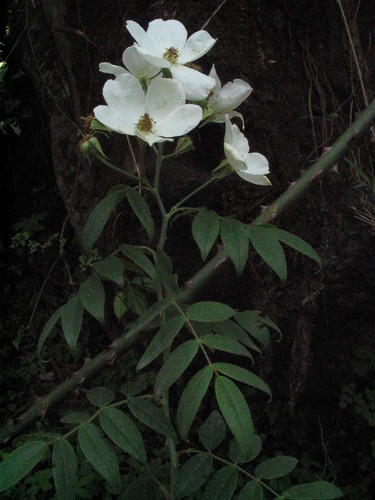
(c) T. Abe Lloyd, some rights reserved (CC BY-NC), uploaded by T. Abe Lloyd

(c) Mehmet Çelik, some rights reserved (CC BY-NC)
What to Eat
Edible parts: Leaves, Flowers, Fruit
The fruit, up to 15mm in diameter, can be eaten raw or cooked, though only a thin layer of flesh surrounds the many seeds. Care should be taken when eating the fruit regarding the known hazards. Young leaves, stems and the young shoots as they emerge from the ground in spring can be eaten raw or cooked. The petals are used raw or cooked as a flavouring in sorbets, confections and similar preparations. The seeds are a good source of vitamin E and can be ground and mixed with flour or added to other foods as a supplement — be sure to remove the seed hairs before use.
Known Hazards
Where to Find It
It is a temperate plant. In Chile it grows from sea level to 2,000 m above sea level. It grows in full sun but can tolerate some shade. It suits hardiness zones 6-10. It can tolerate some frost and snow. In NW Pakistan it grows in high mountain valleys.
Asia, Australia, Chile, Europe, Himalayas, Indonesia, Iran, Middle East, Pakistan, SE Asia, South America,
How to Identify
A shrub or climbing rose. The stems can arch over. It grows 3-10 m high and spreads 3 m wide. It has a few thorns. The leaves are shiny grey-green. The flowers are cream or pink and single. They are in loose clusters. The fruit are small downy hips. They are oval and orange-red.
How to Grow
Succeeds in most soils, preferring a circumneutral soil and a sunny position. Grows well in heavy clay soils. Dislikes water-logged soils. Grows well with alliums, parsley, mignonette and lupins. Garlic planted nearby can help protect the plant from disease and insect predation. Grows badly with boxwood. A very ornamental plant, it is sometimes cultivated for its edible flowers and there are some named varieties. The cultivar 'Belinda' has been very highly rated for its edible flowers. The flowers emit a delicate musk-like perfume. Hybridizes freely with other members of this genus. Plants in this genus are notably susceptible to honey fungus.
Propagation: Rose seed often takes two years to germinate, as it may need a warm period following a cold one to mature the embryo and reduce the seedcoat. One way to reduce this time is to scarify the seed and place it for 2–3 weeks in damp peat at 27–32°c until imbibed, then keep it at 3°c for the next 4 months until germination begins. Alternatively, green-harvested seed — fully developed but not yet dried on the plant — sown immediately may germinate in late winter, though this had not been fully tested as of 1988. Seed sown fresh in a cold frame sometimes germinates in spring but may take 18 months. Stored seed should be sown as early as possible and stratified for 6 weeks at 5°c; it may take 2 years to germinate. Prick seedlings into individual pots when large enough, plant out in summer if over 25cm tall, or overwinter in a cold frame and plant out in late spring. Half-ripe heel cuttings taken in July in a shaded frame, overwintered and planted out in late spring, yield a high success rate. Pencil-thick mature cuttings of the current season's growth, 20–25cm long, taken in early autumn and placed in a sheltered spot or cold frame, take around 12 months to establish but normally succeed at a high rate. Suckers can be divided during dormancy and planted directly into permanent positions. Layering takes around 12 months.
Medicinal Uses
The plant is said to be beneficial in the treatment of bilious affections, burning of the skin and eye diseases, though the source does not specify which parts are used. The fruit of many members of this genus is a very rich source of vitamins and minerals, particularly vitamins A, C and E, flavanoids and other bio-active compounds. It is also a fairly good source of essential fatty acids, which is unusual for a fruit. It is being investigated as a food capable of reducing the incidence of cancer and as a means of halting or reversing cancer growth.
Other Uses
An essential oil obtained from the flowers is used in perfumery.
Wikipedia
Source ↗Rosa moschata, the musk rose, is a species of rose which has been long in cultivation. Its wild origins are in southern Iran to Afghanistan.
Production
In NW Pakistan fruit are available in August.
Other Information
It is a cultivated food plant. The fruit are especially eaten by children.
Notes
There are about 150 Rosa species and many cultivated varieties.
Names & Synonyms
Falari, Kembang ros, Khorach, Kwrach
References (15)
- Ahmad, K. & Pieroni, A., 2016, Folk knowledge of wild food plants among the tribal communities of Thakht-e-Sulaiman Hills, North-West Pakistan. Journal of Ethnobiology and Ethnomedicine, 12:17
- Bodkin, F., 1991, Encyclopedia Botanica. Cornstalk publishing, p 889
- Brickell, C. (Ed.), 1999, The Royal Horticultural Society A-Z Encyclopedia of Garden Plants. Convent Garden Books. p 904
- Cundall, P., (ed.), 2004, Gardening Australia: flora: the gardener's bible. ABC Books. p 1216
- De Rosa 15. 1762
- Facciola, S., 1998, Cornucopia 2: a Source Book of Edible Plants. Kampong Publications, p 207
- Hibbert, M., 2002, The Aussie Plant Finder 2002, Florilegium. p 270
- Kermath, B. M., et al, 2014, Food Plants in the Americas: A survey of the domesticated, cultivated and wild plants used for Human food in North, Central and South America and the Caribbean. On line draft. p 755
- Khan, A. H., et al, 2023, Traditional foraging for ecological transition? Wild food ethnobotany among three ethnic groups in the highlands of the eastern Hindukush, North Pakistan. Journal of Ethnobiology and Ethnomedicine 19:9
- Martin, F.W. & Ruberte, R.M., 1979, Edible Leaves of the Tropics. Antillian College Press, Mayaguez, Puerto Rico. p 216
- Ochse, J. J. et al, 1931, Vegetables of the Dutch East Indies. Asher reprint. p 626
- Plants for a Future database, The Field, Penpol, Lostwithiel, Cornwall, PL22 0NG, UK. http://www.scs.leeds.ac.uk/pfaf/
- Terra, G.J.A., 1973, Tropical Vegetables. Communication 54e Royal Tropical Institute, Amsterdam, p 70
- www.chileflora.com
- Zeven, A. C. & de West, J. M. J., 1982, Dictionary of cultivated plants and their regions of diversity. Wageningen. p 86
More from Rosaceae


