Rosa multiflora
Thunb.
Multiflora rose, Seven Sister's Rose, Japanese rose

(c) Douglas Goldman, some rights reserved (CC BY-SA), uploaded by Douglas Goldman
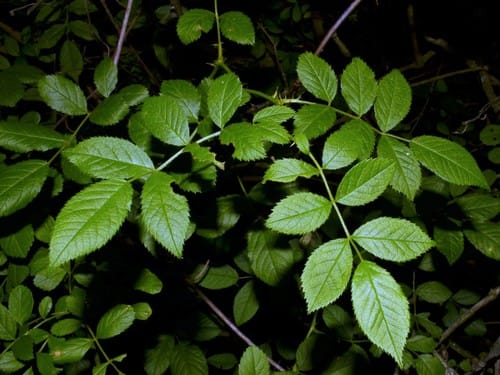
(c) J. Richard Abbott, some rights reserved (CC BY-NC)
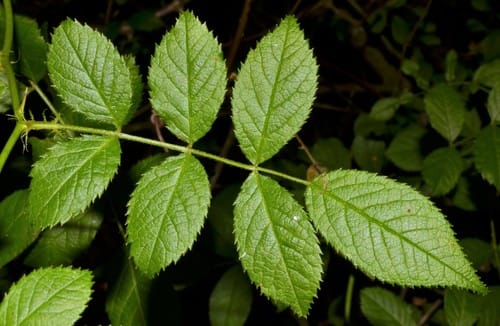
(c) J. Richard Abbott, some rights reserved (CC BY-NC)
What to Eat
Edible parts: Fruit, Seeds, Stem, Flowers, Leaves
The fruit can be eaten raw or made into preserves, pies, and similar preparations. Each hip is about 7mm in diameter, though only a thin layer of flesh surrounds the many seeds. The fruit is rich in carotene (81.4mg per 100g) and vitamin C. Care should be taken when eating the fruit — see known hazards. Young leaves and shoots are edible raw or cooked, best used as they emerge from the ground in spring; the young leaves contain more than 200mg per 100g of vitamin C. The seeds are a good source of vitamin E and can be ground and mixed with flour or added to food as a supplement — always remove the seed hairs first. The seed contains about 8% oil.
Known Hazards
Where to Find It
It is a subtropical and temperate plant. In Indonesia it grow above 1,000 m above sea level. It suits hardiness zones 5-10. In Yunnan.
Argentina, Asia, Australia, China, India, Indochina, Indonesia, Japan, Kiribati, Korea, Myanmar, North America, Pacific, Sao Tome and Principe, SE Asia, Slovenia, South America, Taiwan, Vietnam,
How to Identify
A climbing rose. It has a stem which arises as a small arch from the roots then lays along the ground. It grows 3-4.5 m high and spreads 3 m wide. The stems are prickly. The leaves have 7-9 leaflets. The flowers are 3 cm across. The fruit are red to black hips.
Nutrition
| Part | Moisture | kJ | kcal | Protein | Vit A | Vit C | Iron | Zinc |
|---|---|---|---|---|---|---|---|---|
| Fruit | — | — | — | — | 81.4 | — | — | — |
| Leaves | — | — | — | — | 200 | — | — | — |
How to Grow
Succeeds in most soils, preferring a circumneutral soil and a sunny position. Grows well in heavy clay soils. Succeeds on poor soils. Dislikes water-logged soils. Grows well with alliums, parsley, mignonette and lupins. Garlic planted nearby can help protect the plant from disease and insect predation. Grows badly with boxwood. A very ornamental plant, more than 100 blooms can be produced in a single cluster. These flowers possess a delicious sweet fruity perfume. Plants often self-layer. Hybridizes freely with other members of this genus. Plants in this genus are notably susceptible to honey fungus.
Propagation: Rose seed often takes two years to germinate, as it may require a warm period following a cold spell to mature the embryo and reduce the seedcoat. One approach to shorten this is to scarify the seed and place it in damp peat at 27–32°c for 2–3 weeks until it has imbibed, then keep it at 3°c for four months until germination begins. Seed harvested green — fully developed but not yet dried on the plant — and sown immediately may germinate in late winter, though this method had not been fully tested as of 1988. Seed sown fresh in a cold frame sometimes germinates in spring but may take 18 months. Stored seed should be sown as early in the year as possible and stratified for 6 weeks at 5°c; it may still take 2 years to germinate. Prick out seedlings into individual pots when large enough to handle. Plant out in summer if plants exceed 25cm, otherwise overwinter in a cold frame and plant out in late spring. Half-ripe heel cuttings taken in July in a shaded frame, overwintered and planted out in late spring, give a high success rate. Mature cuttings of pencil-thick current-season shoots, 20–25cm long, taken in early autumn and planted in a sheltered spot or cold frame, can take 12 months to establish but normally succeed at a high rate. Suckers can be divided in the dormant season and planted directly into permanent positions. Layering takes 12 months.
Medicinal Uses
The leaves can be made into a poultice and applied to sores. The fruit is anodyne, diuretic, hypoglycaemic, and laxative, and acts as an antidote to fish poisoning; it is used to treat constipation and articular pain and applied to foul ulcers, wounds, sprains, and injuries. The seed is laxative and diuretic. The root is rich in tannins and is astringent and carminative. The fruit is a very rich source of vitamins and minerals, particularly vitamins A, C, and E, flavonoids, and other bio-active compounds, and is also a fairly good source of essential fatty acids, which is unusual for a fruit. It is being investigated for its potential to reduce the incidence of cancer and to halt or reverse cancer growth.
Other Uses
The plant is fairly wind tolerant and can be grown as a shelter hedge, though it may be damaged by salt-laden winds. Its dense, sturdy habit also makes it an excellent garden hedge. The root contains 23–25% tannin. An essential oil obtained from the fresh flowers is used in the cosmetic industry. The plant's extensive root system makes it useful for soil stabilization. It can also serve as a rootstock for other rose species, particularly ramblers and those grown on poor soils.
Wikipedia
Source ↗Rosa multiflora (syn. Rosa polyantha) is a species of rose known commonly as multiflora rose, baby rose, Japanese rose, many-flowered rose, seven-sisters rose, Eijitsu rose and rambler rose. It is native to eastern Asia, in China, Japan, and Korea. It should not be confused with Rosa rugosa, which is also known as "Japanese rose", or with polyantha roses which are garden cultivars derived from hybrids of R. multiflora. It was introduced to North America, where it is an invasive species, forming extensive, impenetrable stands within forest understories, thickets, borders, and lowlands.
Notes
There are about 150 Rosa species and many cultivated varieties. It can be invasive.
Names & Synonyms
Huong nhieu-hoa, Jjillenamu, Jjilrekkot, Mnogocvetni šipek, Santtalgi, Ye Qiangwei
References (23)
- Ambasta S.P. (Ed.), 2000, The Useful Plants of India. CSIR India. p 529
- Bodkin, F., 1991, Encyclopedia Botanica. Cornstalk publishing, p 889
- Brickell, C. (Ed.), 1999, The Royal Horticultural Society A-Z Encyclopedia of Garden Plants. Convent Garden Books. p 904
- Cundall, P., (ed.), 2004, Gardening Australia: flora: the gardener's bible. ABC Books. p 1217
- Duke, J.A., 1992, Handbook of Edible Weeds. CRC Press. p 168
- Facciola, S., 1998, Cornucopia 2: a Source Book of Edible Plants. Kampong Publications, p 207
- Hibbert, M., 2002, The Aussie Plant Finder 2002, Florilegium. p 270
- http://www.botanic-gardens-ljubljana.com/en/plants
- Kermath, B. M., et al, 2014, Food Plants in the Americas: A survey of the domesticated, cultivated and wild plants used for Human food in North, Central and South America and the Caribbean. On line draft. p 755
- Liu, Yi-tao, & Long, Chun-Lin, 2002, Studies on Edible Flowers Consumed by Ethnic Groups in Yunnan. Acta Botanica Yunnanica. 24(1):41-56
- Marinelli, J. (Ed), 2004, Plant. DK. p 467
- Martin, F.W. & Ruberte, R.M., 1979, Edible Leaves of the Tropics. Antillian College Press, Mayaguez, Puerto Rico. p 216
- J. A. Murray, Syst. veg. ed. 14:474. 1784 May-Jun (Fl. jap. 214. 1784 Aug)
- Ochse, J. J. et al, 1931, Vegetables of the Dutch East Indies. Asher reprint. p 627
- Ong, H. G., et al, 2015, Ethnobotany of the wild edible plants gathered in Ulleung Island, South Korea. Genet Resourc Crop Evol. Springer
- Pham-Hoang Ho, 1999, An Illustrated Flora of Vietnam. Nha Xuat Ban Tre. p 802
- Plants for a Future database, The Field, Penpol, Lostwithiel, Cornwall, PL22 0NG, UK. http://www.scs.leeds.ac.uk/pfaf/
- Song, M., et al, 2013, Traditional knowledge of wild edible plants in Jeju Island, Korea. Indian Journal of Traditional Knowledge. 12(2) pp 177-194
- Tanaka,
- Terra, G.J.A., 1973, Tropical Vegetables. Communication 54e Royal Tropical Institute, Amsterdam, p 70
- Thaman, R. R., 1987, Plants of Kiribati: A listing and analysis of vernacular names. Atoll Research Bulletin No. 296
- Valder, P., 1999, The Garden Plants of China. Florilegium. p 220
- Zeven, A. C. & de West, J. M. J., 1982, Dictionary of cultivated plants and their regions of diversity. Wageningen. p 41
More from Rosaceae


