Rosa virginiana
J. Herrmann
Virginia rose

(c) Benny Mazur, some rights reserved (CC BY)
(c) Sara Rall, some rights reserved (CC BY-NC)
What to Eat
Edible parts: Fruit, Leaves
The fruit can be eaten raw or cooked and is up to 15mm in diameter, though only a thin layer of flesh surrounds the many seeds — care should be taken when eating it. The buds are eaten by Native Americans in North America, though it is unclear whether this refers to leaf or flower buds and no further details are given. The seeds are a good source of vitamin E; they can be ground into a powder and blended with flour or added to other foods as a supplement. Always remove the seed hairs before use.
Known Hazards
Where to Find It
It is a temperate plant. It suits hardiness zones 3-10. In Arboretum Tasmania.
Australia, North America, Slovenia, Tasmania, USA,
How to Identify
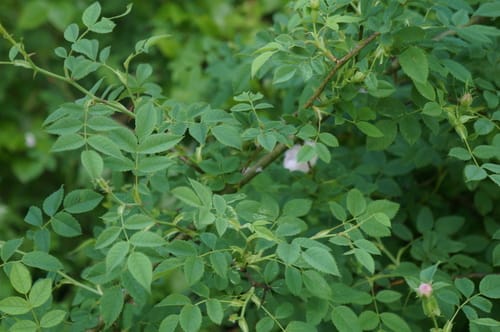
An erect shrub. It can form suckers. It grows 1.5 m high and spreads 1.5 m wide. The leaves are shiny green. The flowers are single and deep pink. They have prominent yellow stamens. The fruit are round red hips.
How to Grow
Succeeds in most soils, preferring one on the dryish side. Grows well in heavy clay soils. Prefers a circumneutral soil and a sunny position. Dislikes water-logged soils. Does well in a windy position. Grows well with alliums, parsley, mignonette and lupins. Garlic planted nearby can help protect the plant from disease and insect predation. Grows badly with boxwood. The flowers are fragrant. The form in cultivation in Britain is very invasive, forming thickets with its suckers, whilst the wild form does not produce suckers. Hybridizes freely with other members of this genus. Plants in this genus are notably susceptible to honey fungus.
Propagation: Rose seed frequently takes two years to germinate, as it may require a warm period following a cold spell to mature the embryo and break down the seedcoat. One approach to reduce this time is to scarify the seed, then place it in damp peat at 27–32°c for 2–3 weeks to allow imbibition, followed by 4 months at 3°c, after which germination should begin. Seed harvested green — fully developed but not yet dried on the plant — and sown immediately may germinate in late winter, though this method had not been fully tested as of 1988. Seed sown fresh into a cold frame sometimes germinates in spring but may take 18 months. Stored seed can be sown as early in the year as possible and stratified for 6 weeks at 5°c; it may still take 2 years to germinate. Prick out seedlings into individual pots when large enough to handle, and plant out in summer if they exceed 25cm, or overwinter in a cold frame and plant out in late spring. Half-ripe cuttings with a heel taken in July in a shaded frame and overwintered before planting out give a high success rate. Pencil-thick cuttings of mature current-season wood, 20–25cm long, taken in early autumn and placed in a sheltered spot outdoors or in a cold frame, typically take 12 months to establish but succeed at a high rate. Suckers can be divided during dormancy and planted directly into permanent positions. Layering also works but takes 12 months.
Medicinal Uses
A decoction of the roots has been used as a bath treatment and to treat worms in children. An infusion of the roots has been drunk and applied as a wash to treat bleeding cuts on the feet. A root infusion has also been used as a wash for sore eyes. The fruit of this genus is a very rich source of vitamins and minerals, particularly vitamins A, C, and E, along with flavonoids and other bio-active compounds. It also provides a fairly good supply of essential fatty acids, which is unusual for a fruit. It is being investigated for its potential to reduce the incidence of cancer and to halt or reverse tumour growth.
Other Uses
This rose can be grown as a hedge and tolerates windy positions. The suckering form is useful for stabilizing sand dunes, and it also makes effective ground cover.
Wikipedia
Source ↗Rosa virginiana, commonly known as the Virginia rose, common wild rose or prairie rose, is a woody perennial in the rose family native to eastern North America, where it is the most common wild rose. It is deciduous, forming a suckering shrub up to 2 metres in height, though often less. The stems are covered in numerous hooked prickles. The leaves are pinnate, usually with between 7 and 9 glossy leaflets. The pink flowers are borne singly or in small clusters and appear over a long period in midsummer. The fruits are small, round and bright red, rich in vitamin C and edible, being both used to make jams and tea. It grows in clearings, thickets, and shores. The plant attracts birds, bees, butterflies, and hummingbirds. Charles and Bridget Quest-Ritson describe R. virginiana as "the best all-rounder among the wild roses", and draw attention to its leaf coloration in the fall: "the whole plant turns yellow, orange, scarlet, crimson and brown for weeks on end". In cultivation, this plant has gained the Royal Horticultural Society's Award of Garden Merit.
Notes
There are about 150 Rosa species and many cultivated varieties.
Names & Synonyms
Viržinski šipek
References (10)
- Beckstrom-Sternberg, Stephen M., and James A. Duke. "The Foodplant Database." http://probe.nalusda.gov:8300/cgi-bin/browse/foodplantdb.(ACEDB version 4.0 - data version July 1994)
- Brickell, C. (Ed.), 1999, The Royal Horticultural Society A-Z Encyclopedia of Garden Plants. Convent Garden Books. p 913
- Cundall, P., (ed.), 2004, Gardening Australia: flora: the gardener's bible. ABC Books. p 1219
- Facciola, S., 1998, Cornucopia 2: a Source Book of Edible Plants. Kampong Publications, p 208
- Gard. dict. ed. 8: Rosa no. 10. 1768 (As Mill.)
- Hibbert, M., 2002, The Aussie Plant Finder 2002, Florilegium. p 280
- http://www.botanic-gardens-ljubljana.com/en/plants
- Kermath, B. M., et al, 2014, Food Plants in the Americas: A survey of the domesticated, cultivated and wild plants used for Human food in North, Central and South America and the Caribbean. On line draft. p 756
- Moerman, D. F., 2010, Native American Ethnobotany. Timber Press. p 485
- Plants for a Future database, The Field, Penpol, Lostwithiel, Cornwall, PL22 0NG, UK. http://www.scs.leeds.ac.uk/pfaf/
More from Rosaceae


